
Dear Souls & Hearts Member,
We are circling back through a final time in our series of reflections on personal vision, values, and mission statements. I have covered revising personal vision statements and redoing personal values statements.
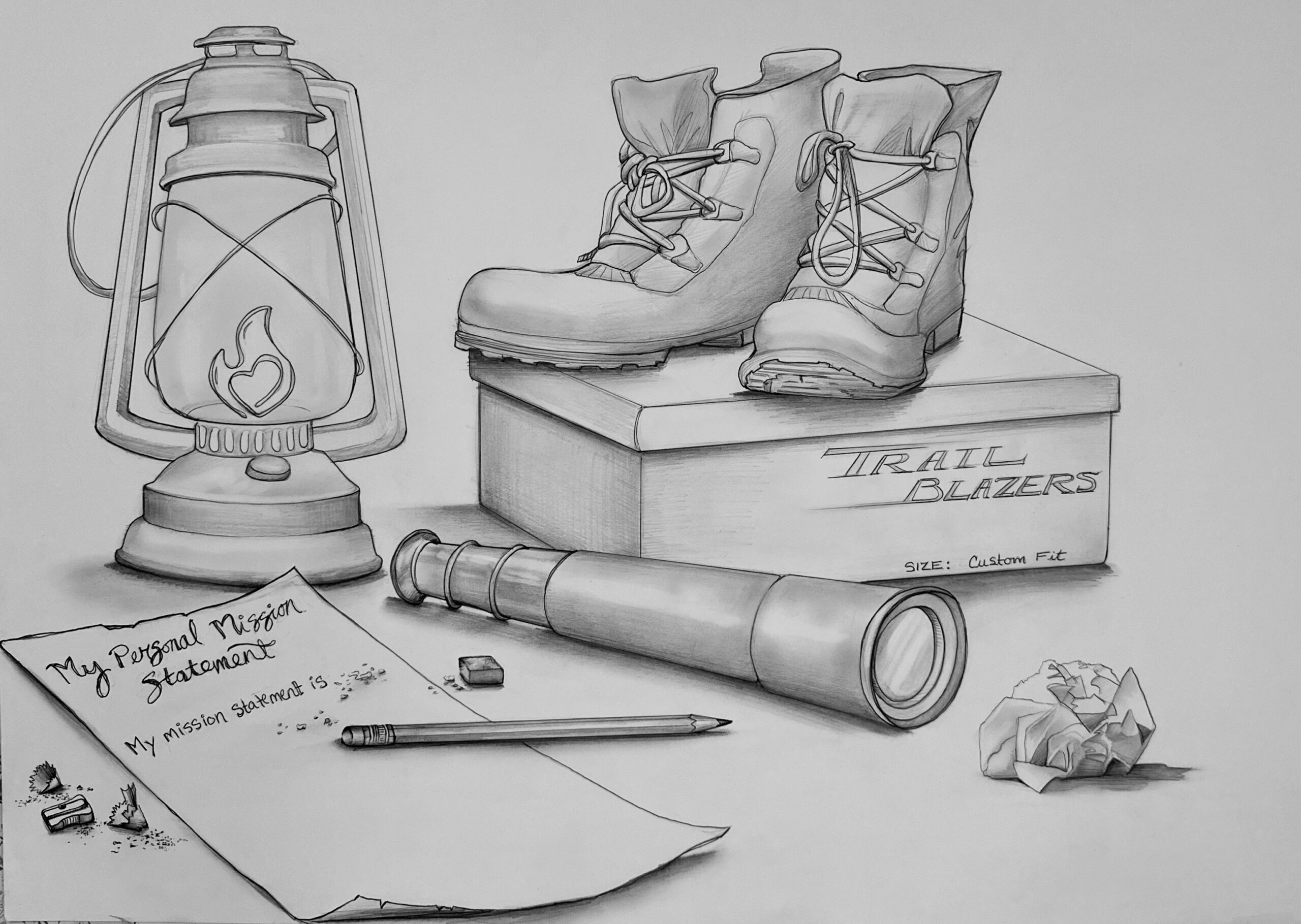
Now we are on to renewing personal mission statements, showing both the iterative, back-and-forth process and how messy it can be.
In our spiral learning, going back all the way to our July 22, 2024 seminal reflection in this series, I defined your personal mission statement as “your expression of the means you will use in the present to realize your personal vision in the future.”
As a reminder, “Your mission statement focuses not on the future (like your vision statement does), but rather on the present, what you are called to do now to realize your future vision. Mission statements that are clear and precise lay out guidance for how to follow the star – they are your maps and compass.”
The 14 steps of writing my personal mission statement
For further review and spiral learning, here is the list of 14 steps to write a personal mission statement that I shared and expanded upon in the February 10, 2025 reflection Writing Your Personal Mission Statement:
- Pray for wisdom and guidance
- Connect with your parts
- Review your personal vision statement
- Review your personal values statement
- Write down your vocation and your duties of state
- Write down a list of your closest relationships
- Write down a list of your key roles
- Reconnect with your parts
- Use a template to write a first draft
- Check in with how the current draft lands with your parts
- Bring the current draft to God in prayer
- Practice living your mission statement draft
- Share your mission statement
- Go through these steps again to revise your personal mission statement.
Now I am going through all the steps again, especially steps 13 and 14.
You do you
I would emphasize that your personal mission statement may look very different from mine; I firmly believe that the mission statements should vary and be quite different across Catholics. Why? Because we are all so different, we are in different places in our journeys, and we have different responsibilities as well as very different psychological and spiritual makeups. I am reminded of St. Thérèse of Lisieux’s statement in Manuscript C of her Story of a Soul:
“… all souls have very much the same struggles to fight, but they differ so much from each other in other aspects that I have no trouble in understanding what Father Pichon was saying: ‘there are really more differences among souls than there are among faces.’” [p. 381].
Your personal mission statement is yours; and while others might spark ideas or serve as models in some way, ultimately, yours needs to fit you as a unique person.
Going back in time (to last September)
With that caveat, we can go back to the September 8, 2025 reflection titled I Share My Personal Mission Statement, where I offered the following as my working mission statement:
I will deliberately check in with each of my parts each day, specifically on how that part is doing in my relationship with God, and identify, write down, and resolve to do one right next step to bring my entire system closer in union with Him (Who is Love) today.
I will deliberately pray for and either journal or parts map about my relationship with Pam each day and each of my children on his or her day of the week, considering their parts’ attachment needs, integrity needs, and identity issues and write down and resolve to do at least one deliberate act of love attuned to their parts’ love languages that day to better connect with them in love and convey a sense of delight in and appreciation for them.
There’s a lot of good in this personal mission statement. But it’s also lacking in many ways and its shortcomings became more apparent as I worked through it with my IFS coach, Brian Jaudon. Let’s review together how to improve it, focusing on remedying these five deficiencies that plague the original version. The original is:
- Not personal enough
- Too long and wordy
- Too complicated
- Missing key elements
- Not synched with the personal vision and values statements
Bottom line up front
So, let’s start with the final product, my revised personal mission statement so you can compare and contrast:
God, I discern Your will wholeheartedly and I take the next right step to love You, Pam, my children, my neighbors, and myself, primarily through my vocation and duties of state.
The importance of process
How did I get from the original to the revised versions? I had help. The most important invitation from my IFS coach Brian Jaudon was to distill out the most important elements from the original version.
Basically, he asked me to cut to the bone, and just keep the core of it. To strip away all the unnecessary elaborations. He saw it was too long; he had to work to make sense of it.
Then, I prayed for 10-15 minutes each day, sitting with my evolving mission statement, making several versions, sitting with my revised vision and mission statements, seeking wisdom and guidance from our Lord. I spent much time with my parts on reworking the statement from major reconstruction to final wordsmithing.
At this point, I wanted to share with you the improvements. Let’s address each deficiency in turn.
- Not personal enough
As when I revised my personal vision and values statements, I wanted to convert the form of the statement from an impersonal, self-contained proclamation that could devolve into a self-absorbed personal improvement project to being a relational prayer.
In opening the personal mission statement by addressing God directly, we start out in relationship, and God now properly in the first place. Speaking directly to God also makes the mission statement seem more like a promise to Him, increasing my sense of commitment to Him, lived out through my mission. All my parts were good with that.
- Too long and wordy
In Writing Your Personal Mission Statement, I criticized Roger Merrill’s mission statement for being too long, coming in at 169 words. But then, I went ahead and fell into the same trap, with my original mission statement above coming in at 131 words.
Way too long.
Science fiction writer Daniel Keys Moran wrote: “Remember, you don’t really own anything you can’t carry at a dead run.”
Let’s unpack this a bit.
One way to understand Roger Keys Moran’s dictum is to grasp that unless something is deeply ingrained in you so that becomes second nature, habitual, a part of you, you will lose it when you are under stress in the storms of life, exiting your window of tolerance, in other words – when you are in a dead run.
Part of the problem with my original mission statement being so long is that I never could memorize it. And if I do not memorize it, I cannot easily bring it to mind when I’m at a dead run on the hard road.
I needed something much shorter, something I could memorize easily. Something my intellect could retrieve under duress, recovering my map and compass. Why? So that my will could re-anchor and engage and my innermost self. So that my innermost self could resume more leadership of the parts in my system. So that I could slow down and bringing this mission to my intellect and will to all of my inner experience, all my passions, powers, appetites, faculties, etc.
This revised mission statement came in at a much more manageable 31 words, less than a quarter of the length of the original. And now that I have memorized it, I bring it to mind, even when life is hard and demands are high.
In other words, I carry now this mission statement in my mind and heart at a dead run.
- Too complicated
Along with being too wordy and long, the mission statement was to conceptually complicated. There were too many actions to be taken, too many intentions to be considered. The original personal mission statement got into the weeds, too many details, too much specificity. It was too focused on specific actions that might not fit the circumstances and demands of a particular day.
All those complications resulted in my not living it out as effectively.
I needed something much simpler to understand.
I needed something much simpler to execute against.
My revised mission statement zeros in on the key element of love, and love in the five most important domains. It leaves room for flexibility in the specifics of what that love means in the specific circumstances of any given day. Rather than locking me into pre-determined activities, such as checking in with every part every day and journaling or parts mapping, it allows for a process of determining the “next right step,” permitting greater responsivity to varying situational dynamics.
And I found that I needed that freedom and flexibility.
- Missing key elements
My original personal mission statement missed out on anything having to do with discerning God’s will for me, which is central in my spiritual life right now. It also did not mention the primacy of my vocation and duties of state in the process of discernment of next right steps.
The centrality of vocation and duties of state is so critical for my system, as I have visionary parts that love to dream big and conceive grand ideas – and then chase them. For me, personally, I need to remember what C.S. Lewis wrote in a letter to Dom Bede Griffiths in 1951: “Put first things first and we get second things thrown in: put second things first & we lose both first and second things.”
My vocation as a married man and father and my duties of state are “first things”; Souls and Hearts and my clinical practice are “second things.” If my relationships with Pam and my children suffer because of my professional work, then I know I’m failing to prioritize correctly. If I sacrifice my family in following some disordered vision of success in my professional work, I will lose both things.
- Not synched with my personal vision and value statements.
Finally, my new personal mission statement flows from my revised personal vision statement, shared in the reflection Renewing and Revising a Vision Statement:
My God, (Who is Love), I am becoming love in union with You, in all my being, in every moment, with trust in You and detachment from all else.
And from my revised values statement, which I shared with you in the last reflection titled Renewing and Revising a Personal Values Statement, and which reads as follows:
- I welcome love to all of me.
- God, I embrace You, my Father, adopting all of me as Your beloved son and heir.
- God, I love You back wholeheartedly.
- In loving You, I love all of my neighbor.
- In loving You, I love all of me.
And to avoid having to scroll back up, here is the revised personal mission statement again:
God, I discern Your will wholeheartedly and I take the next right step to love You, Pam, my children, my neighbors, and myself, primarily through my vocation and duties of state.
As you can see elements of my personal vision statement and personal values statement are now captured clearly and directly in my personal mission statement.
The importance of resolutions
What unlocked the rewriting of my mission statement was a deeper realization of the importance of resolutions. I discussed this in my October 17, 2025 reflection titled A Catholic Guide to Writing Personal Resolutions. Daily resolutions should take on the heavy lifting of the specific means for today to live out the mission, in accordance with the values, following the vision.
I will discuss the interconnections between a personal mission statement and daily resolutions in our next reflection, which comes out on December 8, 2025, so stay tuned for that!
Help in writing your own personal resolutions on December 27, 2025
January 1 is coming, and this is a great time to make a resolution to make resolutions. And to help you prepare, on Saturday, December 27 from 3:30 PM to 4:30 PM Eastern time, I am hosting another Zoom workshop in the whole series on personal vision, values, and mission statements. This one follows up on our October 23 workshop on resolutions. We will start out with an experiential exercise to help you connect with your parts and by the end of the workshop, you will write your first resolution, and we will have plenty of time for Q&A.
This workshop is titled Practical Guidance for Daily Resolutions and it’s free. If you are not already on my email list, just reach out at crisis@soulsandhearts.com and I will get you on so that you can receive the Zoom link via email. If you are on the email list, you should of already received the Zoom link earlier today.
Register for the Q&A in Interior Integration for Catholics podcast episode 178 on December 4, 2025
Join Dr. Gerry, Dr. Peter Martin, and me live on Zoom on the evening of Thursday, December 4, from 8:00 PM to 9:30 PM Eastern time 2025 for a special discussion and Q&A about any of the material in episodes 171 to 177 of the IIC podcast. The link to register is here. In those episodes, we cover Internal Family Systems and parts work, grounded in a Catholic understanding of the human person through so many lenses:
Episode 171 Know Thyself, Love Thyself, Govern Thyself: Socrates and Plato Discuss
Parts Work (111 minutes) Video Audio PDF Transcript
Episode 172 Questions About Catholicism and Parts Work Answered (79 minutes) Video
Episode 173 Aristotle and Aquinas on Proper Self-Love (105 minutes) Video Audio PDF Transcript
Episode 174 Richard Schwartz and IFS Meet St. Thomas Aquinas (86 minutes) Video Audio
Episode 175 IFS, Parts Work, Vatican II, and Your Conscience (88 minutes) Video Audio
Episode 176 The Catholic Catechism Guides Our Parts Work (92 minutes) Video Audio
And we have a special treat – in IIC 177, which comes out on December 1, 2025, we will have Christopher West join us for fascinating discussion of IFS and St. John Paul II’s Theology of the Body.
Episode 178 is a chance for us to come together discuss all of this. So join us if you can! Registration is free, but requires, and the link to register is here.
Opportunities for Catholic formators!
Catholic therapists, coaches, spiritual directors, priests, and others who accompany individuals in their personal formation are welcome to come to learn the basics of Internal Family Systems, grounded in a Catholic anthropology in two free webinars. These are designed for Catholic formators to get acquainted with both the intellectual concepts and the inner experience of Catholics parts work.
IFS Basics for Catholic Formators will be on Tuesday, January 13, 2026 at from 1:00 PM to 2:30 PM Eastern (register here). In this webinar, IFS Level 2 trained coach Bridget Adams and I walk through IFS for those who may be quite new to parts work. No previous experience with IFS is needed. We will cover the innermost self, parts, multiplicity, systems thinking, inner polarizations and alignments and much more – both in the “telling” of brief informational talks and the “showing” of experiential exercises, Here is the schedule:
- 1:00 PM to 1:30 PM The “why” of bringing in IFS to human formation work and an introduction to the basic concepts of IFS grounded in a Catholic anthropology
- 1:30 PM to 1:50 PM Experiential exercise, where you experience your own parts
- 1:50 PM to 2:10 PM Debrief from experiential exercise
- 2:10 PM to 2:30 PM Q&A and discussion
I hope you can join us for this introduction, which is perfect for those just starting to get interested in IFS and parts work. Register here for the Zoom meeting, and join us! We will also make the recording available afterward, for those who cannot make it in person.
Catholic Parts Work in Human Formation will be on the evening of June 10, 2026 at 8:00 PM to 9:30 PM Eastern (register here). This workshop and assumes that you have taking in the information from the previous workshop on January 13 or have at least a little experience in parts work in accompanying others in their formation.
- 8:00 PM to 8:30 PM Talk on preparing yourself to accompany others with IFS/part work.
- 8:30 PM to 8:50 PM Experiential exercise, where you experience your own parts’ reactions to accompanying others
- 8:50 PM to 9:10 PM Debrief from experiential exercise
- 9:10 PM to 9:30 PM Q&A and discussion
Join us by registering here for that workshop.
The Second Annual Formation for Formators Retreat is August 10-13, 2026
Consider joining us for our 2026 retreat, an opportunity for formators (therapists, coaches, spiritual directors, priests, any Catholic who accompanies others in formation) to make a leap forward in your human formation work.
Our theme is “Authentic Being and Authentic Relating.” Authentic means genuine, real, true, trustworthy, and reliable. To be fully authentic means being fully present, not part disconnected, no part neglected, no part rejected, no part subjected to condemnation and abandonment, no part left behind. In short, in requires interior integration. Get the details and register.
Our Lady, Untier of Knots Rosary
Former Resilient Catholics Community members, Jonathan Conrad and Jonathan Ruffing, run The Catholic Woodworker, a small business that offers beautiful handmade rosaries. Souls & Hearts is working with The Catholic Woodworker to offer an Our Lady Untier of Knots Rosary as an affiliate partner. Rosary orders using these affiliate links earns Souls & Hearts a small commission to support our mission.
Conversation hours with me every Tuesday and Thursday
Finally, remember that you can call me on my cell (317.567.9594) every Tuesday and Thursday from 4:30 PM to 5:30 PM to discuss these reflections or the IIC podcast, or anything else related to Souls and Hearts’ content. Those calls are usually about 10 minutes or so. I can’t offer clinical services to you (like therapy, assessment, or clinical advice) but we can connect on the themes of what Souls and Hearts offers.
Warm regards in Christ and His Mother,
Dr. Peter