
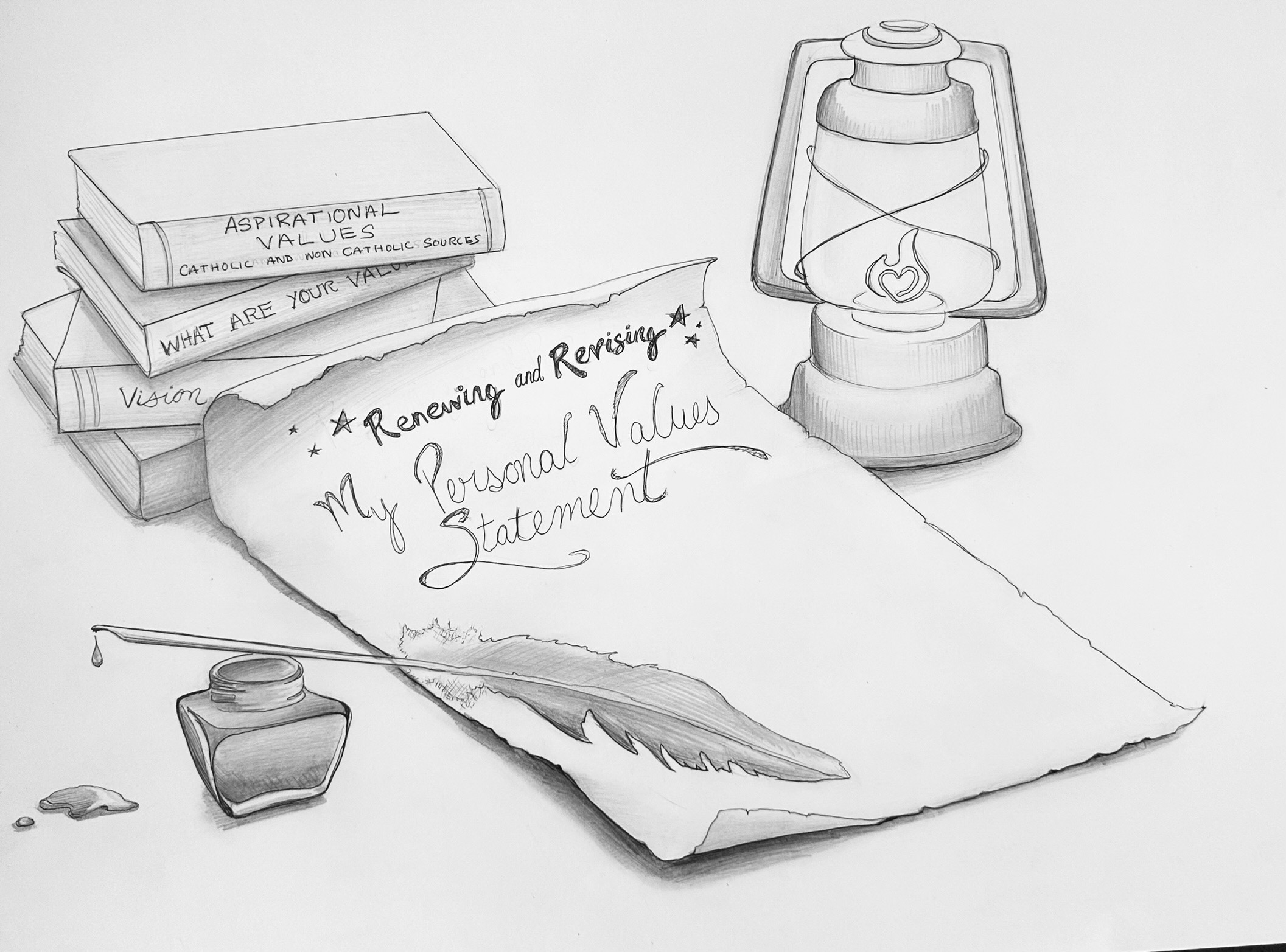
Dear Souls & Hearts Member,
Contemporary American author Robert Greene recommended “Create a ladder of values and priorities in your life, reminding yourself of what really matters to you.”
I agreed.
So I wrote a series of these reflections on values:
- What Are Your Personal Values?
- Understanding Values More Deeply
- Discerning your Aspirational Values with Catholic Saints and Traditional Spiritualities
- Receiving the Light of Natural Aspirational Values from Non-Catholic Sources
And then I gave specific guidance about writing your own personal values statement in these reflections:
- Writing your Personal Values Statement as a Catholic – this reflection offers you ten general considerations for writing your personal values statement and ten recommendation for your actual writing process
- I Share My Values Statement – in this reflection I share my process of writing my personal values statement, including the version I stayed with for many months.
And now I’d like to share with you my process of revising my personal values statement.
But to be honest, it wasn’t a revision. It was a complete overhaul. A total re-do. And I will explain why.
What is a personal values statement?
In our spiral learning, let’s review what a personal values statement actually is. In the opening reflection of our series on personal statements, Your Vision, Mission, and Values, I defined a personal values statement as “a delineation of a small set of three to seven core, vital, and unchanging principles that define who your best self is – and that guide you toward who you want to be by clearly naming what you most cherish.”
Your values statement helps you to create a system around and within you that fosters those deliberately chosen values and serves as a set of guardrails to protect you against living in a way that runs counter to your values in your process of realizing your vision.
My original and current personal values statements
In the reflection I Share My Values Statement, I eventually came up with this personal statement:
Dear Lord, I value:
- Partaking of Your divine nature – Divinization/deification
- Loving my neighbor with all of me
- Interior integration
- Trusting in Your Providence – ROTATE the PIECES
- Drinking in the PHOD-CA
- Caring for my body as Your temple, Holy Spirit
- Joy, peace, and play
That was back on December 9, 2024, so I have had nearly a year to reflect on this statement, and while there were very many helpful, good, useful and clarifying elements in it, there was much to be improved. Here were the difficulties I discovered with this original value statement:
- It was too long, and hard to memorize
- It contained too much, ranging over too many values
- The fifth point involves some cheating, bringing in six values under the guise of the one bullet point
- I discovered that it contained outcomes and derivatives, rather than virtues that I value
- In some ways, it got too specific, getting into means and actions (e.g. ROTATE the PIECES) rather than values, which would be better included in a mission statement or in resolutions
After my IFS coach, Brian Jaudon and I had reviewed and worked through my vision statement, we took on my personal values statement. He helped me walk through what was most important to me in that statement. I also realize that I wanted this statement to harmonize much more with my vision statement, with love as the organizing principle of all the values. To begin at the end, after much consideration and substantial wordsmithing to maximize clarity, I came up with this final version of my personal values statement, at least at this point in my life:
- I welcome love to all of me.
- God, I embrace You, my Father, adopting all of me as Your beloved son and heir.
- God, I love You back wholeheartedly.
- In loving You, I love all of my neighbor.
- In loving You, I love all of me.
The order of these elements of the values statement is important. Let’s go through each of these statements in turn.
I welcome love to all of me
Most people have parts that want what I call “Hallmark Movie Love,” which is rendered in Latin “Lovus Hallmarkius” (just kidding).

Kristine Brown captured the nature of Hallmark Movie Love in her online article Living in a Hallmark Movie December 11, 2015. After discussing how much she wants to live in a small town where everyone smiles at you and greets you warmly, where her son will make instant friends in school and there’s time for all the lovely things like baking Christmas cookies, decorating trees and drinking hot cocoa, she writes:
“I want to live in a Hallmark movie.
I want to walk my child to school holding hands and have him tell me how much he loves me and what a great mom I am. I want to live where kids don’t make bad choices and parents don’t make mistakes. Where the toughest decision is whether to stay in the small town where you grew up or chase after a promising dream in the big city. Where things always just work out.
And the movie always ends with a kiss from your true love and snow. Always snow.”
Hallmark Movie Love is all about gratification and consolation. But real love isn’t like Hallmark Movie Love, at least not all the time.
We know instinctively that when real love is given, it’s given freely. But, in our fallen human condition, real love is not received without cost. There’s a price to pay in being loved.
Vulnerability
Openness
Receptivity
The feared risk of being wounded again, harmed again, betrayed again, abandoned again.
Real love also burns. It burns away anything that is sinful. It burns away even imperfections.
And real love makes demands on us. It changes us, if we accept it. Real love transforms us.
Parts struggle with all these things.
But I can’t give what I don’t have. And I can’t generate love on my own. So I must be small enough, vulnerable enough, dependent enough, receptive enough to receive love first. So that I can become love. And that love has to reach all my parts if I am to love God wholeheartedly. Every. Single. Part. No exceptions, no parts left behind, no “no-go zones” in my heart for love’s transforming effects.
And I want to move beyond tolerating being loved in my entire being – to welcoming being love, with all the implications, with all it will cost me.
And I want to receive love from where God, in His Providence offers it to me, even from unexpected people.
God, I embrace You, my Father, adopting all of me as Your beloved son and heir
Here I address questions of identity. God’s identity first, as my Father. And my identities as his beloved son and heir. Questions of identity are one of the three legs of the “Stool of Security and Stability.”
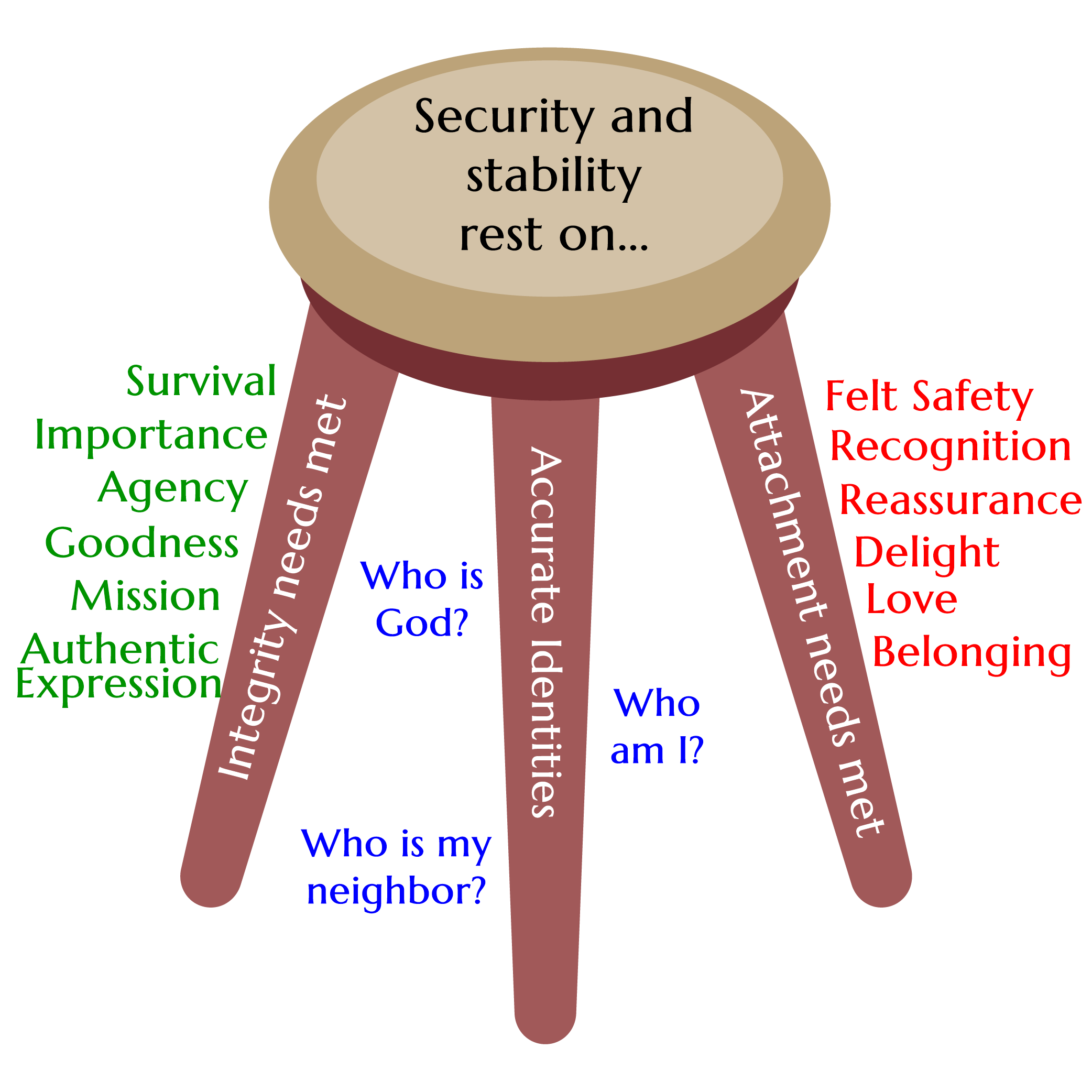
It helps so much if I can understand God as He is, as He has revealed Himself. As a loving Father.
And if I can understand myself, in all my parts, as his beloved little son. This is particularly important for my manager parts who try to earn God’s love, for them to know that God’s love is freely given because of Who He is and who I am. Our relationship.
I discuss these identities at length in these previous reflections:
- The Key to Personal Statements: Getting God’s Identity Right First
- Self Images and Identity
- Our Identity as Heirs of God
It is so easy for so many of my parts to lose track of Who God is and who I am, the nature of our relationship. I need to deliberately value these identities, so into my values statement they go.
God, I love You back wholeheartedly
Once my parts and my innermost self have a grip on these identities, it makes sense for me to love God back with all my heart, with all of my being.
But so often, for me and for so many other Catholics, one or two or three spiritual manager parts try to love God, leaving the other parts out, considering them unworthy, unacceptable, undesirable, or even condemning them as “bad” or utterly inadequate. With their distorted God images, spiritual managers often try to put their “best foot forward” to God, trying to at least be acceptable to God, to be tolerated by God, even to go to desperate lengths so God won’t smite them.
These spiritual managers either don’t know that God is reaching out in love to all of you, all your exiled parts without exception – or they forget. But God wants to connect in love with your inner outcasts, the parts of you who are walking in darkness and gloom, your inner lost sheep, your inner prodigals, your inner lepers, your lame, deaf, and blind parts, your inner tax collectors, and your inner prostitutes – all those parts of you deemed unworthy and unacceptable by your spiritual protector parts. All of the parts are called to union with Him. (That reality is what motivated Souls and Hearts to launch our short, daily Scripture for Your Inner Outcasts podcast – make sure to check it out!).
All of our parts are like the musicians of a jazz band. For the music to be complete, it requires contributions from every musician. Likewise, in order for our love for God to be complete, it requires all of our parts. I address this in Tammy Sollenberger’s podcast The One Inside, in episode 190 titled Loving With Your Parts.
Thus, interior integration, with all parts under the leadership and guidance of the innermost self is a prerequisite for wholeheartedly loving God.
And it’s interesting that in the First Great Commandment, Jesus leads with loving with your whole heart; then He goes on to loving with your whole soul and your whole mind and all your strength (see Mark 12:30) He leads with the heart. Not the intellect, not the will, but the heart, which includes all our parts (see this PDF image from Dr. Gerry’s book Litanies of the Heart)
In loving You, I love all of my neighbor
In this element, I value loving my neighbor not because my neighbor is gratifying or lovable. I used to try to love “difficult” people by finding some positive quality in them that appealed to me and seemed to redeem them in some way. That’s not how God loves.
Now, I value loving others because God loves them. They are made in His image and likeness, and if they are baptized Christians, they are His beloved little sons and daughter.
And I value loving all of my neighbor. All of his or her parts. Plato, in his Republic, wrote that “Love is the pursuit of the whole” and that “…if a man can be properly said to love something, it must be clear that he feels affection for it as a whole, and does not love part of it to the exclusion of the rest.”
God loves every single one of my neighbor’s parts. Not just the pleasant ones, not just those on the surface who are curating the person’s socially desirable image and presentation. No. He loves all of them in all their parts.
I love all of my neighbor because I love God, and He loves all of my neighbor, all of the parts. This value cuts through any evaluative process which questions whether my neighbor is “worthy” of my love, or which parts of my neighbor I will love.
And here’s the kicker: In loving my neighbor, I am loving God.
Matthew 25:40 reads “And the King will answer them, ‘Truly, I say to you, as you did it to one of the least of these my brethren, you did it to me.’”
Therefore, no part of my neighbor should be left out of my love.
In loving You, I love all of me
And finally, I love myself, again, because God loves me. In loving myself in an ordered way, I also love God. I am one of the least of His brethren too. And this includes loving all of me, including the parts of me that carry shame and rage and are often unappealing to almost everybody.
And I love me not primarily because I have good qualities or even because I am a “good person” (ontologically speaking). No. I love myself because God does. And I’m not going to question His judgement on this. God tells us in Isaiah 55:8-9 that “… my thoughts are not your thoughts, neither are your ways my ways, says the Lord. For as the heavens are higher than the earth, so are my ways higher than your ways and my thoughts than your thoughts.”
How far I’ve come
In sharing the process of revising my personal values statement with my IFS coach, Brian Jaudon, he was surprised that there was really only one value in my values statement – love. He was surprised that I didn’t mention Souls and Hearts or the farm or include any of the values on the standard lists which I offered you in my reflections titled Receiving the Light of Natural Aspirational Values from Non-Catholic Sources.
But in the process I came to see how everything worth valuing either is love or flows from love. So this entirely revised list is working for me now.
Meetup with Dr. Peter at his farm in Indianapolis November 19!
Are you in driving distance of Indianapolis, or are you coming into Indy for the National Catholic Youth Conference? If so, can we get together for a small meetup at my home and farm? Wednesday evening, November 19 from 5:30 PM to 9:30 PM, before the NCYC kicks off on Thursday.
Pam (to whom I’ve been married for nearly 30 years, and a great cook) is willing to make chili for us (with many ingredients from our farm) and we can break bread together. Pam’s specialty sourdough bread (it’s really good).
We will have four hours together, time for experiential exercises, a demonstration or two, and conversation, in addition to our chili supper and prayer together.
If you are interested, fill out this quick Google form and let us know a bit about you and Dr. Peter will make a special evening for those attending. Reserve your spot by registering here and paying $50. Space is limited to 10 guests to keep this gathering close-knit.
Tune in to Scripture for Your Inner Outcasts
I do not hesitate to address your exiled parts when I appear as the guest presenter on Souls and Hearts’ Scripture for Your Inner Outcasts podcast.
Scripture for Your Inner Outcasts is a daily podcast where we bring Jesus’ ministry inside, to all parts of us. Just as Jesus reaches out to the outcasts of society, we reach out to your inner outcasts– the parts of you that feel unworthy or unlovable. Join us in seeing Scripture through a new lens, coming alive for those parts of you that may have experienced spiritual neglect and need healing. This podcast aims to help listeners integrate inside, heal from emotional burdens, and grow to flourish in accepting being loved and loving yourself in an ordered way. Each day we reflect on a verse from Sacred Scripture taken from the daily Catholic Mass readings. All informed by Internal Family Systems and other parts work approaches, and all firmly grounded in a Catholic understanding of the human person.
Saying “No” to Mental Clutter – A Guest Presentation
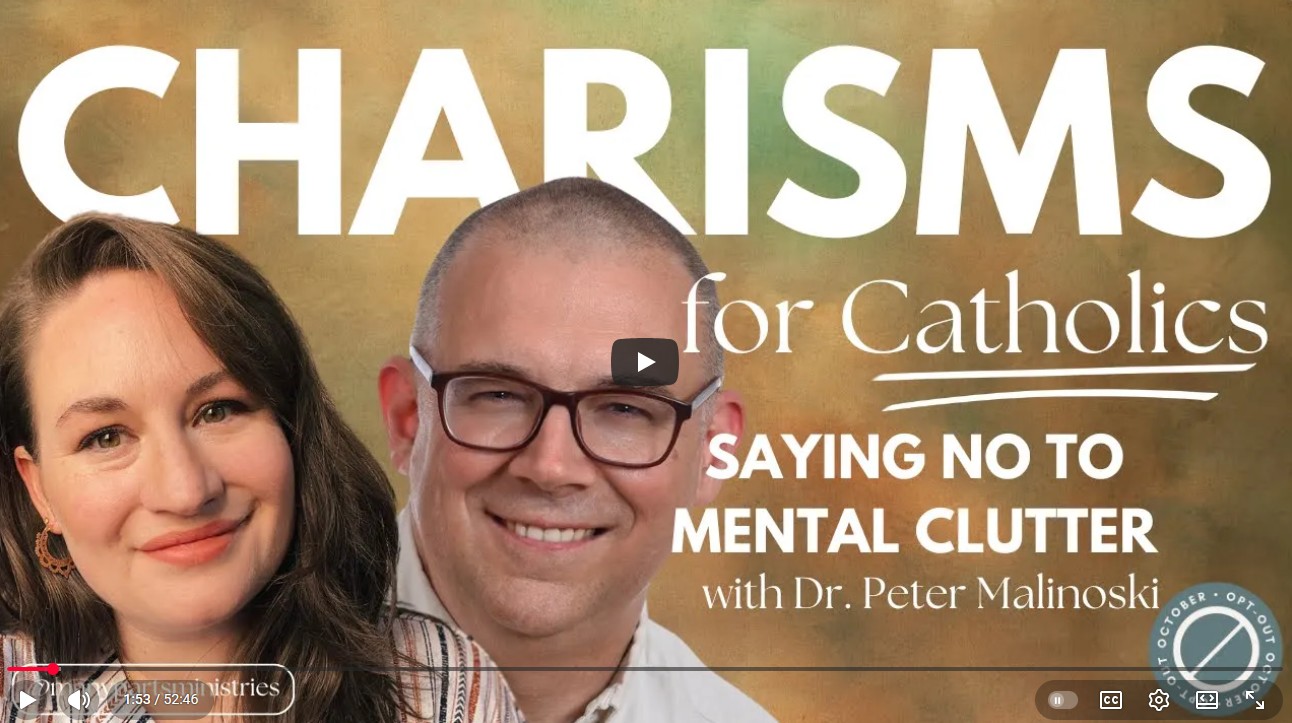
The good folks at Many Parts Ministries (I love the name) including executive director Jill Simons invited me on their Charisms for Catholics podcast for episode 147, Saying “No” to Mental Clutter (video audio). Here’s the description:
In this episode, we dive deeply into the concept of mental clutter and its role in our spiritual and personal development. much of the so-called “clutter” we experience—our racing thoughts, emotional outbursts, and inner fragmentation—points to underlying wounds, unmet needs, or unresolved issues from our past. Dr. Peter emphasizes that, rather than random noise, mental clutter carries important messages about parts of ourselves that need healing or integration. He notes research suggesting that 90% of our reactions to present situations come from unresolved issues in our past, making interior integration essential for true spiritual and emotional peace.
Jill and I discuss how many Catholics tend to avoid looking inward, fearing self-absorption or thinking it’s unspiritual. Dr. Peter insists that genuine self-knowledge and self-love aren’t selfish; in fact, St. Thomas Aquinas and the great commandments teach that we cannot love neighbor or God fully without loving ourselves and knowing who we truly are. He provides examples of how distraction and internal noise in prayer are often signs that our hearts are trying to show us where we need attention.
If you’re looking for a practical, Catholic perspective on how to quiet internal noise, heal old wounds, and discern your unique gifts, this episode is packed with insightful guidance, relatable examples, and great resources to continue your journey.
Warm regards in Christ and His Mother,
Dr. Peter