
Dear Souls & Hearts Member,
My father was a navigator on a B-52 squadron in the early 1970s. One of the lesser-known facts about long-range aircraft navigation is that holding the initial heading toward your destination over a long distance leads the plane to follow a spiraling path that eventually curves away from the most direct route. Therefore, in-flight navigation adjustments are necessary.
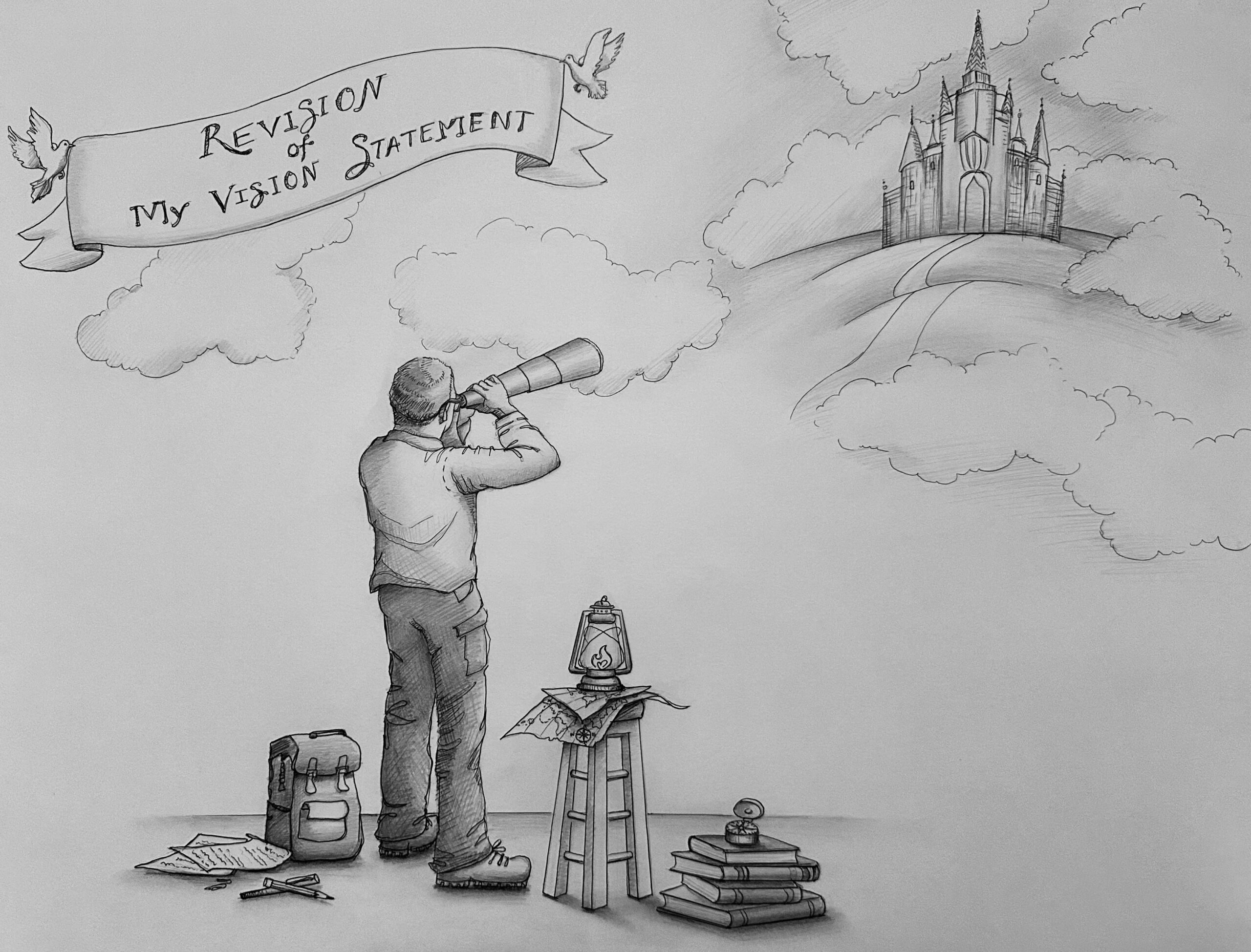
That’s what I am doing with my personal vision statement in this reflection.
Fourteen months ago in my August 22, 2024 reflection titled Writing your personal vision statement as a Catholic, I shared with you my original vision statement:
I will be love.
Six months later, in my February 24, 2025 reflection titled Catholic Personal Vision Statements, Revisited, I shared my process of revisions to my original personal vision statement, along with the process of working through those revisions with my parts, to come up with this statement:
I will become love in union with You, in all my being, in every moment.
And this revision was a major improvement over the original, much more satisfying to my parts. And I was content with that.
However, several weeks ago, I began working with a new IFS coach, Brian Jaudon, who emphasizes starting personal coaching work with writing a vision statement, so we reviewed the revised one and explored it in depth. In that process, I realized that further revisions could be very helpful.
So, in this reflection, I wanted to share with you some of the process of revising my vision statement yet again, as a model for your work with your own vision statement (and endeavor which I highly recommend).
Taking the time
Before we dive in, I just wanted to say that this process can take longer than you expect; it certainly has for me. Remember that your vision statement is all about and monitoring your course in life. You want to get that right.

If you’re flying from Chicago to Rome and you get a degree or two off on your course, you can wind up in Istanbul.
Verb tenses matter
One thing my coach immediately noticed was that my vision statement was all about the future; I will be love. He suggested the present progressive tense of the verb “to be,” capturing both the future and the present.
I am becoming love…
My parts all liked it. This connects my future state to the present moment. It impacts my identity now, my identity as a beloved little son of God, partaking of His divine nature now. All of my parts got on board with this first change quickly.
Peace and joy
Given my desire for peace and joy in my life, it seemed good to feature them in my value statement. Then, I also experimented with including peace and joy in the vision statement, which looked like this:
However, I came to realize that in my life, peace and joy are outcomes. They depend on the trust I have in God, my accepting and embracing complete dependency on Him.
And initially, that seemed satisfying. But.
There was a but…
I’ve been reading in Abbot Marc Foley’s exploration of St. John of the Cross titled The Dark Night: Psychological Experience and Spiritual Reality and I realized how attached I had become to the consoling experiences of peace and joy. Abbot Foley writes:
One of the great dangers in the conversion process is substituting one attachment for another. In John’s drawing of Mount Carmel, there are three paths going up the mountain. The path in the center leads to the top of the mountain; it is the path of detachment. The path on the right side, which leads us astray, is called “the goods of earth.” It consists of joy, knowledge, consolation, and rest. The path on the left side, which leads us astray, is called “the goods of heaven.” It consists of joy, knowledge, consolation, and rest. Sometimes what seems like a spiritual conversion amounts to little more than a lateral shift from the “goods of earth” to the “goods of heaven.” [p. 4]
I realized that the consolation of peace and joy for me was often located in knowing – my Evaluator part reaching for a “localized omniscience,” finding a sense of security and satisfaction in being able to understand and predict what would happen in my sphere.
And that was foreshortening the hand of God in my life.
Trust
I came to realize that in my life, peace and joy are outcomes. They depend on the trust I have in God, my accepting and embracing complete dependency on Him. So I rewrote the statements as follows:
I am becoming love in union with You, in all my being, in every moment, with trust, peace and joy.
And the more I meditated and prayed and discerned on this, the more central the whole idea of trust became, and how on trusting parts of me can be. Also, I noticed that the vision statement was getting longer. And as my aspirational prayers during the day shifted from seeking peace and joy to trust in God, another element became indispensable: detachment.
Detachment
In the passage from Abbot Foley above, the center path that leads to the top of the mountain is detachment. Now there was no doubt that I was attached to peace and joy at this point in my life. So I dropped peace and joy from the vision statement, deepened the trust, and added detachment.
I am becoming love in union with You, in all my being, in every moment, with trust in You and detachment from all else.
Bringing in more relationship in claiming God as mine
As a final step, in considering God’s identity first, as I recommended in the reflection from March 10, 2025, titled The Key to Personal Statements: Getting God’s Identity Right First, I added a bit more about Who God is and my relationship with and commitment to Him, so this became the final version:
My God, (Who is Love), I am becoming love in union with You, in all my being, in every moment, with trust in You and detachment from all else.
And as I prayed with and reflected on this version, looking inside myself to my parts and to God for many days, it stuck and seemed right and good reminding me of Carl Jung, who wrote that “Your vision will become clear only when you can look into your own heart. Who looks outside, dreams; who looks inside, awakes.”
Now every morning, for several minutes, my innermost self and my parts review this vision statement and how I can live it out that day. The focus on love, union, trust, and detachment seem to be hitting all the right notes for where I am now in my journey, and the vision statement is short enough for be easily memorized. And, it opened a whole new way of understanding my personal values, my personal mission, and resolutions; I will be addressing each of these in turn over the next three reflections.
A few more days to join me and 260 others in the Resilient Catholics Community
The RCC is accepting applications for four more days – until October 31. Is your heart moved by our discussions of parts and the innermost self? Can you sense a pioneering spirit of adventure within you? Are you ready to take your human formation seriously and learn to love yourself, your neighbor, and your God in a much more ordered and wholehearted way? Are you ready for much more interior integration, for the inner unity needed for union with God? If so, come join us. We have helped hundreds of Catholic men and women and this adventure of deeper loving. Take in some of their testimonials and find out more on our RCC landing page and if the time is right, apply here. If the money is an issue, contact Pam Malinoski at office@soulsandhearts.com for information on scholarships. And if you have questions about if the RCC is right for you, check out this audio recording of our recent Q&A and then call me at 317.567.9594 and we will discuss it!
Warm regards in Christ and His Mother,
Dr. Peter