
Dear Souls & Hearts Member,
Writing good resolutions? You might be thinking, “Dr. Peter, we’re only in October, and the New Year is still months away. Isn’t it a bit early?”
Nope.
The least important resolutions in life are the yearly ones. Yet those are the ones that get the most attention and the most press.
Let’s explore the who, what, where, when, why, and how of resolutions. And will start with the big question first, why? Why should we make resolutions?
The “why” of resolutions
Author and entrepreneur Richie Norton, in discussing New Year’s resolutions stated that “Most people will passively do exactly what they did last year. Whatever you do, don’t let that person be you.”
And the research bears Norton’s statement out.
Researcher Rich Wiseman followed 3,000 people who made a range of New Year’s resolutions (e.g., losing weight, and found that while 52% of them were confident of success, only 12% of them actually achieved their goal (see here for his summary). And these were individual who were willing to make resolutions in the first place.
But are resolutions that important anyway?
Fr. Emile Neubert answers with a resounding “yes” and gives the reasons why. In his book Life of Union with Mary, Fr. Neubert stated that:
We must start with what is most important. What is most important in spiritual work is the resolution, for on each resolution a whole series of actions depends. Mental prayer, particular examen, spiritual renewals, reviews in the evening, at the end of the week, and monthly or annual retreats – all these exercises should end in practical resolutions. Resolutions are much more precise, much more energetic, especially much more efficacious, if they have been submitted to Mary have been approved by her. [p. 75].
Fr. Neubert argues that resolutions are both initiators and catalysts for a positive series of actions that follow.
Neuropsychologist Theo Tsaousides in his Psychology Today article titled 8 Reasons We Really Do Need to Make Resolutions names and expands on these reasons in the natural realm for why resolutions are important. He argues that resolutions
- are how things get done
- are the language of the brain
- bring clarity
- give us meaning
- make us feel good
- mean progress
- keep us connected
Dr. Tsaousides also challenges you to consider how your alternative is to operate in your default mode, continuing to do what you have been doing, and whether that is satisfying to you. In this, he is echoing G. K. Chesterton, who said
“The object of a New Year is not that we should have a new year. It is that we should have a new soul and a new nose; new feet, a new backbone, new ears, and new eyes. Unless a particular man made New Year resolutions, he would make no resolutions. Unless a man starts afresh about things, he will certainly do nothing effective.”
So let’s assume that you have bought into the importance of resolutions. But let’s take a step back, let’s address the question, “What is a resolution?”
The “what” of resolutions
Fr. John Hardon in his Catholic Dictionary defines “resolution” as “the firm determination to carry into effect what a person has decided should be done. It includes some decision to use the means for putting resolution into practice.”
In unpacking this definition, we see the emphasis on the means necessary to carry out the resolution, to bring it to its completion. Author and speaker Steve Maraboli drives home this point in saying, “It is important that when we make a resolution, or establish a goal, that we take the ACTION necessary to accomplish that goal.”
The “where” of resolutions
Where do resolutions fit in the process of change in our lives? Many people put them first. After all, didn’t Fr. Neubert say in the quote above that they were “what is most important”?
French novelist and literary critic Marcel Proust said that “It is always during a passing state of mind that we make lasting resolutions.” We don’t want that passing state of mind to be a whim. We want to make resolutions to be grounded firmly on our vision, values, and mission.
Thus, I think of resolutions as ideally occupying the “fourth place.”
- In first place is your personal vision statement, defined as “your expression of the future state of who you seek to become, who you are called to be in the future.” Your vision statement is your North Star, the shining city on the hill that you are approaching, and I discussed it at length here and here.
- In the second place is your personal values statement, which is “a delineation of a small set of three to seven core, vital, and unchanging principles that define who your best self is – and that guide you toward who you want to be by clearly naming what you most cherish.” I discuss personal values statements here and here.
- In the third place is your personal mission statement. “A personal mission statement is your expression of the means you will use in the present to realize your personal vision in the future.” It focus on “how” you will work toward your vision, guided by your values and I discuss personal mission statements at length here, here, and here.
You can think of your resolutions as actualizing or bringing to life your mission statement today, in the fourth place. But that doesn’t mean you have to have these three personal statements written already. So let’s turn to the “when” of resolutions.
The “when” of resolutions
Most of the attention, most of the emphasis, most of the hype around resolutions focuses on the New Year. There’s a long tradition in the United States, going back to the Depression era of implementing resolutions yearly, on January 1.

But January 1 is not the most important time to make and keep resolutions.
The most important time to making resolutions is today. Now.
Business Trainer Robert Braathe captures this spirit when he writes, “I don’t believe in New Years Resolutions. I believe in new day or new hour resolutions.”
Media psychology expert Dr. Cynthia Vinney in her article The Psychology Behind Why New Year’s Resolutions Fail argues that one reason why so many resolutions fail is because they are “too big.” We need to get down to the nitty-gritty of life today. We need resolutions for today, and sometimes for this hour, as Robert Braathe pointed out.
So I recommend that we start with resolutions on a daily basis, and then work up to weekly resolutions, then monthly, then yearly.
This is consistent with Protestant Pastor Charles M. Sheldon’s assertion that “Good resolutions are like babies crying in church. They should be carried out immediately.” There’s an immediacy to this quote that is so important.
Practicing setting and keeping resolutions daily sets you up for success on a weekly, monthly, and yearly basis.
The “who” of resolutions
The answer to this question might seem obvious – it’s for me, the resolutions are for me, and for those whom I love.

I firmly believe that one reason why so many failed (88%, according to Dr. Wiseman) in keeping their resolutions was because those resolutions were made without interior integration, without including the input, perspective, needs, and positions of all parts of the person.
As I argued in episodes 116 and 117 of the Interior Integration for Catholics podcast, we are not single, homogenous, monolithic personalities. We have parts, which “feel like separate, independently operating personalities within us, each with own unique prominent needs, roles in our lives, emotions, body sensations, guiding beliefs and assumptions, typical thoughts, intentions, desires, attitudes, impulses, interpersonal style, and world view.” (You can find out a lot more about parts in episode 159 of the Interior Integration for Catholics podcast, titled Who Are My Parts and Why Do They Battle Within Me?
So often, our manager parts drive the process of making resolutions, and if they are not in right relationship with our innermost selves, they will lack the breadth of vision and the compassion needed to meet the attachment, integrity, and identity needs of all the parts, particularly your exiles.
A resolution is more likely to be carried out if the entire set of parts had contributed to making the resolution and agree (even grudgingly) to it. If parts feel left out of the process of considering and committing to a resolution, they are likely to resist it or even rebel against it, especially if the resolution seems unattuned to their needs and contrary to their agendas.
The “how” of resolutions
As we turn to how to formulate, commit to and execute resolutions, the first recommendation is to just get started with one daily resolution. You don’t have to do this anything like perfectly. If you don’t have your vision statement, your values statement, and your mission statement completed, don’t let that hold you back. A little reflection can probably shed significant light on what your next right step is for today.

Saint John Chrysostom describes how God pours out his graces on those who make sincere resolutions. He says “When we once begin to form good resolutions, God gives us every opportunity of carrying them out.” I can visualize the graces coming down on newbie resolution makers.
Second, focus on today. Don’t start with New Year’s resolutions, or the completion of major goals or wait until your personal vision, values, and mission statements are written. Make a resolution today, start now.
Third, make a single resolution for today. Don’t start with five or three or ten. Resolutions start with one. In the long run, process of learning to making keep resolutions is more important than any individual resolution. It’s important to notch some successes to help motivation stay high.
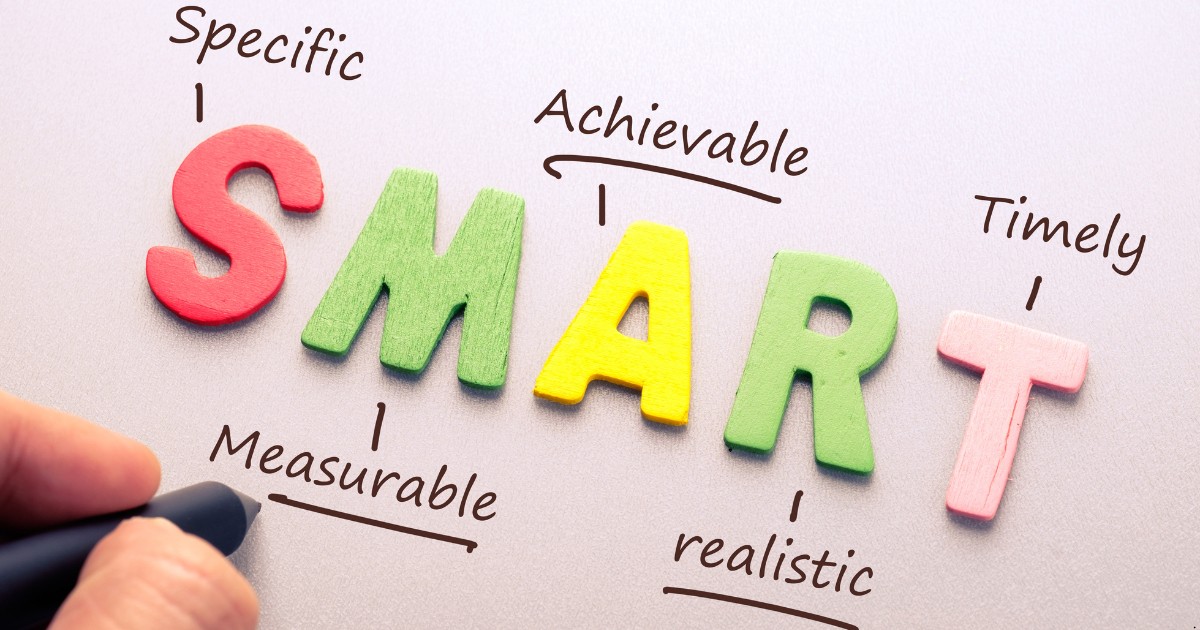
Image courtesy of Liviti Property, used by permission via CC BY-NC 4.0
Fourth, as Dr. Wiseman recommends (especially for men), make your resolution SMART. George T. Doran coined the acronym in a 1961 paper titled There’s a SMART Way to Write Management’s Goals and Objectives, and SMART stands for:
- Specific — The resolution should be clearly defined (i.e. I will spend 30 minutes with my spouse this evening, asking questions about his or her day to deepen our conversation) rather than vague (i.e. I will be kind to my spouse today).
- Measurable — this often requires the use of numbers — something quantifiable, something that is verifiable. You can’t readily measure virtue (i.e. I will be more charitable toward my children today). You want something where the resolution can be clearly seen as executed or not (i.e. I will ask my daughter to tell me all about her volleyball tournament after supper tonight).
- Achievable — the goal must be realistic on the one hand, yet still challenging on the other hand, so that it stretches you out of your comfort zone.
- Relevant — your goal must be worth the effort and oriented to the good.
- Timely — your goal must be time-delimited; for a daily resolutions, that means completing it before bedtime.
Other recommendations from Dr. Wiseman’s research summary include:
- Focus on how much better life will be for you and those you love when you achieve your resolution
- Share your resolutions with someone else, someone who knows you, to help with accountability
- Stay with it. The process is more important than the outcome of any given resolutions. You will make mistakes, and new habits take time to develop.
In determining resolutions, it helps so much if all parts granted at least grudging acceptance of the resolution. This might involve some negotiation among parts, which becomes part of the discernment of the daily resolution in the morning.
In determining resolutions, it helps so much if all parts granted at least grudging acceptance of the resolution. This might involve some negotiation among parts, which becomes part of the discernment of the daily resolution in the morning.
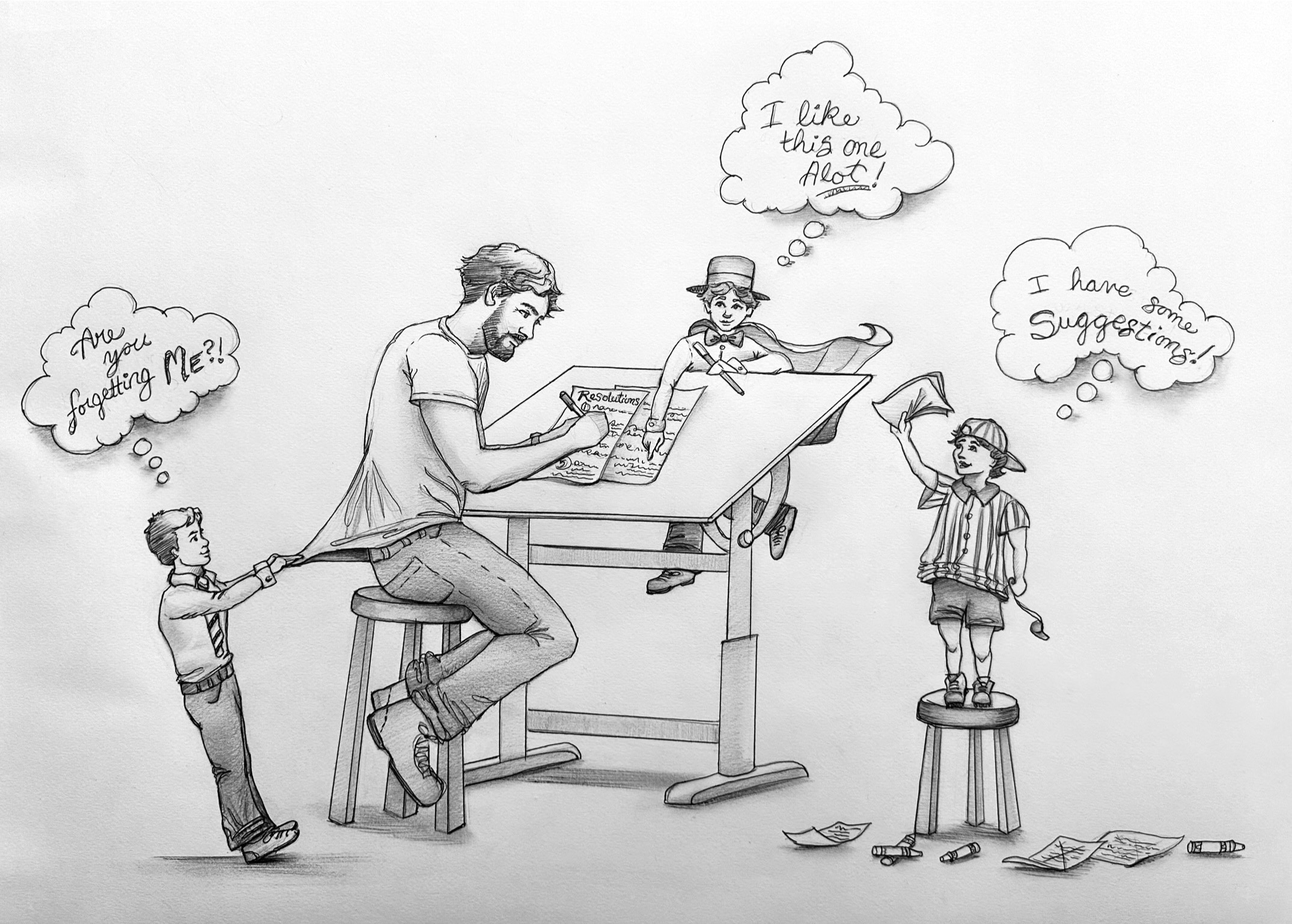
Once you can consistently make and keep daily resolutions, I would move to making a morning resolution, and afternoon resolution, and an evening resolution, as time and resources permit. This is an excellent way to continue to check in with your parts throughout the day, bring them together in cooperation and collaboration around what is most important. It also signals to your parts that they are valued partners in your efforts, not obstacles who are thwarting your “progress.” In our header image above, you can see “Mike” working with his parts on his daily resolution.
Help for the journey
If you practice , you discerning, writing, and keeping daily resolutions, will learn by trial and error. For those that have been on the journey of writing personal vision, values, and mission statements, we have another online workshop, this time on Writing Good Personal Resolutions – all about how we implement the doing of our mission statements in the service of the being of our vision statements.
Our resolutions workshop will take place on Zoom on Thursday, October 23, 2025 from 8:00 PM to 9:00 PM Eastern time. If you are on my workshop email list, you should have already received an invitation with the Zoom link. If you’d like to be on my list and either attend that workshop live or receive a video link to watch it afterward, reach out to me at crisis@soulsandhearts.com. You do not have to have written your vision, mission, or values statements to participate; come as you are.
Take the challenge. Write a resolution today. Experience what the poet Henry Wadsworth Longfellow meant when he wrote, “Resolve, and thou art free.”
The Resilient Catholics Community is open for new applications until October 31
Are you wanting to get to connect, understand, be with, and love all your parts? Our Souls and Hearts team has brought together the best of IFS and other parts approaches and grounded them in a Catholic understanding of the human person for you. For your benefit.
The RCC Foundation Year is a structured program consisting of 44 weeks of Inner Connections talks and experiential exercises, with sharing and connecting in companies of 5-7 other likeminded Catholics, all on a pilgrimage to better human formation.
The whole process begins with the PartsFinder Pro, an extensive set of questionnaires that help our staff hypothesize the parts of your interior system as well as how they might be interacting with one another. You can download a PDF for a sample fictional report for a man and a woman.
The RCC is at the core of Souls and Hearts – where our RCC members do so much beautiful personal human formation work, leading to interior integration, transformation, and flourishing.
Applications for the St. Kateri Tekakwitha cohort are now being accepted until October 31.
If you are interested in working with your own parts, bring them into greater harmony within you, under the leadership and guidance of your innermost self, journeying toward flourishing, consider joining us in the RCC. Listen to this 19-minute experiential exercise to help you discern about applying to the RCC.
Meetup in Person in Indianapolis November 19!
Are you in driving distance of Indianapolis, or are you coming into Indy for the National Catholic Youth Conference? If so, can we get together? I don’t know precisely what the experience would look like, but it would be great for a Souls and Hearts in-person meetup to happen on Wednesday evening, November 19 from 5:30 PM to 9:30 PM, before the NCYC kicks off on Thursday.
Pam (to whom I’ve been married for nearly 30 years, and a great cook) is willing to make chili for us (with many ingredients from our farm) and we can break bread together. Pam’s specialty sourdough bread (it’s really good).
We can have four hours together — and depending on how many, we will determine a local venue, considering transportation needs and we will figure out programming depending on who can make it — Catholics new to IFS, our beloved RCC and FFF members, etc, but it will likely include experiential exercises, a demonstration or two, and conversation, in addition to the chili supper and prayer together. There will be a charge of $50 to offset the costs if we can make this happen.
If you are interested, fill out this quick Google form and let us know, and we will be in touch as we know more.
Ignatian IFS retreat opportunities with Fr. Jeff Putthoff, SJ
The following are not Souls and Hearts retreats and Souls and Hearts is not responsible for any of the content, but these may be of interest to our membership. Fr. Jeff Putthoff is a Jesuit priest and a Level 2 trained IFS practitioner. Mary Kruger is an IFS Lead Trainer who has much experience with Catholicism.
Discover “Breaking Dawn: Ignatian Spirituality Meets Internal Family Systems in an Advent Experience,” a transformative retreat combining Ignatian contemplation and imaginative prayer for self-discovery and a deeper connection with God. This silent, preached retreat features guided talks, daily Mass, and abundant prayer time, inviting you to explore your inner world and encounter the Divine. Prepare for Christ’s coming by listening, resting, and responding to the Spirit’s stirrings in a sacred space. The retreat will be led by Fr. Jeff Putthoff, SJ at the Mercy Conference and Retreat Center from Thursday, December 4 to Sunday, December 7, 2025. For more information click this link, or email Fr. Putthoff, SJ with questions at jeff@putthoff.com.
Join us for “Transforming Religious Legacy Burdens,” a transformative 4-day Catholic retreat from January 29 to February 1, 2026, at Our Lady of La Salette Retreat House in Attleboro, MA. Led by Mary Kruger (LMFT, IFS Lead Trainer) and Fr. Jeff Putthoff, SJ, this retreat blends Internal Family Systems (IFS) with Ignatian Spirituality to heal religious wounds and deepen your connection with God. Through guided IFS exploration, Ignatian prayer, daily Mass, and community sharing, participants will find freedom, self-compassion, and spiritual renewal in a sacred, silent atmosphere. Open to all adults (18+), Catholic or non-Catholic, for $650, including lodging, meals, and materials. Click this link for more detailed information and registration. Contact Fr. Jeff Putthoff at jeff@putthoff.com for details.
Interview with Religious Life
An editor from Religious Life, a magazine from the Institute on Religious Life was so interested in Souls and Hearts that they published an interview with me about Souls and Hearts in their InnerView section in the most recent issue. Check it out here, on pages 24-25.
Warm regards in Christ and His Mother,
Dr. Peter