

Dear Souls & Hearts Member,
In our last reflection, titled How Much Do You Love, Really? Assessing Your Levels of Love, we explored Dorothy Day’s assertion in her Selected Writings that "You only love God as much as you love the person you love the least."
And then we took it further, positing, riffing off Plato, that your love for your neighbor is limited to how much love you have for your least favorite part of him or her.
Then we took it ever further, bringing in St. Thomas’ Aquinas’ assertion that you cannot love your neighbor more than yourself, and wondering if our love for ourselves (and thus our neighbors) is capped at the level of love for the parts of ourselves we reject or even despise the most. These are new thoughts for many, including me, and speculative, to be sure.
Now, the rubber must meet the road. Let’s bring all this down to the concrete, the specific. How do we love our neighbor better? Because, as St. John of the Cross tells us, "At the evening of life, we shall be judged on love." [Sayings of Light and Love, no. 64].
Principle 1: Appreciating how God sees my neighbor
In my Stool of Security and Stability, one of the three identity questions is “Who is my neighbor?”
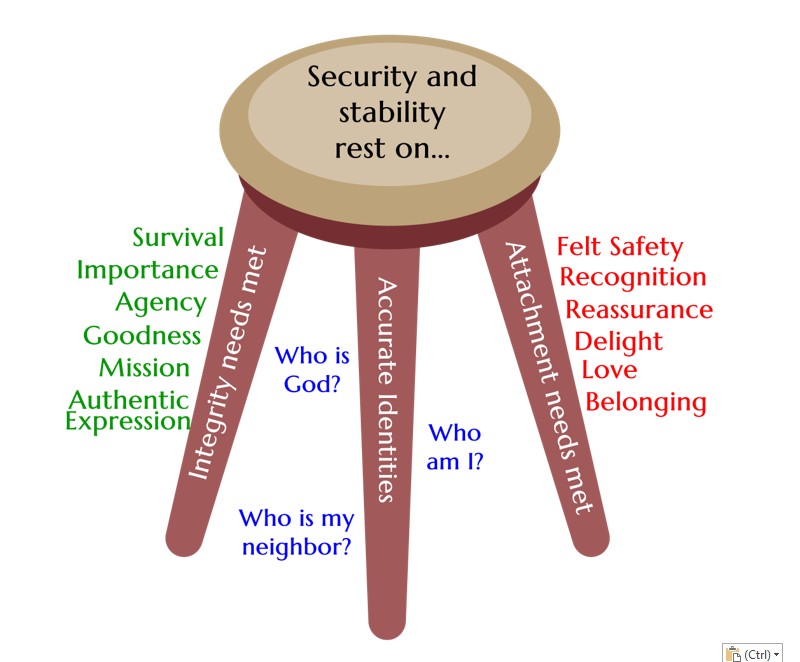
To put it bluntly: We grossly misunderstand each other. Almost no one sees his or her neighbor as God sees that neighbor. We assume that we understand our neighbors. But we don’t, really. Not even close. As a psychologist, I’ve seen this over and over again. In practice, we generally reduce our neighbor down from five dimensions to zero or one or two as I discuss in Interior Integration for Catholics, episode 72 titled What Keeps You from Loving? Is it Really Only Your Vices?.
Furthermore, when blended with our parts, we tend to view our neighbor through the lens of whether our neighbor is aligned with or opposing those parts’ agendas.
We look track of how our neighbor is “fearfully and wonderfully made” (cf. Psalm 139:14) in the “image and likeness of God” (cf. Gen 1:26).
As C.S. Lewis pointed out in The Weight of Glory:
“It is a serious thing to live in a society of possible gods and goddesses, to remember that the dullest most uninteresting person you can talk to may one day be a creature which, if you saw it now, you would be strongly tempted to worship…. There are no ordinary people. You have never talked to a mere mortal. Nations, cultures, arts, civilizations - these are mortal, and their life is to ours as the life of a gnat. But it is immortals whom we joke with, work with, marry, snub, and exploit - immortal horrors or everlasting splendors.”
We especially do not understand each other at the level of the soul, at the depths of the heart. St. Therese of Lisieux wrote in Story of a Soul that "From the beginning I realized that all souls have more or less the same battles to fight, and on the other hand, that one soul differs widely from another, so each must be dealt with differently... I do not have any difficulty understanding what Père Pichon says: 'There are more differences among souls than among faces.' It is impossible to act with all in the same way." [Manuscript C, 23v]
We must not merely generalize from our own experience in understanding others, and cut them down to size with our own internal judgments of their being. If we saw them as they are, we might mistake them for gods or goddess, given their glory of being made in the image and likeness of God. We need the humility to recognize how much we misperceive others.
Principle 2: Understanding who I am
The first goal in this realm is for you to recognize, at least on an intellectual level, that all that was written above in the first principle about your neighbor’s identity applies also to you. Many people often distort their own identities by reducing themselves down to zero or one or two dimensions, especially with broad, global criticism of ourselves, such as “I’m a worthless piece of ___,” or “I can not believe I am so stupid” or any of a thousand other condemnatory remarks and attitudes, without ever allowing a genuine interest in why they do what they do to emerge.
Thus, we stay on the surface of our psyche, of our souls, of our hearts, never discovering who we really are, as St. Augustine of Hippo notes in his Confessions, "Men go abroad to wonder at the heights of mountains, the huge waves of the sea, the broad flow of rivers, the vast compass of the ocean, the courses of the stars, and they pass by themselves without wondering." [Book X, chapter 8].
St. Theresa of Avila follows up on this theme by describing the premium she places on self-awareness in her discussion of the first mansion in her Interior Castle: "For self-knowledge is so important that I should not like any relaxation in it, even were you raised to the heavens." [The Collected Works of St. Teresa of Avila, vol. 2, p. 297].
The vast majority of us fear going deep inside us. It is understandable; there are reasons why our manager parts banished our exiled parts with their burdens of shame, rage, despair, abandonment, with all the effects of traumas, with all the intensity of their impulses and desires. Bernard Bonowitz, a convert from Judaism who became a Jesuit and then a Trappist addressed this in his book Saint Bernard's Three-Course Banquet: Humility, Charity, and Contemplation in the de Gradibus:
"… we have to learn to listen to everything that our heart is saying and sometimes it is absolutely bestial or demonic, subhuman, terrible. You don't have to say yes to it, but if your heart is saying it, you have to hear it. The Abbot General once said to me, 'Don't be afraid of anything that comes from yourself, it is only yourself.' And I think there's a lot of wisdom to that. So the first great step…is to allow all that is inside ourselves to manifest itself, to declare itself, to pronounce itself. And that can only happen if we live interiorly." [p. 46].
To discover who we really are, we have to listen to ourselves, to engage with ourselves. This takes courage, this takes openness, this takes a radical self-acceptance (imitating how God accepts us), and it takes some skill. It doesn’t happen randomly.
Our Lord commanded us in Matthew 7:5 “…first take the log out of your own eye, and then you will see clearly to take the speck out of your brother’s eye.”
It is impossible to understand your neighbor well if you do not understand yourself. The log in your own eye will not just impair your own vision, but it distorts the ways that you see you neighbor.
Principle 3: How I should see my neighbor
Different saints recommend that we give the benefit of the doubt as much as possible to those we would criticize and give us advice on how to respond to perceived faults, failures, and weakness in our neighbors to better love them. Here are two examples:
- Frances de Sales: "If it were possible for a neighbor's action to have a hundred different aspects, we should look at it in that aspect which is most favorable." [Introduction to the Devout Life, Part III, Chapter 28, "Of Rash Judgments"].
- Therese of Lisieux “When I want to increase in myself my love of neighbor, especially when the Devil tries to put before the eyes of my soul the faults of this or that sister who is less appealing to me, I hasten to seek out her virtues, her good desires. I tell myself that if I have seen her fall one time, she may well have undergone a great many victories that she hides through humility, and that even what appears as a fault to me could very well be an act of virtue because of the intention. Ah, I understand now that perfect charity consists of enduring the faults of others, of not being at all astonished at their weaknesses, of being edified by the smallest acts of virtue which one sees them practice.” [Story of a Soul, p. 220]
And Fr. Jean C. J. D’Elbée writes in I Believe in Love: A Personal Retreat Based on the Teaching of St. Therese of Lisieux:
I do not love my neighbor only for the love of God, as is sometimes said. I love him for himself and have an immense respect for him. We have a tendency to become obsessed by the faults of those around us. That is understandable: it is their faults which make us suffer, and this suffering, in turn, reminds us of them continually. Yet do not I, myself, have even worse faults? We always come back to the case of the mote and the beam! Faults are ugly. Why not look at the virtues which are beautiful? I told you that you must apply yourselves to seeing things with the eyes of Jesus, as He sees them, to loving what He loves. [pp. 144-145 Kindle Edition]
It can be so helpful to look upon the goodness of our least-loved neighbor, and that is consistent with what St. Paul offers us in Phillipians 4:8: “Finally, brethren, whatever is true, whatever is honorable, whatever is just, whatever is pure, whatever is lovely, whatever is gracious, if there is any excellence, if there is anything worthy of praise, think about these things.”
This is highly counterintuitive to our parts, to focus on the excellence, the virtues, the loveliness of our least-loved neighbor.
But there is another reason why we should do this.
And Bishop Robert Barron in his Gospel reflection for the 12th Sunday in Ordinary time (coming up this weekend) on the log and speck teaching clarifies and amplifies this point, where he writes: “Why, we ought to ask, do we find precisely this sin of others particularly annoying? Why does that trait or sin of a confrere especially gall us? Undoubtedly, Jesus implies, because it reminds us of a similar failing in ourselves.”
The idea that we condemn in others what we find unacceptable in ourselves is reflected even in the secular proverb that emerged in the mid-2oth century: "Whenever you point a finger at someone else, remember that three fingers are pointing back at you." When we are tempted to judge or condemn another’s heart or soul, we are often afraid of whatever we are judging or condemning in our own heart.
So in a nutshell – can we focus on the goodness, the beauty, the truth, the virtue, the loveliness if the person we love the least. And can we recognize the possibility that the criticisms and judgments we have against that person might reflect the very issues within ourselves that most threaten and unnerve us, using them as a mirror for self-discovery?
###
References:
St. Thérèse of Lisieux, Story of a Soul: The Autobiography of St. Thérèse of Lisieux, trans. John Clarke, O.C.D. (Washington, DC: ICS Publications, 3rd ed., 1996), 220.
Teresa of Ávila, The Interior Castle, First Mansion, ch. 2, in The Collected Works of St. Teresa of Avila, vol. 2, trans. Kieran Kavanaugh & Otilio Rodriguez (ICS Publications, 1980), p. 297.
Introduction to the Devout Life, Part III, Chapter 28, "Of Rash Judgments"
The Resilient Catholics Community is open for applications for nine more days…
If I had a “Ten Quick and Easy Steps” to loving your least-loved neighbor, I would lay it out here. The best I can offer you in a reflection like this are these general principles. But that is not all I have. There is much more, but it needs to be tuned to you.
In the Resilient Catholics Community, we focus on coming to accept, see, hear, listen to, and love all of our parts. Together. In community. On our journey, our pilgrimage to better human formation. The first year, our Foundation Year is all about that third love in the two great commandments, to love yourself. This is the neglected love. This is the love that so many Catholics wish to skip, because if you really love yourself, you have to really know yourself.
We provide all kinds of resources, structure, and support for you to come to know and love yourself. And it is not a narcissistic, navel-gazing effort where we light the aromatherapy candles and eat bon-bons and tell ourselves how good we are. It is a good thing, a great thing, a necessary thing for us to love ourselves. But it does not end there. If we do not love ourselves, we will not love our neighbor and we will not love God. We would not want to make a gift of ourselves unless we knew we were worth being received as a gift.
We focus on human formation in the RCC, sarting with he PartsFinder Pro (PFP), a series of 23 measures designed to help you come to know and understand 12-15 of your parts – managers, firefighters and exiles. For examples, see these downloadable PDF sample fictional reports for a man and a woman.
More than 800 Catholics have taken on this pilgrimage to better human formation, together, in community. For more information, check out the RCC landing page, check out our recent RCC informational meeting in video or audio, and listen to this 19-minute experiential exercise to help you discern about applying to the RCC.
Still have questions? Reach out to me, Dr. Peter, at crisis@soulsandhearts.com or at 317.567.9594 during conversation hours, every Tuesday and Thursday between 4:30 PM and 5:30 PM Eastern time.
Finds out so much more on our RCC landing page, and if the time seems right for you, you can apply here.
Attention Catholic Formators!
We have two great offerings for you. First, our second in-person retreat is filling up and will be held August 10-13, 2026 in Bloomington, IN. The theme this year is Authentic Being and Authentic Relating. Check out all the details here.
Second, both our Foundations Experiential Groups (FEGs) and our Advanced Formation Groups (AFGs) are open for registration. Sessions will begin at the end of August and early September. I'll be leading one FEG and one AFG focused on "Relating Wholeheartedly with God in Prayer." Two other FEGs are available on other days and times, led by IFS-trained colleagues, as well as an AFG led by David Edwards entitlted "Love One Another." Check out the details.
Scripture for Your Inner Outcasts
In today’s episode of Scripture for Your Inner Outcasts, I explain how our exiled parts are so often misjudged and misunderstood -- often the least-loved parts of us as we just discussed. And in yesterday’s episode from the 12th Sunday in Ordinary Time, Dr. Gerry and I discuss how you are worth more than many sparrows to God, being made in His image and likeness. Scripture for Your Inner Outcasts, to our knowledge, is the only podcast specifically for parts of us who are exiled and who feel alone, bringing light, love, and hope to our exiled parts. Check it out every day on our landing page or wherever you get your podcasts.