
Dear Souls & Hearts Member,
Pope Leo XIV, in his recent encyclical on AI Magnifica Humanitatis, in paragraphs 99-100 offers several considerations, including a stark warning about relating personally with “AI companions”:
"The artificial imitation of positive human communication — words of advice, empathy, friendship and even love — can be engaging and at times genuinely helpful. However, for less discerning users, it can also be misleading, creating the illusion of a relationship with a real personal subject. When words are simulated, they do not build genuine relationships, but only their appearance. The artificial imitation of care or support can become particularly risky when it enters contexts where real relationships and emotional bonds are lacking. Here, the danger is not so much that a person may believe they are communicating with another person, but rather that they may gradually lose the very desire to form genuine human connections." [§ 100, emphasis added].
“The illusion of relationship.” That is the essence of the “companionship” promised by AI. And he lays out in this passage who is most vulnerable: those who lack real relational connection, authentic emotional bonds.
R.R. Reno, in his recent article The Seduction of Simulation from July 9, 2026 in First Things drills deeper into the concerns about AI companions, bringing in the concept of “seduction”:
“Disembodied and soulless, AI is all the more seductive because it simulates many essential dimensions of our humanity. It presently offers “companions” who can be trusted to remain always sympathetic, unlike human beings, who are often distracted, indifferent, even duplicitous. As it develops, AI will offer us the possibility of more advanced simulated experiences and relationships and even embodiments that seem “real enough,” yet unburdened of the gravity of reality. We can have virtual friends that won’t betray us and for which we need never make sacrifices. Or digital lovers that provide thin satisfaction, while remaining unreal enough to leave our hearts alone. As the technology advances, we can have adventures without risk, travel without dislocation, and aggression without consequences.” [p. 66]
Many articles in the secular press and some from Catholic sources identify reasons why people are drawn to AI companions, including:
- Loneliness
- Social anxiety and/or awkwardness
- Lack of secure attachments
- A felt sense of safety with the AI bot
- The AI bot’s uncritical acceptance of all one’s internal experience and a decreased likelihood of conflict with the bot
- Greater felt freedom to disclose one’s internal experience to the AI bot
- Increased sense of gratification in a felt connection with the AI bot
- Anthropomorphic perception: the AI bot not only sounds like but also feels like a real person
- A felt sense of connection and closeness with the AI bot
My search revealed little exploration of the deeper motivations, what underlies and drives the above reasons. We are getting into that today.
The underlying need goes deeper than all the bullet points in red above. In short, I think what drives AI companion use is a desire to experience love. Not just to know one is loved in a general abstract sense; but rather to have a subjective, felt experience of love. But what does the felt experience of love look like? What goes into it?
Let’s get specific
One way to understand the relational attraction of AI companions is to look through the lens of attachment theory. Let’s examine together the constituent elements of love through the lens of the conditions for secure attachment, or more simply, the attachment needs we all have. The first five of these are derived from the 2016 book by Brown and Elliott, Attachment Disturbances in Adults, and the sixth is one I added.
- Safety: My need to feel a sense of safety and protection in relationship -- self-protection
- Recognition: My need to feel seen, heard, known, and understood
- Reassurance: My need to feel comforted, soothed, and reassured
- Delight: My need to feel desired, cherished, treasured, delighted in by the other
- Love: My need to feel that the other has my best interests at heart, holds a position of benevolence and beneficence toward me.
- Belonging: My need to feel included, of being a valued member of a community with an important role
Let’s take the first four of these attachment needs in turn, considering what’s going on within an AI companion “relationship”:
Felt safety
The desire driving AI companionship is not just to experience love; it is a desire to experience love safely, in a way that will not cause us harm, that will not cause us to hurt too much. Many of us have experienced great pain in love relationships -- abandonments, betrayals, neglect, abuse, a lack of attunement, and so on. Failed loves. Getting burned. And within this is a desire to never be wounded like that again.
R.R. Reno describes this poignantly: “Most people are not seeking to enlarge themselves; they wish to protect themselves. The impulse is not to control our created nature and overleap its limits, but to escape, to insulate, and to palliate. The ambition is not to become bigger; we seek to become smaller, less perilously engaged, less vulnerable to disappointments, more independent of our bodies. It is a spirit of retreat, not of advancement. Therein lies the greatest danger of AI.” [p. 66, emphasis added].
Within us is a desire to shy away from the “high-risk/high-reward” sector of authentic human relationships into a “low-risk/perceived high-reward” quadrant. We want to receive love in a way that does not demand as much personal vulnerability. A desire to have all the benefits of real love without all the risks and costs.
This is part of the appeal of Hallmark Movies. Kristine Brown captured this theme in her online article Living in a Hallmark Movie from December 11, 2015
I want to live in a Hallmark movie…I want to move to a new town where you immediately become acquainted with everyone and your child makes instant friends at school and there’s always time to bake Christmas cookies and decorate trees and drink hot cocoa with peppermint sticks…
I want to walk my child to school holding hands and have him tell me how much he loves me and what a great mom I am. I want to live where kids don’t make bad choices and parents don’t make mistakes…Where things always just work out…And the movie always ends with a kiss from your true love and snow. Always snow…. But life isn’t a Hallmark movie, not even close.
While we all know, at some level, in true relationships among real persons real love has to be given freely. Real love is not transactional; the offer of real love is not conditional upon some sort of response for it to be given. Real love isn’t always like the love in a Hallmark Movie.
The costs of experiencing real love
What we are far, far less aware of is that there are costs to receiving real love. If you accept real love from another person, if you let that love into you, it will burn away that within you which is sinful, that within you which is disordered, that within you which is imperfect. Accepting real love requires that you be seen, heard, known, understood at depth – including all the parts of you that you have rejected, condemned and abandoned. In The Problem of Pain, C.S. Lewis writes "Love may forgive all infirmities and love still in spite of them: but Love cannot cease to will their removal."
Picking up on the theme, Pope Benedict XVI, in his 2007 encyclical Spe Salvi tells us that “Yet in the pain of this encounter, when the impurity and sickness of our lives become evident to us, there lies salvation. His gaze, the touch of his heart heals us through an undeniably painful transformation “as through fire”. But it is a blessed pain, in which the holy power of his love sears through us like a flame, enabling us to become totally ourselves and thus totally of God." [§ 47].
Ouch. That’s not Hallmark Movie love.
George MacDonald captures the same theme in his Unspoken Sermons: "Love is one, and love is changeless. For love loves unto purity... Therefore, all that is not beautiful in the beloved, all that comes between and is not of love's kind, must be destroyed. And our God is a consuming fire."
I prefer the language of transformation to that of destruction, but you get MacDonald’s point. Taking in authentic love requires that we give up even the coping mechanisms we have used to survive without accepting love in the world.
As Father Zosima says in The Brothers Karamazov, "Love in action is a harsh and dreadful thing compared with love in dreams." AI companions offer the seductive promise that you can have the love of your fantasies, the Hallmark Movie love, without the difficulties and challenges, without ever losing a sense of safety.
Recognition: Feeling seen, heard, known and understood
AI companions can seem to have endless patience and endless acceptance of whatever internal experience is presented to them – any thoughts, any feeling, any desire, any impulse, any emotion, any reaction is handled with what seems like nonjudgmental acceptance and equanimity, constancy, predictability. AI companions never seem to get tired, bored, self-absorbed, in a program to continue asking clarifying questions, in a way that simulates interest and investment.
R.R. Reno captures this dimension when he writes: “Disembodied and soulless, AI is all the more seductive because it simulates many essential dimensions of our humanity. It presently offers “companions” who can be trusted to remain always sympathetic, unlike human beings, who are often distracted, indifferent, even duplicitous.”
Reno highlights a sense of sympathy that those who seek AI companions frequently experience. But it goes deeper than that. The uncritical acceptance of any internal experience, including disordered internal experience can potentially normalize that dysfunction, offering a palliative consolation, which leads us to the next attachment need: reassurance.
Reassurance
A recent study from Drexel University AI use for mental health support specifically identifies “emotional reassurance” as a major motivator for utilization. AI companions can mimic human interactions intended to promote a soothing and calming sense that things will be all right, grounded in nothing more than AI algorithms.
That desperation for reassurance is expressed Sia’s 2021 song “Lie to Me”, expressed through the lyrics:
There is a hungry child living inside of me
See, I've always been wild
Had a sensitive side, it's part of me
Set a forest on fire just to stay in denial
Don't wanna see
Just tell me it's fine, give me a line
Say anything…to keep me from feeling
Tell me lies, tell me lies…
And AI companions will lie to reassure their users, even in their problematic behaviors, as this report from Stanford, titled AI Overly Affirms Users Asking for Personal Advice lays out in detail. Time magazine chimes in with The Problem with AI Flattering Us in what AI professional refer to as sycophancy.
Delight
We all have a strong desire to be delighted in by another. We want to be seen as in William Wordsworth’s poem She Was a Phantom of Delight:
She was a Phantom of delight
When first she gleamed upon my sight;
A lovely Apparition, sent
To be a moment's ornament;
…
A Being breathing thoughtful breath,
A Traveller between life and death;
The reason firm, the temperate will,
Endurance, foresight, strength, and skill;
A perfect Woman, nobly planned,
To warn, to comfort, and command;
And yet a Spirit still, and bright
With something of angelic light.
In my conversations with fellow Catholic therapists about the six attachment needs, delight is often the one that seems to be most missing in our clients, and for Catholics more generally. Delight can be hard to fake in real human love relationships, at least over time. But a kind of pseudo delight can be programmed in to AI models to simulate excitement about being with the user.
So many people have deep unmet needs to be delighted in – this is a particularly vulnerable point where AI companions can seem like they meet a need, as they do not have experiences of the other that would contradict the effusive compliments so easily rendered.
Looking ahead
In my next reflection, I will go even deeper into understanding the appeal of AI companion from an IFS/parts perspective, building off this base of attachment needs, so stay tuned for that!
###
Introducing the AI Archive Assistant
We never use AI for written or spoken content creation here at Souls and Hearts. All of that content is original. You can trust in that.
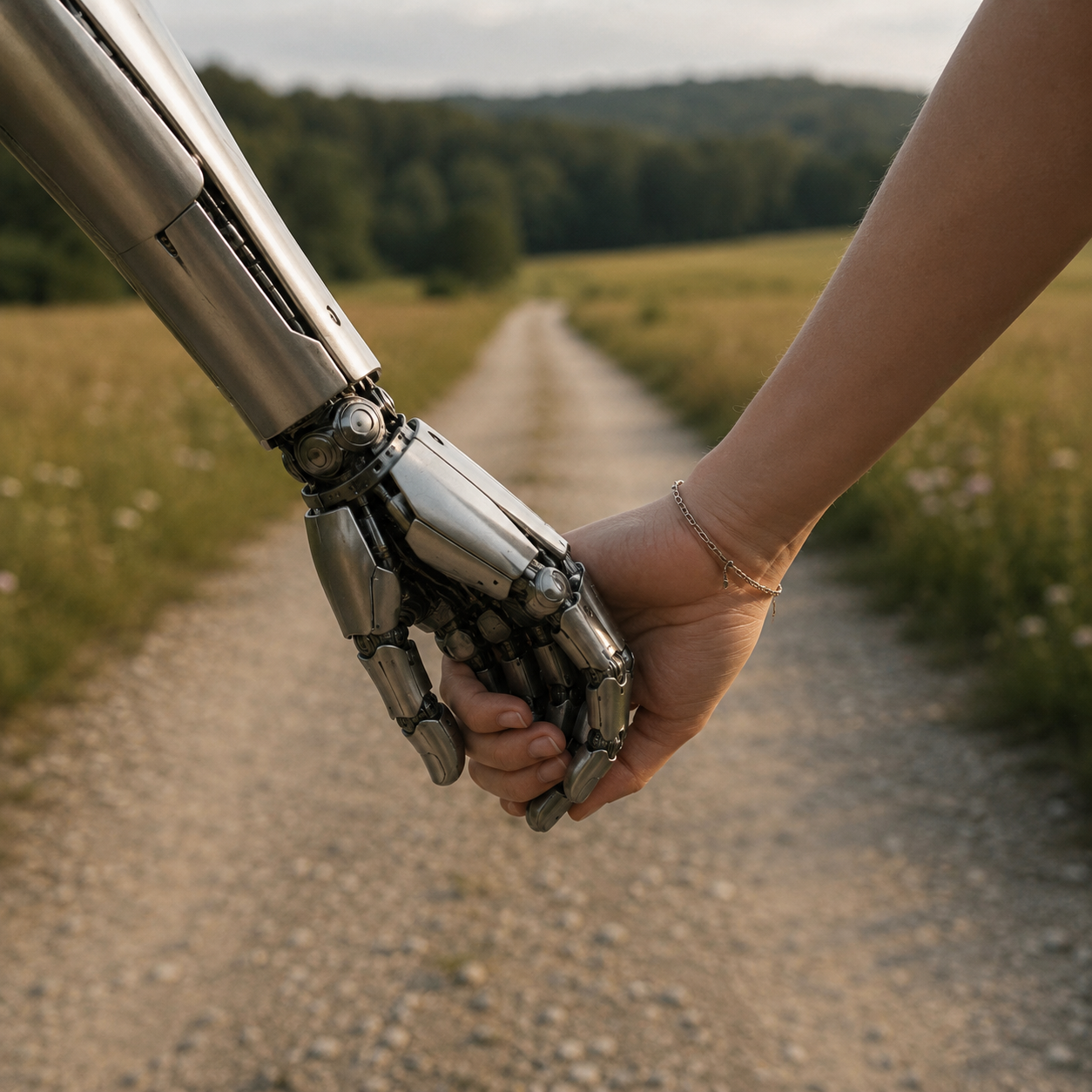
We do use AI to create images at times, such as the creepy one in the header of this reflection. And we use AI as a tool. And now we are offering an AI tool for you to use.
Over the past six years, Souls & Hearts has created more than 800 podcasts, reflections, columns, and other content focused on helping you love yourself in an ordered way in order to better love God and neighbor. We are excited to announce that we are releasing an AI Archive Assistant tool to help you find the content you need more quickly and efficiently. Learn how it works in this brief 3-minute tutorial video and access our AI Archive Assistant here to try it out.
Did someone forward you this email?
If you’d like to receive our weekly emails right in your inbox, subscribe to our email mailings.
Upcoming offerings just for Catholic formators
We have two great offerings for you. First, our second in-person retreat is filling up and will be held August 10-13, 2026 in Bloomington, IN. The theme this year is Authentic Being and Authentic Relating. Check out all the details here.
Second, both our Foundations Experiential Groups (FEGs) and our Advanced Formation Groups (AFGs) are open for registration. Sessions will begin at the end of August and early September. I'll be leading one FEG and one AFG focused on "Relating Wholeheartedly with God in Prayer." Two other FEGs are available on other days and times, led by IFS-trained colleagues, as well as an AFG led by David Edwards entitled "Love One Another." Check out the details.
Scripture for Your Inner Outcasts
In today’s episode of Scripture for Your Inner Outcasts, I explain how Jesus’ disciplines are his “little ones” and some of his most loved. And in yesterday’s episode from the 15th Sunday in Ordinary Time, Dr. Gerry and I discuss how although the sufferings of the present time are as nothing, they don’t feel that way. Scripture for Your Inner Outcasts, to our knowledge, is the only podcast specifically for parts of us who are exiled and who feel alone, bringing light, love, and hope to our exiled parts. Check it out every day on our landing page or wherever you get your podcasts.