
Before I had discovered The Hobbit, there was Narnia. In 4th grade I feverishly made my way through all seven books, loving every moment. I was captivated by the British charm, the magical world, the engaging characters, and the beautifully crafted Christian allegory.
I later watched the charming 1979 Bill Melendez animated television version. And I recall the 1988 BBC “live action” version with grown men wearing giant beaver and badger outfits. I distinctly remember, for some reason, disliking Lucy, a character that should be beloved.
All in all, the BBC series was accurate to the books but, in my mind at the time, lacked charm. Years later, I was cautiously hopeful when Disney acquired the rights and began making Narnia movies. There is a great deal to commend about the Disney films, not least of which is the improved special effects, but to be honest, there was still something missing. Close, but not quite there.
Having said that, I still enjoyed the films immensely, and I highly recommend that you watch these (after you read the books, of course). As I re-watch them, I am impressed by the way the film brings in the most important Christian themes. After just more than 20 years, it holds up very well. And since last week was Holy Week, we should begin with the first film which creatively tells the story of the Paschal Mystery.
Into the wardrobe we go
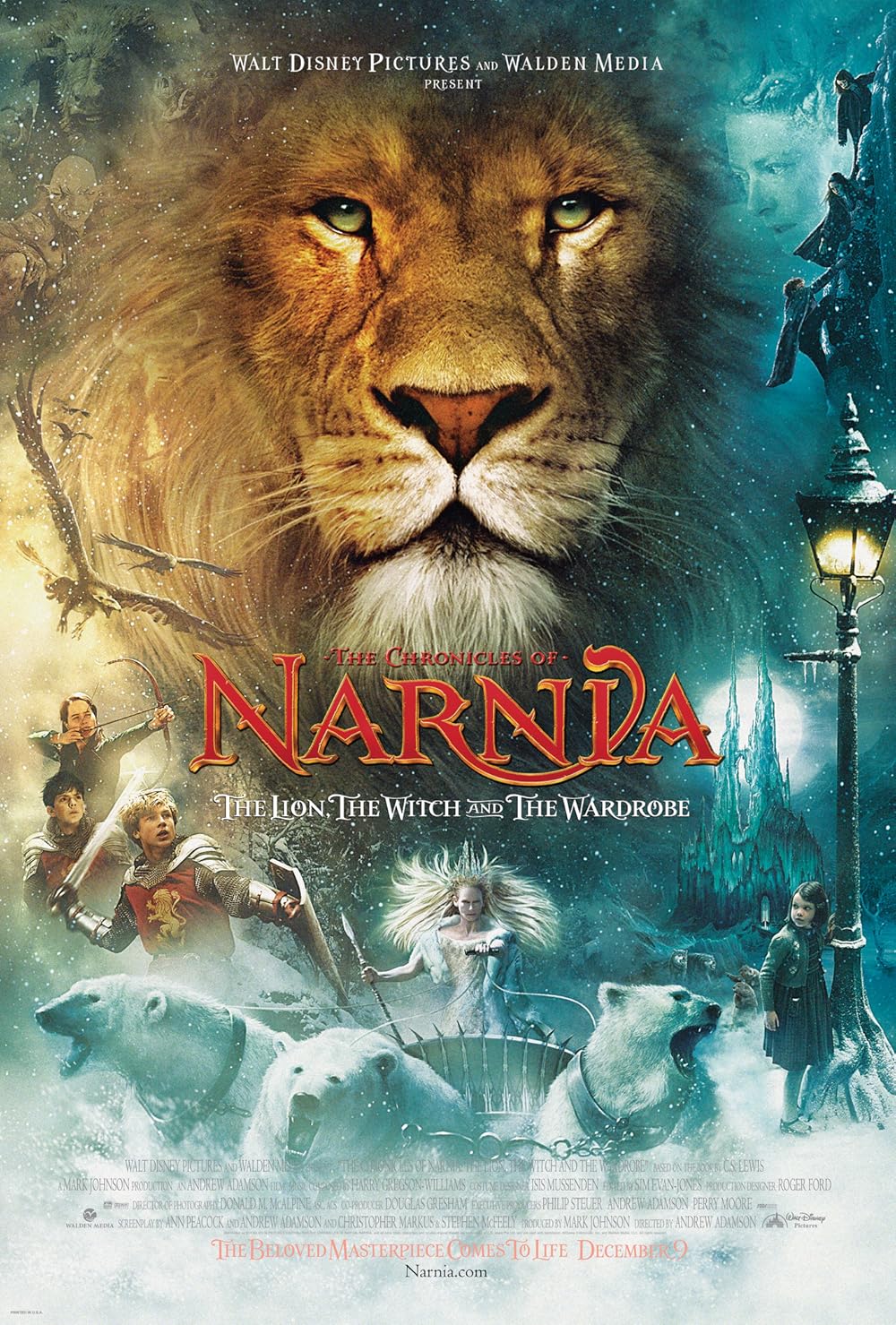
The Chronicles of Narnia: The Lion, the Witch and the Wardrobe is a 2005 Disney and Walden Media film, directed by Andrew Adamson, an adaptation of C.S. Lewis's beloved 1950 novel of the same name which is the second book in the Narnia series (though most readers encounter it first).
As a Catholic therapist and someone deeply invested in parts work and the interior life, I find this film, and indeed the entire Narnia mythos, to be extraordinarily rich territory. Lewis, of course, was not a Catholic but a committed Anglican, deeply influenced by Catholic thought through his friendship with J.R.R. Tolkien and his immersion in the broader Christian tradition. What he gave us in Narnia is nothing short of a theological and psychological masterwork dressed in the clothes of a children's fairy tale.
The film, perhaps like no other previous version, does capture the wonder of Lucy discovering Narnia and meeting Mr. Tumnus, the faun. Lewis captures the psychological depth of the human condition in the character of Tumnus. He initially lures Lucy to his home in order to hand her over to the White Witch, but then repents of his crime, reflects on his own father’s values and how he has failed, and chooses to save her instead. This comes at a great cost to him.
When he confesses his crime, Lucy exclaims, “Mr. Tumnus, you wouldn’t. I thought you were my friend.” His conscience kicks in and he takes her back saying, “I’m sorry. I’m so sorry.” He then adds, “You have made me feel warmer than I have felt in a hundred years.” Doing the right thing comforts the soul. This sets the stage for a story about conscience, about doing the right thing, about fighting evil and restoring God’s kingdom.
A brief recap
For those who may need a refresher: the story takes place during World War II. Four siblings, Peter, Susan, Edmund, and Lucy Pevensie, are evacuated from London to the English countryside to stay with the eccentric Professor Digory Kirke.
While exploring his sprawling manor, young Lucy discovers that a wardrobe in a spare room is a portal to another world: Narnia is a magical land currently gripped in an eternal winter imposed by the White Witch, Jadis, who has usurped the throne and declared that it shall always be winter but never Christmas.
Lucy returns and tells her siblings. Edmund, the second-youngest brother, is dismissive and unkind. But he too eventually stumbles into Narnia alone where he encounters the White Witch herself. She gives him enchanted Turkish Delight that creates an insatiable craving for more, and she promises him power and dominion over his siblings if he will bring them to her. Edmund agrees. When all four children finally enter Narnia together, Edmund secretly works against his family to fulfill his bargain with the Witch.
Through the guidance of the talking beavers, the children learn of a prophecy: that four human children, sons of Adam and daughters of Eve, will sit on the four thrones at Cair Paravel and bring the reign of the White Witch to an end. They also learn of Aslan, the great Lion, the true King of Narnia, who is "on the move" again after a long absence. Edmund slips away to betray his siblings to the Witch. The others, with the Beavers, make a difficult journey to find Aslan.
Aslan, in one of the most powerful sequences in all of Christian allegorical literature, offers himself to the White Witch as a sacrifice in Edmund's place, invoking what he calls the "Deep Magic." The Witch and her forces bind and kill him on the Stone Table.
But the "Deeper Magic from before the Dawn of Time," a law the Witch did not know, decrees that a willing, innocent sacrifice made in another's place will break the power of death itself. Aslan rises. The Stone Table cracks. Aslan rushes to the Witch's castle, breathes life back into her stone prisoners, and joins the battle.
Peter leads the army of Narnia. Edmund, redeemed, destroys the Witch's wand. Aslan kills Jadis. The children are crowned Kings and Queens at Cair Paravel and reign for many years until they stumble back through the wardrobe and find themselves children again in the Professor's house once more with no time having passed at all.
It is a story of betrayal and redemption, of courage and sacrifice, of exile and homecoming. It is the Gospel story, the Passion and Resurrection of Christ, and the story of our redemption told through a lion and four British children with dirt on their shoes.
The theological heartbeat
Let me begin with Aslan where Lewis himself would perhaps want us to begin.
Aslan is the Christ figure at the center of Narnia, and Lewis was transparent about this. He did not want Aslan to be a mere symbol. He wanted children, and adults, to encounter the Lion and feel something they might not be able to feel if they were simply told "this is Jesus."
He was writing what he called "supposal" which is not allegory in the strict sense, but an imaginative exploration of what it might look like if the Son of God entered a world like Narnia in the form that world would recognize. The result is one of the most emotionally and spiritually powerful Christ-images in Western literature.
The film handles this well. Liam Neeson's voice performance as Aslan is dignified, warm, and carries an unmistakable weight. When Aslan walks across a field, you feel something shift. When he speaks, you lean in. The filmmakers wisely do not over-explain him. He is allowed to simply be, majestic, gentle, and terrifying in the best sense of the word. As Mr. Beaver says, “Aslan is not a tame lion.”
From a Catholic perspective, Aslan's sacrifice at the Stone Table is one of the most theologically precise depictions of substitutionary atonement and sacrificial love in popular cinema. Lewis understood the Atonement not as a transaction to satisfy an angry and violent God, but as a deeper law, a voluntary offering of Love itself, overcoming Death itself.
This is entirely consonant with the Catholic understanding of Christ's Paschal Mystery. The White Witch believes she has won when Aslan lays down on the Stone Table. She is wrong. She does not know the Deeper Magic. Evil, at its core, never does.
It is worth noting that in the book, Lucy and Susan keep vigil with Aslan through the night before his death. Lewis writes this with devastating tenderness. The film captures it with genuine emotional restraint, the two girls stroking Aslan's mane, weeping, and then witnessing the crack of the Stone Table at dawn.
This is Calvary and Easter Morning compressed into one seamless image. It is the kind of scene that can open a child's heart to the Gospel before their mind has a category for it. In the Byzantine Church many do an overnight vigil in the church after the Good Friday Entombment Vespers. We mourn and accompany Christ in death, like Susan and Lucy did with Aslan, as we sing psalms and meditate on His death and descent into Hades before the Resurrection.
Four children, four parts
Now let us enter the psychological wardrobe because this is where things get very interesting indeed.
From a parts work perspective, I am struck repeatedly by the way Lewis's four Pevensie children function almost as a complete inner system. They are, in the outer narrative, four distinct personalities. But they also map beautifully onto the kinds of parts we encounter in the interior world of a human person.
Lucy is the youngest and the one who first discovers the wardrobe. She is the one who knows intuitively, immediately, without needing to reason her way to the truth. In IFS terms, Lucy functions most naturally in proximity to what we call the inmost self, the compassionate spiritual center of the person.
She has an open heart, genuine curiosity, a willingness to trust, and an absence of the defensive layers that protect the older children. When she returns from Narnia the first time, full of wonder and excitement, and no one believes her, she is wounded but she does not lose her knowing. She holds onto what is real even when she is made to feel foolish for it.
Lewis loved Lucy. In later Narnia books, she is the one who sees Aslan when no one else can. She is the one who asks the questions that matter. She is, I would argue, Lewis's portrait of the soul in its most undistorted form, the core of us that still knows God, still longs for Home, still recognizes Truth when it walks through the door, or through the wardrobe.
Edmund is the most psychologically complex of the four children and, frankly, the most important figure in the film from a therapeutic perspective. Edmund is a wounded child. We learn almost immediately that he carries deep resentment, of Peter especially, but also of his situation. He is biting, sarcastic, and dismissive.
He mocks Lucy. When he knows Narnia is true, he still works against her, “I was just playing along… I shouldn’t have encouraged her.” Later, when all four children make it to Narnia, he betrays his family and seeks out the White Witch. In IFS terms, Edmund presents as a system dominated by protective parts, specifically, what we would recognize as a combination of Managers (his cynicism, his need for control and superiority) and a prominent Firefighter (his impulsive betrayal, his willingness to blow up the system to get what he wants).
But beneath the protective parts is an Exile, a deeply lonely, overlooked, hurting child. The White Witch doesn't have to work very hard with Edmund. She simply offers him what his wounded inner child has always craved: to be seen, to be chosen, to be first, to be powerful rather than diminished.
The Turkish Delight is the perfect symbol for the kind of false comfort that Firefighter parts seek which is sweet, immediately gratifying, ultimately addictive and hollow, leaving you emptier and more desperate than before.
From an attachment theory perspective, Edmund's behavior is entirely consistent with what we might expect from a child with a disorganized or anxious-avoidant attachment pattern. He has learned that closeness leads to hurt, perhaps especially with Peter, who has perhaps been given the role of surrogate father in their father's absence (their father is away at war). His solution is preemptive detachment and aggression.
The White Witch, tragically, offers him a seductive counterfeit of secure attachment. She "sees" him, she "chooses" him, she offers him a special place. She “grooms” him. Abuse and neglect so often wear the mask of specialness at the start.
What moves me every time I return to this story is Edmund's redemption arc. He is not simply rescued. He is seen, by Aslan, who speaks with him privately after his rescue. We are not told what Aslan says. Lewis explicitly tells us, in the book, that it is no one else's business.
This is a moment of profound therapeutic wisdom disguised as narrative restraint. Healing is intimate. The conversation between a wounded soul and Love itself is sacred and private. What we see afterward is a changed Edmund, not perfect, but no longer driven by the same wound.
Aslan says to the group, “What is done, is done. No need to speak to Edmund about what is past.” This is the story of our redemption. God no longer holds our sins against us. We are to move forward. Lucy hugs Edmund and all is forgiven. Later, with this new-found confidence, Edmund destroys the Witch's wand at great personal cost in the final battle. He acts for others rather than for himself. The exile has been tended to. The protective parts no longer need to run the system.
Peter is the eldest and the one burdened with leadership he does not feel ready for. As the children head out, his mother tells him, “Promise me you’ll look after the others.” He is the reluctant hero, a type we encounter often in Scripture and in literature.
He is not initially admirable. He is dismissive of Lucy, impatient with Edmund, and visibly anxious about what is being asked of him. In IFS terms, Peter presents as a system heavily managed by a protective Manager part, the responsible one, the one who holds it all together, who must appear competent even when he is terrified. He carries the burden of the firstborn.
Aslan does something remarkable with Peter. He does not simply tell Peter what to do. He calls out what is already in Peter. Aslan does not intervene when Peter fights the wolf because he knows this will build Peter’s confidence. Aslan is a mirror, not of what Peter fears he is (weak, unready), but of what Peter actually is when his inmost self is in the lead rather than his anxious protectors.
A powerful moment in the film occurs, after Aslan’s death when Peter has to lead the army and Edmund tells Peter, “Aslan believed in you and so do I.” Peter, the reluctant hero, becomes a true warrior.
Aslan later dubs him, “Sir Peter Wolfsbane, Knight of Narnia.”
There is a scene in the book, not captured quite as powerfully in the film, where Aslan breathes on the stone prisoners in the Witch's castle. This breath (nephesh, ruach, pneuma) is unmistakably the breath of life that God breathes into Adam, the same breath of the Holy Spirit breathed by the Risen Christ on his disciples.
Lewis was a careful theologian. He was also a man who had spent years as an atheist and knew intimately what it was to be a stone statue, alive on the outside, frozen on the inside.
Susan is the most difficult Pevensie to write about, and she becomes more so as the series continues (in The Last Battle, she is notably absent from the ultimate reunion in Aslan's Country, Lewis's controversial portrayal of a soul that traded the transcendent for the temporal).
In the first film and book, Susan functions as a cautious, pragmatic Manager, the voice of reason, the one who hesitates, who needs evidence, who is slow to trust. She is not faithless. But she is afraid, and her fear governs her more than she knows. She is the child who needs to understand before she can trust, which is not entirely a weakness, but becomes one when it calcifies into a refusal to be moved.
The White Witch and the tyranny of the inner critic
Tilda Swinton's White Witch is one of the great screen villains precisely because she does not feel like a villain in the conventional sense. She is cold, yes, but she is also composed, deliberate, and, in her own way, orderly. She has built an entire world organized around her own need for control and the suppression of joy.
Narnia under her reign is a world without Christmas, which is to say, a world from which gift, surprise, warmth, and the arrival of the Incarnate God have been systematically excluded.
In parts work terms, the White Witch is the ultimate Inner Critic, or more precisely, the ultimate protector-gone-rogue, a part that has seized control of the entire inner kingdom and declared itself ruler.
Her magic turns living things to stone. This is precisely what the Inner Critic does: it petrifies. It takes the living, moving, breathing parts of the self-system and freezes them in postures of shame and defeat. The castle is full of stone statues: former rebels, former revelers, anyone who dared to live freely. Any therapist who has worked with a client dominated by a severe Inner Critic will recognize this landscape immediately.
She is also, notably, a counterfeiter. She offers Edmund not real love but a simulation of love. She offers not real power but the shadow of it. She rules not through genuine authority, the kind that flows from truth and goodness, but through fear and enchantment. This is always the nature of a burdened part and its protective systems: they offer us safety that is not safety, significance that is not significance, and love that is not love.
And yet, and this is important, the Witch is not Aslan's opposite in the way we might naively think. Lewis is careful about this. She does not oppose Aslan with equal and opposite power. She invokes the Deep Magic, the law of sacrifice and death, because she believes it is on her side. She is wrong, but she is not wrong that the law exists. She says, “Every traitor belongs to me. His blood is my property… that boy will die on the stone table as is tradition.” Aslan talks with her alone and makes the deal.
Later Aslan enters the enemy camp in a harrowing scene with all the demons and evil creatures rejoicing. He is willing to die for one human. Evil has its day as Lucy and Susan watch from a distance in horror. Aslan is mocked, bound, and shaved. The White Witch exclaims, “You are giving your life and saving no one, so much for love. We will take Narnia forever!”
The Lion makes eye contact with Lucy and Susan just before the White Witch stabs him, killing him. Lucy and Susan visit his dead body on the table. Lucy pulls out her healing vial but Susan says, “It’s too late. He’s gone.”
What the White Witch does not know is that Aslan is not subject to the law in the way she assumes. Love, it turns out, is not bound by the law of death. This is the Paschal Mystery in miniature.
“When a willing victim who has committed no treachery is killed in a traitor’s stead, the stone table is cracked and even death itself is turned backwards.”
When Aslan returns the Witch exclaims, “Impossible!” as all the previously “dead” or “stoned” creatures return. Aslan jumps her before she kills Peter and he states, “It is finished,” the very words of Jesus on the cross.
The true dignity of each human is restored: Queen Lucy, the Valiant; King Edmund, the Just; Queen Susan, the Gentle; and King Peter, the Magnificent. Through the Resurrection, we are restored to our true Good, our true identities in Christ.
Exile and longing: the theological ache of Narnia
One of the things Lewis understood with extraordinary depth, better, perhaps, than almost any other Christian writer of the twentieth century was the phenomenon he called Sehnsucht: the German word for a deep, inconsolable longing. He wrote about it at length in Surprised by Joy, his spiritual autobiography.
He knew this longing from childhood, a piercing, bittersweet ache triggered by beauty, by music, by certain landscapes, by stories that seemed to point beyond itself to something that could not be fully named or grasped.
In Mere Christianity, he writes: "If I find in myself a desire which no experience in this world can satisfy, the most probable explanation is that I was made for another world."
Narnia is built on this longing. It is the longing of the Exile, the part that remembers a home it has never visited, that aches for a belonging it has not yet found. When the children step through the wardrobe into the snow and the lamppost light, something in the viewer recognizes that landscape. Not because we have been there, but because something in us has always been homesick for it.
This is, I believe, the deepest theological function of the Narnia stories. Lewis is not merely telling us about Aslan. He is doing something far more subversive: he is awakening in the reader the very capacity for longing, the spiritual ache that, once stirred, seeks its proper object. He is preparing the heart before the mind has time to object. Perhaps with a child-like innocence, my 4th-grade-self apprehended this truth as I eagerly worked my way through the Narnia books.
For those of us who work with parts, this is deeply significant. My own 4th-grade-Exile part, the wounded, hidden, longing part of me, is not merely a collection of pain. He also carried, buried beneath the pain, the original longing: to be known, to be loved, to belong, to come home. When we do parts work, we are not merely healing wounds. We are, in a sense, leading our Exiles back through the wardrobe, back toward the belonging they always knew existed, even when everything in their experience told them otherwise.
A few criticisms
In the spirit of honest review, I should note where I think the film falls short, not catastrophically, but meaningfully.
The film, for all its beauty, is somewhat flatter emotionally than the book, especially in the last 30 or so minutes. The battle sequence is competently staged but feels more like an obligation than an inevitability.
The book's battle is brief and almost incidental; the real climax has already happened at the Stone Table. The film, shaped by the conventions of modern blockbuster filmmaking, lingers longer in the battle than the story needs.
More significantly: the film does not fully capture the intimacy of Lewis's prose. Lewis writes to his readers directly, warmly, and personally. His narrator is a presence in the book. The film, by necessity, loses this. What we gain in visual spectacle, we sometimes lose in interior warmth.
And while Liam Neeson's Aslan is genuinely moving, the film is cautious about allowing him to be fully what he is in the book which is, at moments, absolutely terrifying in his goodness. Lewis is explicit: Aslan is not safe. But he is good. The film gives us the goodness but softens the “not-safe.”
This matters theologically and psychologically. A God who is only comfortable is not God. A love that never disturbs is not Love. Aslan, at his best, is the kind of presence that breaks you open before he puts you back together and the film is perhaps a touch too careful to let him do that fully.
Final thoughts
The Chronicles of Narnia: The Lion, the Witch and the Wardrobe is a film and, even more, a book that I recommend without reservation to anyone doing serious inner work. It is a story about what happens when God, the Love at the center of all things, re-enters a world that has been frozen by false protection and counterfeit power.
It is a story about exile and return, about betrayal and forgiveness, about the courage required to follow what you know is true even when no one believes you.
Edmund is every one of our wounded parts, bargaining with the wrong power for the wrong promises. Lucy is the part of us that still knows the wardrobe is real, that still knocks on the back of it even when it's become ordinary wood. Peter is the part of us that is braver than we feel. And Aslan is not our invention. He is not a projection or a metaphor or a coping mechanism. He is, Lewis insists, the One toward whom every longing, every ache, every deep wound, and every moment of grace has always been pointing.
The wardrobe is always there. The only question is whether we are willing to step through.
###
Dr. Gerry Crete is the author of Litanies of the Heart: Relieving Post-traumatic Stress and Calming Anxiety Through Healing Our Parts which is published by Sophia Institute Press. He is the founder of Transfiguration Counseling and Coaching, Transfiguration Life, and co-founder of Souls and Hearts.
Dr. Gerry on the panel for Interior Integration for Catholics episode 181
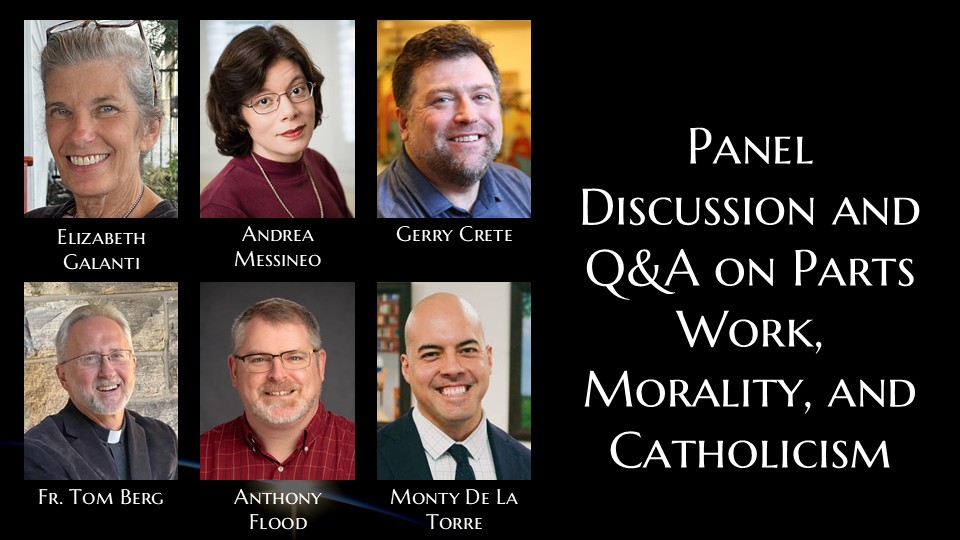
In IIC episode 181, titled Roundtable Discussion: Catholic Philosophers and Therapists Take On the Tough Questions about IFS and Catholicism, our dear Dr. Gerry joins three other Catholic therapists and four Catholic philosophers.
These professionals take on the most frequently asked metaphysical questions about grounding Internal Family Systems in a Catholic worldview.
Join Elizabeth Galanti, Dr. Anthony Flood, Dr. Andrea Messineo, Dr. Gerry Crete, Dr. Monty De La Torre, Fr. Thomas Berg, and Dr. Peter Malinoski for a spirited discussion of:
- The relationship between IFS and the Catholic Church
- Problems with the IFS conceptualization of “Self’
- The importance of the Catholic IFS clinician staying true to the teachings of the Church
- Distinguishing between parts and demons in IFS work
- How can we prevent parts work from opening the door to demons?
- What does it mean to say that all parts are good?
- How does ordered self-love differ from selfishness?
- Is there a danger of creating an endless nesting of parts within parts within parts, an “infinite regress” of parts?
- How does the Catholic understanding of conscience relate to parts in IFS?
Dr. Gerry’s new hymn “His Work of Art” just released
Dr. Gerry and his group Pateras Agape just released His Work of Art, a parts-based musical reflection on the beauty of the human person.
New Scripture for Your Inner Outcasts episodes here
In today's episode of Scripture for Your Inner Outcasts, Dr. Gerry reflects on how Mary Magdalene feels the pain of our exiles as well as the joy of re-integration with Christ on this Easter Monday. You can also check out yesterday’s episode from Easter Sunday as Dr. Peter and Dr. Gerry discuss how our Jesus goes to the depths of hell to bring our exiles home, making them the cornerstones of our systems. Scripture for Your Inner Outcasts, to our knowledge, is the only podcast specifically for parts of us who are exiled and who feel alone, bringing light, love, and hope to our exiled parts. Check it out every day on our landing page or wherever you get your podcasts and share it with those you think it might help.
Get on the Resilient Catholics Community interest list for the St. Mary Magdelene Cohort
Interested in greater interior integration? The Resilient Catholics Community (RCC) is where a community of faithful Catholics focus on learning about parts and systems thinking, grounded in a Catholic anthropology to overcome human formation deficits.
Find out more and to join the interest list for our 13th cohort under the patronage of St. Mary Magdalene, visit the RCC landing page. Although we’ll open formal registration on June 1, there is still a possibility to “fast track” into the St. Luke’s cohort if your schedule aligns with groups that are forming now. Programming for the St. Luke cohort will begin in May 2026.
Catholic formators (therapists, coaches, spiritual directors, priests, etc.) come on retreat with us!
Consider joining us for our 2026 retreat, an opportunity for formators (therapists, coaches, spiritual directors, priests, any Catholic who accompanies others in formation) to make a leap forward in your human formation work.
This retreat focuses on you finding and loving you in more of your parts, including parts you have not yet encountered – your exiles – and for those parts you have met, but who your manager parts frequently forget. And, we focus on how your parts can help you “be with” others in formation in ways that lead to healing and flourishing.
We'll be meeting August 10-13, 2026, in Bloomington, Indiana, at the lovely Mother of the Redeemer Retreat Center. Get the details in our flyer or on our landing page. You do not need to be a member of the Formation for Formators community, our online community of Catholic formators, to go on retreat.
While you're waiting, you may be interested in our free workshop, titled Catholic Parts Work in Human Formation , which will be held on June 10, 2026 from 8:00 PM to 9:30 PM Eastern time. Details are in this downloadable PDF. Registration is free, but required.
Sign up for weekly emails
If you love our content, sign up to receive not only Dr. Gerry's monthly Parting Thoughts, but also his monthly Kingdom Within columns. In the weeks between, you'll receive semi-monthly reflections from Dr. Peter Malinoski. You'll hear from us each Monday with one of these offerings, all focused on learning more about Internal Family Systems from a Catholic understanding of the human person.