
In 2008 the St. Paul Center for Biblical Theology published Temple and Contemplation: God's Presence in the Cosmos, Church, and Human Heart, which was edited by Scott Hahn and part of the Letter & Spirit series of books.
In this volume, a remarkable group of biblical theologians and patristic scholars made a sustained case that the Temple is not merely an ancient building in Jerusalem. It is a cosmic reality, a sacramental reality, and a human reality. The Temple, they argue, finds its ultimate fulfillment not just in stone or ritual, but in the human heart itself.
Now, when I read that, my philosopher part, my theologian part, and my therapist part lit up inside me, but so did my inmost self! Because if the human person is truly a temple, a dwelling place for the Divine, then what happens inside that temple matters enormously. The architecture of the inner life, the rooms and corridors of the self-system, the guardians at the gates, the hidden chambers where old wounds live, all of it is sacred ground.
So, let us walk into this together, slowly, with curiosity and with reverence.
The temple as interior architecture
Gary Anderson, in his essay "To See Where God Dwells: The Tabernacle, the Temple, and the Origins of the Christian Mystical Tradition," traces a beautiful line from the ancient Tabernacle through the Jerusalem Temple to the interior life of the Christian mystic.
The Tabernacle in the wilderness was not merely a portable sanctuary; it was a microcosm of creation, a place where heaven touched earth, and where God consented to dwell among His people. Anderson shows how this tradition of divine dwelling evolved through Israel's history and eventually was internalized in Christian mystical theology: the dwelling place of God is ultimately within the human person.
Thomas Dubay, S.M., picks up this thread in his essay "The Indwelling of Divine Love: The Revelation of God's Abiding Presence in the Human Heart." Drawing on both Scripture and the mystical tradition, Dubay argues that the human heart is not merely analogous to the Temple, it is the Temple, the locus of the Trinitarian indwelling that begins at baptism and deepens through contemplative prayer and love.
This is breathtaking. And for those of us who work with Internal Family Systems (IFS) or Ego State Therapy, it raises a profound and clinically rich question:
If the human heart (i.e. the self-system) is a temple, what is happening in the inner rooms of that temple? And what does healing look like when we understand ourselves as sacred dwelling places?
The self-system as sacred architecture
In IFS, Richard Schwartz describes what he calls the "Self" as a core, undamaged, spiritually luminous center of the person from which the qualities of compassion, calm, creativity, confidence, clarity, curiosity, connection, and courage naturally flow. Surrounding this “Self” are "parts,” subpersonalities that have taken on various roles in the psyche, often in response to early wounds or threats.
Some parts become protectors which includes managers who try to keep the system functional and organized, and firefighters who react impulsively to extinguish emotional pain. Others, the exiles, are parts that carry the original wounds themselves, holding the pain, shame, fear, and grief that the system has deemed too dangerous to feel.
Ego State Therapy, developed by Helen and John Watkins (1997) and later elaborated by scholars like Robin Shapiro (2016), offers a compatible model: the psyche is composed of ego states which are coherent patterns of feeling, thought, and behavior organized around particular experiences or developmental periods. They exist in varying degrees of harmony or conflict with one another.
What strikes me is how this maps beautifully, and not accidentally, onto the architecture of the Temple itself.
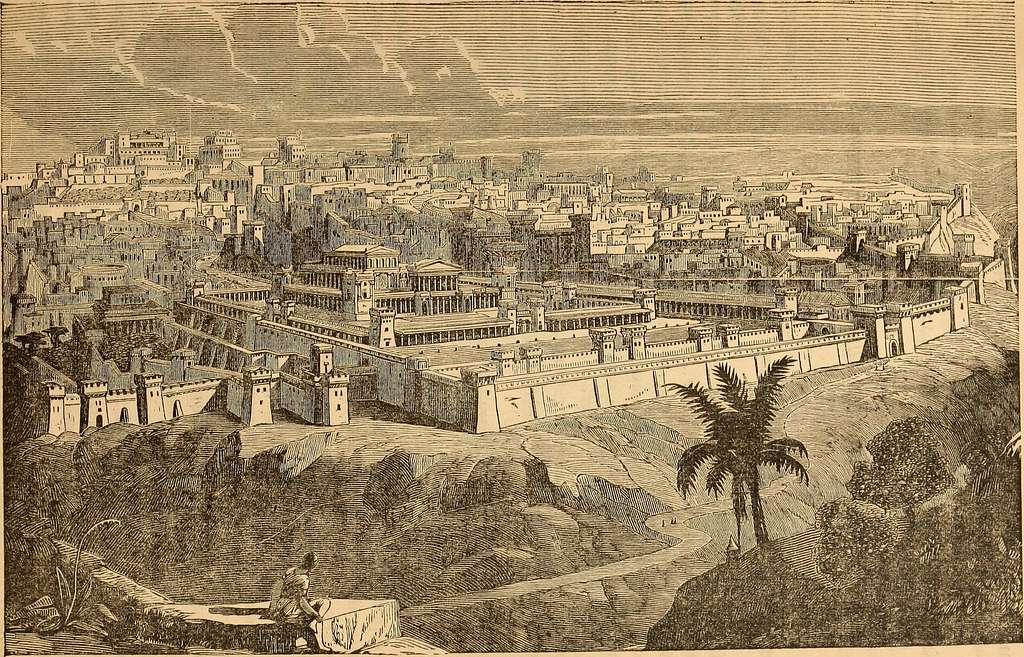
The Jerusalem Temple was not a single open room. It was structured in concentric zones of increasing holiness. Brent Pitre in his article, “Jesus, the New Temple, and the New Priesthood,” describes the many parts of the Temple beginning with the outer Court of the Gentiles which was accessible to all. It was a busy, transactional place of commerce and encounter.
Moving inward was the Court of the Women, followed by the Court of Israel, the Court of the Priests, the Holy Place, and finally, innermost of all was the Holy of Holies, the Devir, the inner sanctuary where the Ark of the Covenant rested and where God's presence, the Shekinah, dwelled in particular intensity.
The outer courts were accessible and active. The inner sanctuary was protected and set apart. It could only be approached with great care and preparation. Between these zones stood barriers, veils, walls, and boundaries that regulated who could approach and how.
Does this not describe the human interior with remarkable accuracy?
The outermost parts of ourselves, our social persona, and our public-facing managers are the outer courts. They are the parts of us that conduct the commerce of daily life, that interact with the world and manage impressions and relationships. They are not false; they are genuinely part of us but they are not the whole of us.
Moving inward, we encounter the more vulnerable layers: the parts that carry our deeper longings, our relational wounds, and our grief and shame. These are the inner chambers, more carefully guarded, and less easily accessed.
And at the very center, if we have the courage and the grace to enter, is what I would call the inmost self: what the mystical tradition calls the apex mentis or the scintilla animae: the spark of the soul where the Divine dwells.
John Bergsma's contribution to the volume, which traces the priestly and Temple imagery in the New Testament, reminds us that in the new covenant, it is Christ who tears the Temple veil from top to bottom (Matthew 27:51) and this opens access to the Holy of Holies, which is the innermost sanctuary providing access to the very heart of God. In psychological language, Christ's redemptive work opens the way to the inmost self as it tears the veil that trauma, shame, and sin have drawn across our deepest interior.
This is not merely a pious metaphor. It is a clinical reality for those of us who sit with people in pain.
When the temple becomes a fortress: protective parts and blocked access
Here is where it gets very personal and very practical.
In attachment theory, we know that early experiences of attunement, or its absence, shape the developing child's internal working models of self, other, and the world (according to Bowlby, Ainsworth and others).
When a child experiences consistent, warm, responsive caregiving, they develop what we call secure attachment: an internal sense of worthiness and an expectation that relationships are safe. But when caregiving is inconsistent, frightening, or neglectful, the child's nervous system and psyche adapt. Protective strategies emerge. The inner self becomes armored.
In IFS terms, these protective adaptations take on the roles of manager and/or firefighter parts and they are not enemies. They are loyal, often exhausted servants who learned early that the innermost self had to be protected at all costs. They drew their own veils across the inner sanctuary.
And here is the deep irony that both the Temple theology of Temple and Contemplation and our clinical work illuminate: the very protections that were necessary for survival can become the barriers to encounter with the Divine presence within.
The Temple veil was holy. It was meant to mark the sacred boundary between the profane and the holy. But it was never meant to be permanent. It was never meant to keep the High Priest out forever. It was designed for a particular moment in salvation history, and a moment that Christ's coming brought to its appointed end.
In the same way, the protective parts of the self-system are not evil. They are not the enemy. They deserve our gratitude and our compassion. But they adopt temporary measures that point beyond themselves to something more. As healing deepens, as trust is established in the therapeutic relationship and in the relationship with God, these parts can relax their vigilance. The veil can be drawn back. The inmost self can be accessed.
Thomas Dubay puts it this way: "The indwelling of the Trinity in the soul in grace is not merely a theological abstraction... it is the very ground of the mystical life, the inexhaustible source of interior transformation" (Dubay, p. 195). The Divine presence is already there. The work of healing, whether psychological or spiritual, is the work of clearing the path to what is already, inescapably home.
A moment of personal recollection
Before we go further, I want to invite you to pause.
Take a breath. Let the business of the day recede just a bit.
I want you to imagine the architecture of your own interior. Not with judgment, not with the pressure to "fix" anything, but just with gentle curiosity.
Can you notice the outer courts; the parts of you that manage the world, that show up for work, that hold things together? Can you offer them a simple acknowledgment? Thank you. I see you. You work so hard.
Can you sense, somewhere deeper, the parts that carry older things: old fears, old hurts, old stories about who you are and whether you are lovable? Can you be with them for a moment, not to solve them, but simply to let them know they are not alone?
And can you, even for a moment, turn your attention toward the very center, toward that inmost place, that Holy of Holies within you, and consider that God is already there? That He has always been there? That no wound, no sin, no failure, no accumulation of shame has ever extinguished the Image of God at the core of your being?
St. Paul wrote, "Do you not know that your body is a temple of the Holy Spirit within you, which you have from God, and that you are not your own?" (1 Corinthians 6:19).
This is not an abstraction. This is your life. This is your interior. This is the ground of your healing.
Coming up in part two
Join me next month in our next installment where we will go deeper into the Temple imagery in the Gospel of John and Paul's letters to Corinth and explore how the biblical vision of holiness as wholeness maps onto our understanding of psychological integration.
We will look at what it means when Scott Hahn writes about the Temple as the meeting point of heaven and earth and how that vision transforms the way we understand the healing work we do with our parts.
We will also explore how the concept of defilement in Temple theology helps us understand the burden-bearing of exiled parts and how purification is not self-punishment but self-restoration.
Until then, be gentle with your inner temple. Walk its corridors with reverence. The God who made you has not left the building.
Christ is among us!
Dr. Gerry Crete is the author of Litanies of the Heart: Relieving Post-traumatic Stress and Calming Anxiety Through Healing Our Parts which is published by Sophia Institute Press. He is the founder of Transfiguration Counseling and Coaching, Transfiguration Life, and co-founder of Souls and Hearts.
References
Ainsworth, M. D. S., Blehar, M. C., Waters, E., & Wall, S. (1978). Patterns of attachment: A psychological study of the strange situation. Erlbaum.
Anderson, G. A. (2008). To see where God dwells: The Tabernacle, the Temple, and the origins of the Christian mystical tradition. In S. W. Hahn (Ed.), Temple and contemplation: God's presence in the cosmos, Church, and human heart (pp. 13–45). St. Paul Center for Biblical Theology/Emmaus Road Publishing.
Bowlby, J. (1988). A secure base: Parent-child attachment and healthy human development. Basic Books.
Catechism of the Catholic Church (2nd ed.). (1997). Libreria Editrice Vaticana.
Dubay, T. (2008). The indwelling of divine love: The revelation of God's abiding presence in the human heart. In S. W. Hahn (Ed.), Temple and contemplation: God's presence in the cosmos, Church, and human heart (pp. 183–214). St. Paul Center for Biblical Theology/Emmaus Road Publishing.
Pitre, B. (2008). Jesus, the new Temple, and the new priesthood. In S. W. Hahn (Ed.), Temple and contemplation: God's presence in the cosmos, Church, and human heart (pp. 47–83). St. Paul Center for Biblical Theology/Emmaus Road Publishing.
Schwartz, R. C., & Sweezy, M. (2020). Internal Family Systems Therapy (2nd ed.). Guilford Press.
Shapiro, R. (2016). Easy ego state interventions: Strategies for working with parts. W. W. Norton.
###
Dr. Gerry’s new podcast Post Traumatic Growth with the Elijah Institute
In this inaugural episode of Post-Traumatic Growth, Dr. Gerry introduces the podcast and its mission: to walk alongside those who have experienced trauma and discover what it means to grow through it. Dr. Gerry shares his own story as a survivor of childhood abuse and unpacks the Christian vision of suffering as a source of meaning, resilience, and transformation. If you've experienced something that shattered your sense of safety, your faith, or your understanding of yourself—this podcast was made for you.
Too often, conversations about trauma stop at survival. We're told to cope, to manage, to just get through. But what if there's something beyond getting through? What if the very wounds that brought you to your knees hold the seeds of a deeper, more grounded life than you had before?
That's the question at the heart of Post-Traumatic Growth. Drawing on decades of clinical experience and his own journey from crisis to flourishing, Dr. Crete introduces the Arc of Healing—a framework that maps the path from Crisis through Languishing, Surviving, and Thriving toward Flourishing. He also introduces the Bio-Psycho-Social-Spiritual-Moral model, a whole-person approach to healing that honors the complexity of what it means to be human: body, mind, relationships, soul, and conscience.
Dr. Gerry introduces IFS and discusses relationships and conflicts
Check out this recent video from this recent morning of reflection at St. Peter Chanel Catholic Church for an introduction to IFS with some experiential exercises.
Catholic therapists, coaches, spiritual directors, priests, and other formators – a retreat just for you!
Consider joining us for our 2026 retreat, an opportunity for formators (therapists, coaches, spiritual directors, priests, any Catholic who accompanies others in formation) to make a leap forward in your human formation work.
This retreat focuses on you finding and loving you in more of your parts, including parts you have not yet encountered – your exiles – and for those parts you have met, but who your manager parts frequently forget. And, we focus on how your parts can help you “be with” others in formation in ways that lead to healing and flourishing.
We'll be meeting August 10-13, 2026, in Bloomington, Indiana, at the lovely Mother of the Redeemer Retreat Center. Get the details in our flyer or on our landing page. You do not need to be a member of the Formation for Formators community, our online community of Catholic formators, to go on retreat.
While you're waiting, you may be interested in our free workshop, titled Catholic Parts Work in Human Formation , which will be held on June 10, 2026 from 8:00 PM to 9:30 PM Eastern time. Details are in this downloadable PDF. Registration is free, but required.
Scripture for Your Inner Outcasts with Dr. Gerry
In today's episode of Scripture for Your Inner Outcasts, Dr. Gerry reflects on how our exiles do not need to earn love and nourishment from God despite what our managers might believe. You can also check out yesterday’s episode from Good Shepherd Sunday as Dr. Peter and Dr. Gerry discuss how our exiles are called to be in relationship with our innermost selves and with God. Scripture for Your Inner Outcasts, to our knowledge, is the only podcast specifically for parts of us who are exiled and who feel alone, bringing light, love, and hope to our exiled parts. Check it out every day on our landing page or wherever you get your podcasts and share it with those you think it might help.