

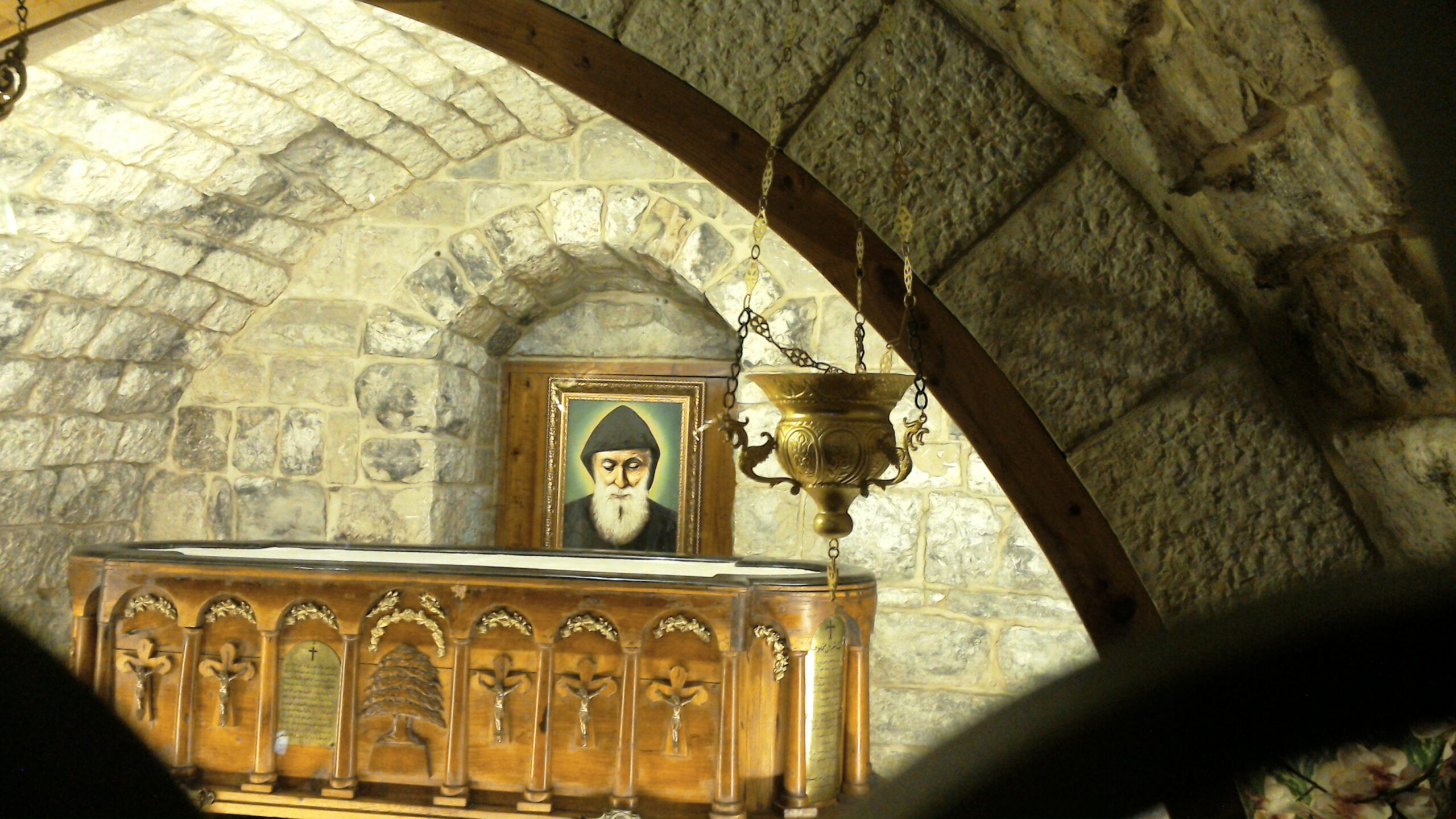
Saint Charbel Makhlouf (1828–1898) was a Lebanese Maronite monk and hermit who spent the last 23 years of his life in a small hermitage in the mountains of Lebanon at Annaya, eating almost nothing, sleeping on the floor, and spending his nights prostrate before the Blessed Sacrament. He was barely known during his lifetime. He left no writings of consequence. He performed no public ministry.
And yet today, his tomb is one of the most visited pilgrimage sites in the world. Thousands of documented physical, psychological, and spiritual healings have been reported by people of every faith background, including Muslims, atheists, and the religiously indifferent. Something in this man's life continues to radiate outward like light through the walls of a tomb.
He was canonized in 1977 by Pope Saint Paul VI and his feast day is July 24. He is known for his humility and is sometimes called the “hidden saint.” He is recorded as having said, “He who seeks to be seen by men will not be seen by God; he who seeks God in solitude will be found by him.” His also known to have said, “Prayer is the breath of the soul; without it, the heart suffocates.”
I find myself coming back to Saint Charbel again and again not just as a devotional figure, but as someone whose life holds an extraordinary mirror up to the interior work we do in parts work, trauma-informed care, and human flourishing. My instinct is that he lived a fully integrated interior life in a way that most of us can only glimpse in our best moments of prayer or therapy. And I want to explore what that might mean for us.
The cedar that grew in silence
Charbel was born Youssef Antoun Makhlouf in the mountain village of Beka-Kafra in northern Lebanon. He grew up in poverty, in a family of deep faith, shaped early by the witness of an uncle who had withdrawn from the world to live as a hermit monk. From childhood, Youssef was drawn to silence, to solitude, to something interior that the busy world around him could not satisfy.
At 23, he left his family home, but not before kneeling one final time before an icon of the Virgin Mary and walked toward the monastery of Saint Maron at Annaya. He took the religious name Charbel, after a second-century martyr of Antioch and he was ordained a priest in 1859. He lived the communal monastic life for 16 years before receiving permission to withdraw to the Hermitage of Saints Peter and Paul, a small structure a short walk from the monastery.
There, he would live for 23 years in what can only be described as radical interiority.
He died on Christmas Eve 1898, collapsing during the celebration of the Divine Liturgy, reportedly at the moment of consecration, holding the Eucharist in his hands. His body, examined after burial, was found to be incorrupt, supple, and luminous. Rather incredibly, witnesses said his body emitting a soft, persistent light. These phenomena were investigated by both religious and secular authorities and remain medically unexplained.
Lebanon's national symbol is the cedar tree, ancient, deeply rooted, unmoved by storms, a shelter for others. Charbel is the cedar. He is also, I want to suggest, a map.
What was he doing in there?
This is the question I keep returning to as both a therapist and a person of faith. What was actually happening in that hermitage for 23 years?
The easy answer is prayer. But I think that undersells it considerably. The more I sit with Charbel's life from a trauma-informed, parts-work perspective, the more I believe that what was happening in the hermitage was something like the most sustained, most complete process of interior integration in the modern historical record.
To be perfectly honest, what follows is a great deal of speculation on my part. I cannot say that I know about Saint Charbel’s interior integration, only that it seems fitting.
Those who knew him said, simply: "He became prayer." He did not practice prayer as an activity. His entire being including his body, his emotion, his memory, his will, and his imagination became a unified act of communion. There were no more competing agendas. No more fragmentation. No more exiled parts screaming from the basement or manager parts controlling the agenda from the front office.
I might be going out on a limb here, but I suggest he had, in the language of Internal Family Systems (IFS), achieved what Richard Schwartz calls self-leadership, not the erasure of his parts, but their full integration under the compassionate, clear, courageous guidance of the deepest center of his personhood.
And he had done it in relationship. Not in isolation from love, but in the most complete surrender to love imaginable.
Let me unpack what I mean.
Attachment, wounds, and the secure base
Before we can talk about what Charbel became, we need to talk about the human condition he started with. He started where we all start as a small child in need of love, safety, and connection.
John Bowlby taught us that human beings are hardwired for attachment. We are not born self-sufficient. We require not just food and shelter, but attunement which is the experience of being seen, known, soothed, and delighted in by a caring other.
When this attunement is consistent and responsive, children develop what Bowlby called secure attachment: an internal working model that says the world is basically safe, I am basically worthy of love, and others can basically be trusted.
When attunement is inconsistent, absent, frightening, or overwhelming, children develop insecure attachment patterns such as anxious preoccupation, avoidant dismissal, or the disorganized confusion of a child who both desperately needs and deeply fears the person they depend on.
Here is what matters most for our reflection on Charbel. Bowlby described the idealized attachment figure, as a potential secure base. And the emerging research on what is sometimes called "God attachment" (drawn from the work of scholars like Lee Kirkpatrick and others building on Bowlby) suggests that the quality of our relationship with God often mirrors and sometimes corrects our earliest human attachment patterns.
For many people, the God they pray to is unconsciously shaped by their relational wounds. An anxiously attached person may experience God as unpredictably present, here today, gone tomorrow, requiring constant performance to stay pleased.
An avoidantly attached person may experience God as distant and uninvolved, safely worshipped from a distance, never truly encountered. A person with disorganized attachment may experience God as both the only source of safety and the primary source of terror.
This is not theology. This is wound.
And what Charbel's life profoundly and beautifully suggests is that it is possible for the interior relationship with God to become a fully reparative attachment experience. Not by bypassing the wounds, but by bringing them, slowly and completely, into the presence of a love that is consistent, attuned, non-punishing, and utterly reliable.
His Eucharistic adoration was not pious performance. It was, I believe, the embodied practice of returning, again and again, to a secure base, bringing every frightened, lonely, yearning part of himself into the presence of the One who would never leave, never withdraw, never shame, never abandon.
Over 23 years, that rewires something very deep.
Parts work in the hermitage
Let me suggest something that might seem surprising: I think Saint Charbel was doing a form of parts work.
Not with a therapist. Not with a framework he could have named. But the substance of what the IFS model describes, the recognition of inner multiplicity, the movement toward self-leadership, and the unburdening of exiled and protective parts. I see all of this in the arc of his interior life.
Schwartz identified the self as the innate core of the person: the seat of compassion, curiosity, calm, courage, creativity, connectedness, clarity, and confidence. The self is not manufactured. It is discovered, gradually uncovered as the noise of burdened parts is quieted and their burdens released.
The Christian tradition says something remarkably similar. The imago Dei, the image of God stamped into the deepest center of every human being, is never fully destroyed by sin or wound. It is obscured but not erased. What the mystics call the scintilla animae (the spark of the soul), what the Eastern tradition calls the nous (the spiritual intellect or heart), what the Maronite tradition calls the cave of the heart, these are different names for the same reality that Schwartz calls the “Self” and I describe in Litanies of the Heart using Saint Paul’s language as the inmost self.
And Charbel's entire life was, in this sense, a sustained process of removing the obstacles to the inmost self that was always there: the self made in the image of God.
The ascetic life as a school for arts
Here is where I want to gently reframe something that is often misunderstood about the ascetic tradition. Charbel's fasting, his sleepless nights, his physical austerities are not acts of self-punishment. They are not the behavior of someone who hates himself or has contempt for his body.
They are, rather, acts of interior negotiation with parts.
In IFS terms, many of our most powerful parts are organized around the management of discomfort. We eat when we are not hungry because an anxious part needs soothing. We scroll endlessly because a lonely part is looking for connection. We fill silence with noise because an exiled part, if the room gets quiet enough, might begin to speak, and what it has to say feels unbearable.
I suspect that Charbel's fasting was not about destroying his appetite. It was about freeing himself from the compulsive grip of appetitive parts so that he could choose, from the center of his inmost self, how to live in his body. His vigils were not about punishing sleep. They were about discovering that the silence of the night, which so many of us fear, could become the space in which the deepest communion was possible.
This is what the tradition calls apatheia, not apathy, but holy indifference: the freedom of a person who is no longer driven by compulsion, who can engage with food, rest, comfort, and relationship without being controlled by them. It is the freedom of the person whose parts have been unburdened.
In IFS terms, Charbel was therefore not a person who had eliminated his parts. He was a person in whom every part had been restored to its rightful role, freed from its burden, and integrated under the leadership of the inmost self, which was itself fully united with God.
The hermitage as the space for unburdening exiles
IFS teaches that at the heart of most psychological suffering are exiled parts which are the young, wounded aspects of the self that carry unbearable burdens of shame, fear, grief, or longing. These exiles are typically kept locked away by protective manager parts, who would rather control, perform, and manage than risk the exile's pain erupting into consciousness.
The hermitage, I want to suggest, was Charbel's space for turning toward his exiles.
The silence of the hermitage is not the silence of suppression. It is the silence of radical attentiveness and the willingness to be present to whatever arises in the interior life without immediately managing, numbing, or performing over it. When Charbel lay prostrate before the Eucharist through the night, he was not disengaging from his interior world. He was bringing all of it into the presence of a love large enough to hold it.
The tradition speaks of the “dark night of the soul”: Saint John of the Cross' great description of the soul's passage through the loss of consolation, the stripping of false certainty, and the confrontation with interior poverty. This is, in the language of IFS, the experience of meeting exiles in the presence of the inmost self: the grief, the terror, the shame, and the longing. All of it surfacing to be witnessed and released rather than managed and suppressed.
Charbel went through this. His 23 years were not uniformly luminous. The tradition attests to periods of profound interior desolation. He persisted. And what the incorrupt, “glowing” body at the end of his life symbolically and sacramentally suggests is that nothing was left in exile. Every part was brought home.
Human flourishing: the cedar that shelters others
Let me turn now to the question of flourishing because Charbel's life raises this question in a striking way.
By every conventional measure, his life was a failure. No career. No family. No written legacy. No public influence. He ate almost nothing. He owned almost nothing. He was known by almost no one.
And yet the tens of thousands who visit his tomb each year, the healings reported across every religious and cultural boundary, the persistence of his luminosity across more than a century, suggest that something in his life resonates at the level of our deepest human longing.
The positive psychologist Martin Seligman describes flourishing through his PERMA model: Positive Emotion, Engagement, Relationships, Meaning, and Achievement. Charbel embodied every one of these, not in ways the world would recognize, but in ways that were perhaps more complete and more enduring than most of us will ever experience.
But I want to go deeper than Seligman, because I think Seligman, brilliant as he is, stops at the natural level. Charbel's flourishing was not merely natural. It was theotic; it participated in the life of God.
Pope Leo XIV, in his beautiful recent Apostolic Letter on the Council of Nicaea, cites Athanasius' great phrase: God became man so that man might be divinized. Divinization or theosis is the ultimate telos of human formation. It is the full realization of what it means to be made in the imago Dei. And as Pope Leo puts it with stunning simplicity, "divinization is true humanization."
I contend that Charbel was not less human for his surrender to God. He was more human, more fully himself, and more fully alive than almost anyone in the historical record. His flourishing was not the flourishing of achievement or accumulation. It was the flourishing of total interior freedom which is the freedom of a person who needs nothing from the world because he has found in God the source and satisfaction of every desire.
The cedar does not need the storm's approval. It is rooted too deep for that.
What his silence speaks to us
When I sit with Saint Charbel in prayer, as I do from time to time, especially when I am working with a particularly wounded person or carrying a particularly heavy week, I am struck not by his distance but by his availability.
Something about this man who said almost nothing continues to speak. Something about this man whose life was almost entirely hidden continues to be, for countless people in our very public and very noisy age, a point of encounter with the divine.
I think this is because what he embodied and what he became is the thing that the deepest part of every human being is actually longing for: interior wholeness, complete love, and freedom from the tyranny of our own wounds.
For those of us doing this interior work, whether in therapy, in spiritual direction, in prayer, or in the quiet struggle of daily life, Charbel is not a reproach. He is not standing over us saying "Why haven't you fasted more?" or "Why are your parts still so noisy?"
He is a witness. He is a sign of what is possible. He is the evidence that the Image of God in us, however obscured, however wounded, however covered over by layers of protective parts and accumulated grief and that Image is never fully extinguished.
I believe he is a real and present intercessor, someone who, having achieved in his own person the integration and the union that we are all moving toward, now accompanies us on the same path.
A reflection for the interior journey
If you are sitting with this article in a moment of interior struggle, if your protective parts are working overtime, if your exiles are making noise, if you feel fragmented and far from peace, I want to offer you this:
You are not required to be Charbel. You are not being asked to go to a hermitage. You are not being asked to fast for 23 years or sleep on a floor.
You are being asked, simply, to turn inward with the same compassion and curiosity that the inmost self always brings and to trust that the Image of God within you is more resilient than your worst wound.
You are being asked to bring your parts, your frightened managers, your hidden exiles, and your reactive firefighters to the same Secure Base that Charbel brought himself to, night after night, prostrate on a cold stone floor. Not to be destroyed. Not to be shamed. But to be held, witnessed, and slowly unburdened.
The Cedar of Lebanon grows slowly. Its roots go very, very deep. And it endures every storm not because it feels no wind, but because it is anchored to something the wind cannot reach.
"He who lives in God lacks nothing, even if he lacks everything."
from the spirit of the Maronite tradition
Saint Charbel Makhlouf, pray for us.
Christ is Among us!
Dr. Gerry Crete is the author of Litanies of the Heart: Relieving Post-traumatic Stress and Calming Anxiety Through Healing Our Parts which is published by Sophia Institute Press. He is the founder of Transfiguration Counseling and Coaching, Transfiguration Life, and co-founder of Souls and Hearts.
Regional Meet-Up & IFS Workshop in Rapid City, SD, March 28-29, 2026 for all Catholics
Meet Dr. Peter and Bridget Adams in Rapid City, South Dakota, in just a couple of weeks. They will be offering a special IFS workshop entitled, “Making Sense of Your Internal Experiences” over Palm Sunday weekend, March 28-29, 2026. Get the details and register in this downloadable PDF flyer.
Human formation retreat for Catholic counselors, spiritual directors, coaches, priests, and other formators
Join us for our 2026 retreat! Our theme is “Authentic Being and Authentic Relating.” Authentic means genuine, real, true, trustworthy, and reliable. This retreat focuses on you finding and loving you in more of your parts. And, we focus on how your parts can help you “be with” others in formation in ways that lead to healing and flourishing. Learn more in this downloadable PDF.
Resilient Catholics Community interest list is open for the St. Mary Magdalene cohort
Interested in greater interior integration? You don’t have to embark on this journey as a hermit like St. Charbel. The Resilient Catholics Community (RCC) is where a community of faithful Catholics focus on learning about parts and systems thinking, grounded in a Catholic anthropology to overcome human formation deficits.
Find out more and to join the interest list for our 13th cohort under the patronage of St. Mary Magdalene, visit the RCC landing page. Although we’ll open formal registration on June 1, there is still a possibility to “fast track” into the St. Luke’s cohort if your schedule aligns with groups that are forming now. Programming for the St. Luke cohort will begin in May 2026.
Scripture for Your Inner Outcasts recent episodes
RCC member Kasey Kimbell discusses how our inner exiles might react to God’s promise of restoration in today’s episode of Scripture for Your Inner Outcasts. You can also check out yesterday’s episode from the Fourth Sunday of Lent as Dr. Peter and Dr. Gerry discuss how exiles are often hidden in darkness as well as how they can be beautiful parts of us.
Scripture for Your Inner Outcasts, to our knowledge, is the only podcast specifically for parts of us who are exiled and who feel alone, bringing light, love, and hope to our exiled parts. Make listening to this podcast a daily part of your Lenten practices for these final weeks before Easter; it’s the perfect way to reach out to the poor and imprisoned within you. Check it out every day on our landing page or wherever you get your podcasts.