

By Monty De La Torre, Ph.D.
In Part I and Part II of this series of reflections, I introduced the function and role of the internal senses, the agent and passive intellect, ideogenesis, and the three acts of the mind and their relationship with parts.
In the current reflection, I want to provide a Thomistic account of our emotions or passions and their interplay with parts. In Internal Family Systems (IFS), our parts are credited with their own set of feelings. In his authoritative book on IFS, Internal Family Systems Therapy, 2nd. Ed., Dick Schwartz, the founder of IFS, describes the feelings of a part from a former client:
“When I pressed her to differentiate these voices, she found – to our mutual surprise – that she could easily identify several regulars who got into heated debates. One voice was highly critical of everything about her… A second defended her by blaming either her parents or the bulimia for her problems. A third felt sad, hopeless, and helpless…” (p.12).
Parts give the appearance of having an affective life. Some, as described above, can have extremely negative emotions. However, if a part is not a substance, is this phenomenology of feelings? What does it mean for a part to feel a certain way? Is there a distinction between what I feel and what a part feels? Or is it the case that our entire affective life is filtered through parts?
In attempting to answer these questions, it will be helpful to begin with some basic principles about our emotional life.
The appetites and our affective life
As human beings we experience reality through the body and rational soul. An aspect of this experience involves ways in which we respond to external stimuli. For example, if I see a grizzly bear running my way, fear serves as a built-in warning that lets me know I should run for my life! This power or emotion of fear, along with all other emotions are called appetites by St. Thomas and other scholastics.
“The English ‘appetite’ derives from the Latin appetere, which means ‘to pursue’ or ‘to hunger after’…” (D.Q. McInerney, 2016, p. 81).
Appetites/passions/emotions are a response to some external stimuli and are meant to direct us in a particular manner. Again, D.Q. McInerny provides a synopsis worth quoting in full
“…emotions, considered in the most general terms, represents a reactive response to some sort of environmental stimulus. To experience emotion, then, means to be moved. And to be moved implies something which is doing the moving. And that makes us aware of the essentially passive aspect of the emotions. Like the external senses, the emotions have to be activated, and, as a matter of fact, they are activated through information that comes to them through the process of sensation. The emotions respond immediately to sense knowledge…
An appetite, for St. Thomas, is a specific power in the soul, an explanatory source of activity. He identifies eleven such powers or appetites. They are essentially reactive powers, responding in a variety of specific ways to objects in the external world, knowledge of which is gained through the senses. It is sense knowledge, therefore, to which the appetites immediately respond. The appetites are either positive or negative responses to specific objects in the external world, and each and every one of the appetites is ordered toward the good of the human person. Their general purpose is to preserve and protect the person in which they reside, and to enhance his overall well-being.” (pp. 212-213)
McInerny’s last point cannot be stressed enough. These appetites/powers/emotions are directed toward our good. They are meant to point us in the right direction via guidance from the intellect, unlike non-rational animals.
Implicit in McInerny’s description are two aspects of emotion that are important to keep in mind. First, our bodies change when we feel an emotion. Second, we can be conscious of that change. The experience of feeling something entails the operation of the body and rational soul. Stevn Jensen, in his book The Human Person: A Beginner's Thomistic Psychology explains:
“An emotion is an inclination directed to some endpoint, and this endpoint comes only from conscious awareness. The emotion of fear, for instance, concerns some danger. A list of bodily changes, such as a rapid beating of the heart, tense muscles, and so on, does not capture the essence of fear, indeed, many of the same bodily changes occur in diverse emotions. Fear becomes the emotion of fear only insofar as the person is aware of some danger, from which he is then inclined to flee.” (p. 68)
In other words, the emotion of fear has a definition or nature which entails both the bodily experience and the conscious recognition of danger. Interestingly, Jensen points out that there are times when our knowledge of some danger is vague.
“This phenomenon arises because we might make a judgment of danger with our power of estimation, but we have not clearly spelled out the danger with our reason. Reason and estimation have failed to unite into the cogitative power.” (p. 68)
The goal is to get reason and the internal senses on the correct path. Trauma, or, attachment and integrity wounds, can wreak havoc on these senses resulting in the perception of inaccurate threats. This is the activity of protectors – to guard against what is a perceived danger or threat. Part of the purpose of IFS is to heal protectors and exiles with the hope of a reorientation of the body and soul toward what is truly good for the individual.
(A pastoral-therapeutic note: the healing process or journey is incredibly nuanced and demands great attention to detail. The metaphysics thus outlined may make it seem that healing is a matter of asserting true propositions over false ones, or possibly worse, suppressing one emotion for the sake of another. The truth, indeed, is always our guide.)
At the same time, we are not robots that can be recalibrated by simply prescribing some form of penance, a passage from Scripture, a Church Father, or a Magisterial document, lest we fall into some form of spiritual bypassing. Fundamentally, we need to be loved, encountered, and recognized before all else. In other words, we need compassion and empathy, and our attachment and integrity needs met. This is part of the project of proper human formation.).
Concupiscible and irascible emotions
Traditionally, eleven basic human emotions are identified and divided into two distinct sets. First, the six concupiscible emotions:
- Love
- Hate
- Desire
- Aversion
- Pleasure
- Pain
Second, the five irascible emotions:
- Hope
- Despair
- Courage
- Fear
- Anger
Why the distinction? All emotions are directed toward something understood as good or bad. However, some things are easy to gain or avoid and some are difficult.
“…Aquinas says that the concupiscible emotions have for their object what is simply good or bad, while the irascible emotions have for their object some difficult good or difficult bad thing.” (Jensen, p. 69)
Eyeing a cookie from across the room and getting up to grab it before anyone else does is easy enough. Losing twenty pounds is not. Going further with Jensen’s description of Aquinas’ treatment of the appetites, our emotions follow a certain progression. Regarding the concupiscible passions,
“…love is a certain impulse toward a good thing…the two emotions of desire and enjoyment follow upon love. When we love something but do not yet possess it, then we desire it, which is a kind of movement out to attain the good… When we love something and we come to possess it, then we rest in it, which is the emotion of pleasure or enjoyment.” (pp. 70-71)
Love, desire, and pleasure or enjoyment are each distinct emotions; each serving a particular purpose, and all directed toward the same object. The purpose of love is to attract us to something. The purpose of desire is to get us to pursue that thing. The purpose of pleasure is to make the process all worthwhile. The same goes for hate, aversion, and pain.
“The impulse in response to something bad is hate, the movement is aversion, and the ‘rest’ is displeasure or pain.” (Jensen, p. 71)
Hate, aversion, and pain function as warning signs indicating to us that something may not be in our best interest. Moving on to the irascible passions, as mentioned above, they are directed toward some difficult good, or bad thing.
“Regarding a difficult good, we have two movements, either toward it, with hope, or away from it, with despair. Likewise, regarding a difficult bad thing we can either move away from it, which is fear, but we can also go out to meet it, which is daring or bravery.” (Jensen, pp. 73-74)
In IFS terms, moving toward something with hope is probably an indication of being in Self, presuming that the object hoped for is truly good. Experiencing despair could be an indication of being blended with a part, but not always. When under the guidance of reason, despair tells us that a particular good should not be hoped for. However, when a good truly is attainable, and we despair of its acquisition, then that is probably a sign of being blended. The common denominator with being blended is a lack of rationality. Our passions are meant to be guided by reason.
Self-leadership is when the intellect and passions are working in harmony and not against one another. Traumatic experiences disrupt that harmony. If this is the case, then being in Self entails more than just the 8C’s of IFS since they only correspond to positive emotions.
I think St. Thomas would argue that to be “in self” is to experience both positive and negative emotions in the right way. This means under the guidance of reason. As Aristotle noted in Book II, Chapter 6 of his Nichomachean Ethics, we have virtue when we experience our emotions “…at the right times, with reference to the right objects, towards the right people, with the right motive, and in the right way, is what is both intermediate and best, and this is characteristic of virtue.”
The passion of anger
The passion of anger is experienced when some difficult bad thing becomes present. Typically, we experience anger when we perceive some injustice taking place. What sets anger slightly apart from the other irascible passions is that it has no contrast like hope and despair. However, it does have a close relationship with pain or sorrow.
“The complex object of a difficult bad thing, then gives rise to sorrow and sometimes to anger as well. When the bad thing is present to you, then you will have sorrow, but you might also have anger toward the one who gave you the bad thing. Sorrow always precedes anger, says Aquinas, for the bad thing must first be present before we can aim to strike out at the one who gave it to us.” (Jensen, p. 77).
The complexity is that the difficult bad thing entails both sorrow and anger. Moreover, we can also experience anger toward ourselves. For example, I can experience sorrow because of some injustice, then anger over the circumstances surrounding the injustice which may include becoming angry at myself, believing that I could have prevented the injustice from happening in the first place.
From an IFS perspective, it looks like we potentially have three parts: one part expressing sorrow/pain; another, perhaps a justice-seeking part, that gets angry at the actual injustice; and a self-critic that gets angry at you! Some IFS practitioners argue that parts experience actual emotions. Is this the case?
Of parts and passions
The hylemorphic composition of the human person does not allow for parts to experience actual emotions in isolation from the rest of oneself because parts are not actual people given their existence as an accident and not a substance. It is important to remember that passions are powers of the rational soul, and so too are parts. However, a part’s existence is contingent upon and not independent of the human person. Therefore, it is metaphysically incoherent to attribute an actual body, soul, emotions, beliefs, etc., to a part despite the good intentions of Richard Schwartz and other IFS practitioners. It is only the human person that experiences emotion.
Nevertheless, how do we explain the phenomenology of emotions and parts? I want to leave that question for the next reflection where I will begin to piece together what has been said thus far about the metaphysics of the human person in attempting to answer the question surrounding the metaphysical status of parts and their function in the rational soul.
Check out Dr. Monty De La Torre on Interior Integration for Catholics
If you didn’t catch it last week, Dr. Monty De La Torre made his debut on the IIC podcast, in episode 181 titled Roundtable Discussion: Catholic Philosophers and Therapists Take On the Tough Questions about IFS and Catholicism. If you haven’t taken that episode in yet, it’s excellent.
Dr. Peter’s Keynote Address: “Your Human Formation and the Secrets of Well-Being”
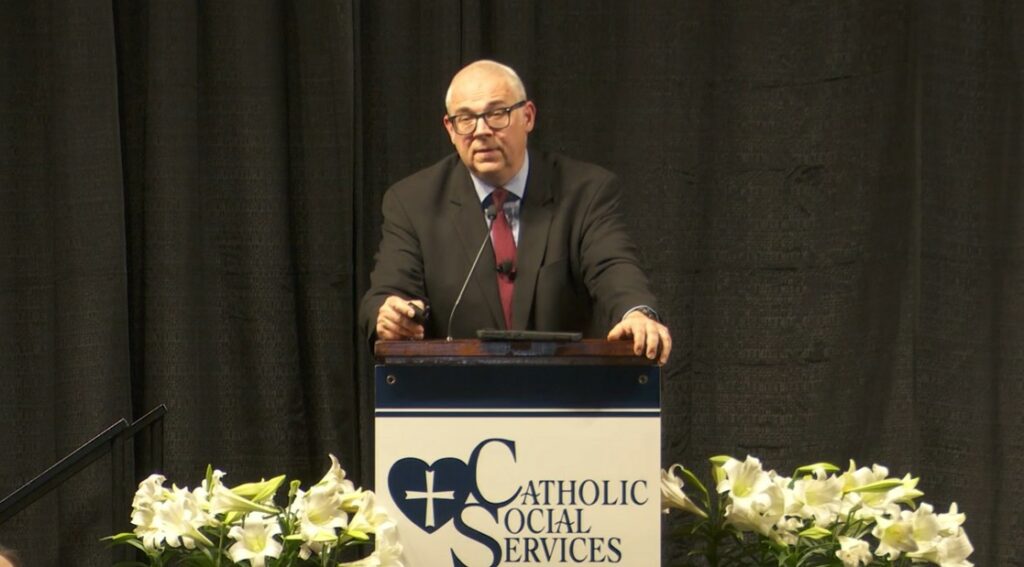
Catholic Social Services of the Diocese of Rapid City, SD invited Dr. Peter to give the keynote address titled Your Human Formation and the Secrets of Well-Being for their fundraiser on March 30. This was the largest live event he has addressed, with more than 550 people in attendance. The Diocese of Rapid City is a hotspot for human formation work in the Catholic Church at an institutional level – if you want to support all the good work they are doing, you can join Dr. Peter in praying and donating to support their efforts.
Get on the Resilient Catholics Community interest list for the St. Mary Magdelene Cohort
Interested in greater interior integration? The Resilient Catholics Community (RCC) is where a community of faithful Catholics focus on learning about parts and systems thinking, grounded in a Catholic anthropology to overcome human formation deficits.
You're invited to an informational Zoom meeting, which will be 8:30 PM to 9:30 PM Eastern on Tuesday, May 26, to learn more about applying to the upcoming cohort, which will open in June. Advanced registration is required for this meeting using this link. After registering, you will receive a confirmation email containing information about joining the meeting.
You can also find out more and join the interest list for our 13th cohort under the patronage of St. Mary Magdalene by visiting the RCC landing page. Although we’ll open formal registration on June 1, we are finalizing company meeting times and days for the St. Luke’s cohort this week. If we have space in certain groups, we'll be inviting interested individuals to "fast track" into St. Luke with programming to begin in May 2026.
Scripture for Your Inner Outcasts with Dr. Peter and Dr. Gerry
In today's episode of Scripture for Your Inner Outcasts, Dr. Peter reflects on how every part of us, especially our exiles, make important contributions to our ability to love. You can also check out yesterday’s episode from Divine Mercy Sunday as Dr. Peter and Dr. Gerry discuss how our Thomas is an exile in the system of the 12 apostles. Scripture for Your Inner Outcasts, to our knowledge, is the only podcast specifically for parts of us who are exiled and who feel alone, bringing light, love, and hope to our exiled parts. Check it out every day on our landing page or wherever you get your podcasts and share it with those you think it might help.