

A Caveat
In light of a certain amount of controversy generated by this film, I feel the need to offer a few thoughts to consider. Many of the harsher critics (e.g. Matt Walsh) are neither literary critics nor film theorists. That is not to say they are not entitled to their opinions, but in my view, they are so focused on their political concerns (and outrage) that their analysis becomes reductionistic and misses the real message. I was especially delighted that Dominican priest Father Gregory Pine gave an intelligent, insightful, and balanced review which you can find here.
Jonathan Pageau, the Eastern Orthodox iconographer who does The Symbolic World podcast, has, in my opinion. the most insightful and interesting review I’m aware of as well as a more thorough and brilliant review here.
A good and interesting film that uses historic and/or literary material is always going to be about interpretation and re-interpretation. A brilliant film has layers and complexity, it does not merely copy the source material but offers something new for the modern audience. You may or may not like the new messaging, but it needs to be faced on its own terms.
In any case, my review will focus on the psychological elements, especially the parts-work analysis.
Why this film, why now
Some 20 years ago (am I really that old?), I used to teach The Odyssey to ninth graders, and I loved every minute of it. There is something about Homer's great wandering poem that speaks directly to adolescents: the longing for home (despite their sometimes longing to escape from home), the adventure at sea, the battling with fate, and the slow, hard work of becoming who you were meant to be.
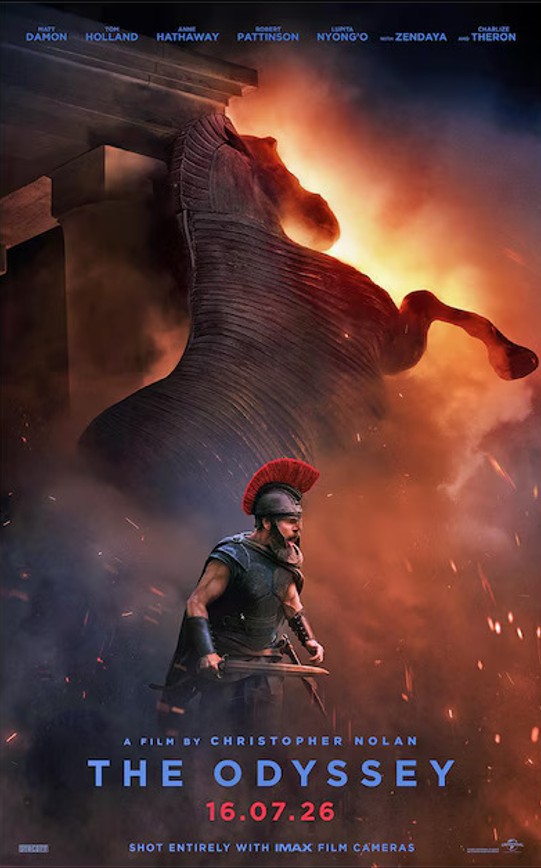
So, when my son Ben, who was a film major and has worked in Hollywood, called me with barely contained excitement about Christopher Nolan's new adaptation, I was definitely on board. His enthusiasm about the true IMAX experience for this film was contagious.
Along with my son Ben, my wife, and her friend Lillian, we drove to the Mall of Georgia which is one of a small handful of theaters in the United States equipped with genuine 70mm IMAX capability, and we watched The Odyssey on opening night.
I want to take a moment to sit with that, because that experience is an important part of this review. Nolan shot this film using actual IMAX cameras, an almost absurdly rare choice. The film reels reportedly weigh approximately 600 pounds each. True IMAX screens measure roughly 72 feet wide and 52 feet tall, nothing like the glorified large-format screens that most multiplexes market under the IMAX brand. The result is something close to immersive: you are not watching the Aegean Sea; you are nearly in it. When those ships rolled across mountainous swells, we were all enthralled.
This is a film that rewards the right conditions of viewing. But more importantly for our purposes here, it is a film that rewards the right conditions of attention because Christopher Nolan has made something far more psychologically and morally serious than a typical historical adventure spectacle.
Initial assessment with SPOILERS
Let me say the headline plainly: The Odyssey is a remarkable achievement, and it is breathtaking, but its central and surprising thesis is what moved me. This is a film about moral injury. It is not so much about post-traumatic stress in the clinical sense, though elements of that are present, instead it is a meditation on what happens to a human soul when it has participated in deeds that shatter its own moral framework.
Nolan has taken one of the oldest stories in Western literature and found something in it that Homer knew but rarely said out loud. Odysseus is not simply lost; he is undone. His long journey home is not primarily geographical, it is the slow, agonizing reconstruction of his self-system after profound psychological and emotional distress.
A recap
Toward the beginning of the film we find Agamemnon in Ithaca enlisting Odysseus, played by Matt Damon, and others to join him in the war against Troy. We then move to the future where Odysseus has been away for 20 years, presumed dead by many, and his son Telemachus challenges his mother Penelope because she won’t let him become King. Meanwhile there are dozens of suitors overstaying their welcome and aggressively vying for Penelope’s hand in marriage.
Much of the story is anchored around Odysseus on the island of the nymph Calypso who feeds him the lotus flower, a mind-altering drug, so that he has no memory of who he is or where he came from.
From here the film unfolds in what Nolan structures as overlapping and interlocking narrative frames, a technique he has used before, but never quite so organically suited to the source material.
We follow Odysseus through his remembered and experienced adventures: the horror of the Cyclops Polyphemus (depicted with practical effects of astonishing craft: no CGI here, only a creation both monstrous and strangely pitiable); the sorceress Circe, who transforms his men into pigs and tells them, with cold precision, that she has simply revealed their "true identity;” the storm of Zeus's wrath; the harrowing descent to the underworld, where Odysseus encounters the blind prophet Tiresias and the shade of the murdered king Agamemnon; the Sirens; and the whirlpool of Charybdis (the one sequence in the film using CGI).
Simultaneously, we follow Telemachus (the coming-of-age thread of the story) as he searches for his absent father, arriving at last at the court of Menelaus, where Helen herself, yes, that Helen, offers a quiet apology: "for everything that happened in my name." It is one of the film's many moments of unexpected grace.
Back in Ithaca, Penelope, played by Anne Hathaway with extraordinary emotional depth, is holding her household together against a court of arrogant suitors, one of whom, played by a scheming Robert Pattinson, emerges as a surprisingly complex but villainous figure in his pursuit of her.
The emotional and moral center of the entire film arrives in a scene of hushed, almost unbearable power: Odysseus, finally home disguised as a beggar, speaks to Penelope through a wooden grille. He asks her: "What if the Odysseus you knew lost his way?" And then, in fragments, the truth of Troy comes out: what he saw and what was done in the night when "ten years of rage poured into the city in one night." We see, briefly and horrifyingly, a child beheaded, and the child's face becomes the face of the goddess Athena. "To burn the walls of Troy," he says, "was to burn the world entire."
This is the wound and this is why he needed Calypso's island.
The film ends not only with the triumphant domesticity of Homer's conclusion where the suitors are slaughtered and the household restored, but with something stranger and, I would argue, truer. Odysseus and Penelope sail together toward the West, to honor the dead, leaving Ithaca to their son Telemachus. The journey does not end at home; it continues beyond it.
My geeky side wants to point out that Nolan, in his third Batman movie, The Dark Knight Rises, had Bruce Wayne (Batman) and Selina Kyle (Catwoman), also incidentally played by Anne Hathaway, leave Gotham and head to Florence, Italy. Perhaps there is a need for the hero, after the great adventure, to let go of the burden of heroism and find personal peace. Or perhaps this is the completion of the hero’s journey – the hero’s ultimate achievement of inner balance through the union with the feminine.
Appreciation
Let me name what Nolan gets brilliantly right before I turn to questions and concerns.
The craft is extraordinary. The cinematography, particularly the ship sequences, achieves something almost sacred in its beauty. These are real vessels on real water, photographed at real scale, and the difference between this and a CGI ocean is not merely technical; it is felt. The body knows it is watching something true.
The horror sequences are genuinely masterful. The Cyclops encounter, and the Circe sequence, these are constructed with the full vocabulary of the horror genre: physical threat, psychological dread, disorienting sound design (those drums), and the particular terror of a situation in which intelligence and courage are not obviously sufficient.
They work precisely because Nolan refuses to make these creatures cartoonishly evil. The Cyclops is a monster, yes, but he is also, undeniably, a being whose home has been invaded, and whose property has been stolen. He has been blinded by a man who then mocks him as he escapes. The pathos and the moral complexity is real.
The acting is uniformly strong. Matt Damon brings something I did not anticipate to Odysseus, a quality of weight, a man carrying something too heavy for too long. Anne Hathaway's Penelope is a revelation: intelligent, aching, and dignified.
The film's pacing and structure are a genuine achievement. Christopher Nolan takes an episodic poem and renders it as a coherent cinematic experience, with multiple timeframes and framing devices that work, without losing the viewer. Although three hours long, I was never bored.
Analysis and critique
Through the lens of parts work
Readers of this column know that I regularly bring an Internal Family Systems (IFS) perspective to the films I review. IFS, developed by therapist Richard Schwartz, proposes that the human psyche is naturally multiple and that we are made up of parts, each with its own perspective, role, emotion, and history, organized around a calm, compassionate inmost self at the center.
When we are wounded, parts take on protective roles: managers who try to control our behavior to prevent pain, and firefighters who act impulsively to douse unbearable feeling when it breaks through. The wounded parts themselves, the ones carrying old pain and shame, are called exiles.
The Odyssey is, from this vantage point, a film about a man whose internal system has been catastrophically overwhelmed.
The lotus-eating on Calypso's island is a textbook firefighter response. It is a chemical deployed to numb against an intolerable inner experience. Firefighters, in IFS, are not villains; they are emergency responders. They do what they must when the pain is more than the system can bear.
Calypso herself functions almost as an unlikely manager in the early sequences, a part of the psyche, if you will, that creates distance and containment so that the exile's wound does not destroy the whole person. Her love for Odysseus does not prevent her from knowing when the time for containment has ended. "He wasn't ready to go home. But now he is."
The exiled content, the wound, is the moral injury of Troy. And here the film does something psychologically sophisticated that many films about trauma do not: it distinguishes between post-traumatic stress (the nervous system's response to overwhelming threat) and moral injury (the soul's response to participating in or witnessing or failing to prevent acts that violate one's own deepest moral code).
Moral injury, as researcher Jonathan Shay first described it in his work on Vietnam veterans, involves the betrayal of what is right by a legitimate authority or by oneself. Odysseus did not merely survive horror, he perpetrated it. The rage of ten years poured into a single night. A child's face. "To burn the walls of Troy was to burn the world entire."
This is not a man whose nervous system needs resetting. This is a man whose moral identity has been shattered and who does not know how to live with himself. And here the film is unusually honest and unusually brave.
The Circe scene deserves special attention from a parts perspective. When she transforms the men into pigs, she says she has shown their "true identity." When she reverses the spell, she tells them they are returning to their "disguise."
Now, from a strict IFS standpoint, this is an interesting inversion: the human form as the protective persona, the animal appetite as the exile or the firefighter breaking through. The "disguise" language suggests that what we present to the world -- our composed, civilized, heroic selves -- is a manager configuration, and that underneath it lurks something raw and less flattering.
Circe is not simply a villain here. She is, in an odd way, a diagnostic genius, stripping the managers away to expose what they have been concealing. The theological resonance is equally rich because the Christian tradition has always known that sin disfigures the image of God, that we become less than human when we act against our nature.
Athena, in this telling, is remarkably understated. She is not a commanding deity pulling strings; she is more like a conscience, a quiet inner voice, a comforting presence. In IFS terms, she functions almost as an external representation of inmost self, that calm, clear, compassionate center from which genuine wisdom flows.
The moment when the beheaded child's face becomes Athena's face is perhaps the film's most theologically and psychologically charged image: the most innocent victim of the war becomes the very voice of wisdom and conscience. The divine speaks through suffering. This is not an accidental choice.
One mild caution from a parts-work perspective: the film, like most films, tends to render the inner life through behavior and affect, i.e. what we see characters do and feel, without quite capturing the inner multiplicity that characterizes actual psychological experience.
We understand Odysseus's injury primarily through his actions and his fragmented memory, not through the full polyphony of competing inner voices. This is an inherent limitation of cinematic storytelling, and Nolan navigates it better than most. But readers who work with IFS will note that what appears in the film as a unified character is, in lived therapeutic experience, a more complex chorus.
Through the lens of faith
Here is where I want to explore what the film offers and what it leaves incomplete.
The Odyssey takes moral seriousness with genuine gravity. It does not treat Odysseus's suffering as merely psychological. Odysseus experiences what the Christian tradition would call a spiritual crisis, a crisis of the soul confronting its own capacity for evil. "To burn the walls of Troy was to burn the world entire." That is not the language of symptom management. That is the language of someone standing at the edge of a frightening moral reality.
The theme of hospitality, the sacred obligation to welcome the stranger, runs through the film as a kind of moral undercurrent. Odysseus himself, disguised as a beggar, depends entirely on the hospitality of others. The suitors who have violated the laws of hospitality in his own house are, by the logic of the poem, receiving what they have earned. There is something here that resonates with the Christian tradition's insistence that how we treat the stranger and the vulnerable is, in fact, how we treat Jesus. "I was a stranger and you welcomed me."
What the film does not quite offer is redemption in the full theological sense. Odysseus is healed or at least set on the road to healing. But we do not see him forgiven in any deep way, neither by a divine source, nor, importantly, by himself. The film's world is one of fate, moral weight, and hard-won wisdom, but it is not quite a world of grace. The gods are forces: Poseidon's wrath, Zeus's storm, Athena's quiet accompaniment, but they are not personal, and they do not forgive. The wound that Troy left is honored, sailed toward, perhaps lived with, but not dissolved or resolved in any act of mercy.
I’m reminded of the fact that Calypso offers Odysseus the lotus flower so that his "pain would be only in his body, not in his mind." He does not know how long he has been on the island, and when she tells him it has been seven years, he is genuinely startled.
Calypso, it becomes clear, has not held him captive in any simple sense. She has been sheltering him, from his memories and from himself, until she judges he is ready. She says, "You weren't ready to go home, but now you are."
Eventually she returns to him a pendant given to him by his wife Penelope, and with it, the first fragile threads of recollection begin to return. He builds a raft from the wreckage of his ship, and she instructs him: "Give yourself to Poseidon. Give up control." His redemption begins with surrender, not mastery, and that is the beginning of his return home. This “letting go” is at the heart of the Christian Gospel of faith.
This is, of course, an ancient Greek story, not a Christian one, and it would be unfair to demand of Homer what we might ask of Augustine. But for viewers who bring a Christian anthropology to the theater, the absence of grace is worth noticing. It is not so much a failure of the film, but a question worth asking.
What would it mean for Odysseus's moral injury to be truly healed? The film's answer, powerful as it is, points toward love, surrender, and the honoring of the dead. The Christian answer would add something more: that the one who burned the walls of Troy is also, precisely and scandalously, the one to whom mercy is offered.
Synthesis / parting thought
I walked out of that enormous IMAX screen at the Mall of Georgia into the ordinary Georgia night with my wife, my son Ben, and I did not say very much for a while. That, in my experience, is one of the marks of a serious film: it earns silence.
The Odyssey is not a perfect film, but it is a genuinely important one. It takes Homer's poem and finds in it something that our cultural moment desperately needs: a serious, unsentimental, compassionate account of what happens to human beings when they have participated in atrocity.
It refuses the easy arc of the hero who suffers and then triumphs. It insists, instead, that some wounds require years of stillness and a slow return of memory. We must, like Odysseus, be willing to surrender to forces larger than oneself, and above all, to receive the love of someone who is still waiting.
For Catholic viewers and parents, this is a film worth watching and worth discussing. The Greek world it inhabits is not our world, its gods are not our God, and its moral universe lacks the transforming grace that we believe is available to every wounded soul. But the questions it raises are our questions: What do we owe the dead? What does a man do with the knowledge of what he is capable of? Can a person who has burned the world entire find their way home?
For therapists and those in helping professions, the film's treatment of moral injury, dissociation, and the conditions necessary for healing is more clinically astute than almost anything Hollywood has offered in recent memory.
Calypso's patient, knowing containment and the slow return of memory speak to the experience of trauma. The necessity of surrender before transformation speaks to each and every one of us. Nolan has, perhaps without intending to, filmed something close to a case study in how the psyche protects itself, and what it takes to begin the long work of coming back.
And for those of us who once taught ninth graders that the greatest journey is always the one home: bring your students, and let there be silence for a while afterward.
That is usually where the real conversation begins.
Dr. Gerry Crete is the author of Litanies of the Heart: Relieving Post-traumatic Stress and Calming Anxiety Through Healing Our Parts which is published by Sophia Institute Press. He is the founder of Transfiguration Counseling and Coaching, Transfiguration Life, and co-founder of Souls and Hearts.
###
IIC episode 185 just released: What Is Flourishing? Defining the Good Marriage and the Good Family

Join us as we start a whole series on family life and IFS, grounded in a Catholic understanding of the human person.
Home. Family. Belonging. Love. What does it mean to have a healthy marriage, a healthy family? Join Dr. Gerry Crete and Theresa Robinson to explore that question: “What does a thriving marriage and flourishing in family life look like? We bring in Internal Family Systems, attachment theory, perfectionism, the importance of family members delighting in each other, parents’ vows and scripts, how loving children involves more than the will, and the importance of “being with” each other. Check it out in video or audio.
Fall Foundations Experiential Groups registration open
Consider joining a Foundations Experiential Group (FEG) beginning later this month, designed just for Catholic formators. Check out all this information and officially register here. A $200 non-refundable deposit (to be applied to course fee) will secure your spot.
We also offer Advanced Formation Groups (AFGs) for those who have already completed an FEG or have IFS Level 1 training, or who have completed Foundation Year in the RCC. New AFG sessions begin in September 2026. See details here.
Scripture for Your Inner Outcasts episodes
Dr. Gerry encourages your exiled parts to take courage and be not afraid in today’s episode of Scripture for Your Inner Outcasts. You can also check out yesterday’s episode from the 18th Sunday in Ordinary Time as Dr. Gerry and Dr. Peter discuss a hunger that food cannot satisfy. Scripture for Your Inner Outcasts, to our knowledge, is the only podcast specifically for parts of us who are exiled and who feel alone, bringing light, love, and hope to our exiled parts. Check it out every day on our landing page or wherever you get your podcasts.