

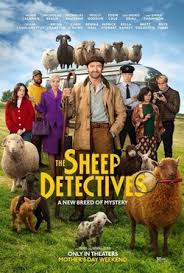
One of the quiet joys of writing Parting Thoughts is that occasionally a reader sees something in a film that I have not seen yet, and sees it with such clarity and personal honesty that it stops me in my tracks.
That is exactly what happened when Dr. Thomas McGovern, a dermatologist, Mohs surgeon, and fellow traveler in the world of Catholic Parts Work, sent in this reflection on Sheep Detectives, the delightfully improbable animated film that arrived on streaming platforms on June 24, 2026. I will confess: I have not watched it yet. But after reading Tom's piece, I intend to remedy that very soon.
What Tom has written is not primarily a film review. It is something rarer and more valuable: a first-person account of what can happen when a person who has done serious, sustained Internal Family Systems (IFS) work sits down to watch a movie without an agenda. He finds that the movie walks straight into the middle of something unfinished inside of him.
Tom brings a remarkable combination of gifts to this reflection. He is medically trained and intellectually precise. He is also someone who has spent years in the often humbling work of getting to know his own parts. He writes about two parts, one is Tommy, his image-managing Good Boy part, and the other is his Angry Part. I am sure you have similar parts, even if they go by different names.
What moved me most in reading his reflection was the moment when Tom describes watching Lily, the know-it-all Shetland sheep, leans into the self-like presence of Mopple, and realizing that Tommy was watching too. That is the kind of thing that only happens when a person has done enough inner work to notice it, and when a film, perhaps accidentally, becomes a mirror.
I am grateful to Tom for sharing this so generously. I think you will be too.
- Dr. Gerry Crete
P.S. Instead of reading the story, you might have parts that prefer to listen to it; Dr. McGovern's share the story out loud with us here, and it's definitely worth the 14-minute listen, as his emotion, connection, and relationship with his parts comes through with even greater clarity.
Sheep Detectives: How a Movie Helped Two Polarized Parts Begin to Heal
by Thomas McGovern, MD
My wife suggested watching a new movie that sounded kind of dorky—Sheep Detectives. How in the world could that even be interesting? Nevertheless, a week after its streaming release on June 24, I agreed to watch it over two evenings (July 1–2) because the trailer had hooked me. Why?
The shepherd, George Hardy (Hugh Jackman), reads murder mysteries to his sheep each evening from the step of the caravan where he lives in the pasture. For the last 20 years, I have relaxed by reading classic British detective fiction in bed before falling asleep. As a dermatologist and Mohs surgeon, I have admired Hugh Jackman because he has been treated multiple times with Mohs surgery for basal cell carcinoma on his nose and because he has become an outspoken advocate for sun protection.
As the shepherd George Hardy, he also made $30 million—something not revealed until later in the movie—after developing a remedy for orf and selling the patent to an agricultural corporation. Orf is a viral disease that often affects the lips, muzzle, and skin around the mouths of sheep. It can also infect the hands of humans, and I saw and treated cases during my residency training in Colorado. And finally, from the trailer, I could see that the movie was stunningly hilarious! Therefore, even before watching it, my manager parts were completely on board with my wife’s suggestion.
Some personal background
Dr. Gerry does a creative job of analyzing films in terms of parts and IFS. Rather than doing that for Sheep Detectives, though, I want to give an example of how watching this movie without an agenda led to the unclenching and beginning of healing for my two most intensely polarized parts: Tommy and my Angry Part.
Tommy serves as my image manager and Good Boy part who tells other parts what to do because he believes he knows better than any of them. He relates to others transactionally, and he never showed emotion in over two years of parts work with a counselor. My Angry Part bears the burden of injustice and being taken advantage of, and he is both an exile and a firefighter.
For over 30 years, until 2020, I required medication to make it through daily life because of severe anxiety. Years of cognitive-behavioral therapy had made only a small dent in my anxiety; even Tommy could not reason me out of it. After more than two years of one-on-one IFS therapy, he still did not trust the experiential approach of IFS, although virtually all my other parts did. In fact, I considered it a breakthrough when Tommy, as the last holdout, said it was okay to apply to the Saint Luke cohort of the Resilient Catholics Community (RCC) after saying “no” to the previous five cohorts.
The week before watching the movie, my wife and I took our adult children to the Canadian Rockies. It was the best time we had ever had together with our adult children. What is not to love about hiking amid world-class scenery with snow-capped mountains, turquoise-blue lakes, and voluminous waterfalls? One day, providentially in retrospect, Tommy and my Angry Part had a brawl. My family stopped at a large visitor center where we wanted to eat the lunches we had brought in our backpacks. One restaurant employee told us that, as long as we bought something at one of the walk-up food counters, we could eat our own food at a table in the outdoor dining area.
However, when I went through the line, Tommy did not trust what I had heard from that employee. Sure enough, the other employees said we could eat only food purchased from the counter at those tables. My Angry Part said—out loud—“I wouldn’t have purchased this overpriced food if I had known that. Your other employee told me I could eat my own food as well.” Tommy did everything he could to suppress my Angry Part, who responded by talking louder and fighting both Tommy and the restaurant employees. Fortunately—progress for me—my friendly Mirror Part noticed the expressions on the employees’ faces, and my Driving Manager realized this was going nowhere. I stopped talking and walked out of the food counter area with my purchases.
Tommy fears that if Angry Part expresses himself with intense anger or rage, my system will literally fall apart and cease to exist. Nobody would like or love me, and I would be doomed to a life of intense loneliness. Anarchy would be complete, and he would be unable to put the system back together.
That day at the visitor center happened to be the day—while doing Independent Study in the RCC—that I listened to Bridget Adams’s Inner Connections talk about a “Z-chart” or “zigzag chart.” The next morning, I used that experience at the visitor center to complete my own Z-chart. Understanding the polarization between Tommy and my Angry Part more clearly prepared me to watch Sheep Detectives.
How the sheep characters embodied IFS parts
In the movie, the cinnamon-colored Shetland sheep Lily correctly identifies the murderers in George’s stories before he reads the endings. The other sheep know she is smart and recognize her as the intellectual leader of the flock. They unquestioningly defer to her on important decisions.
However, within minutes of the movie’s opening, their beloved shepherd dies, and Officer Tim Derry, the bumbling local police officer, believes George died of natural causes. Lily knows otherwise, and she spends most of the movie collecting clues and presenting them to Officer Derry in a way even he cannot miss.
Lily gains the support of the flock in finding George’s murderer. Two sheep particularly help her: Mopple and Sebastian.
Mopple is a large, woolly, teddy-bear-like Merino ram. In a letter to his estranged daughter, Rebecca, George described Lily as his smartest sheep.
Later, when Lily struggles not to forget a sheep who dies, she recalls George’s words: “You may be the smartest sheep, but Mopple’s the wisest.” That distinction between Lily’s intelligence and Mopple’s wisdom became central to how I experienced Mopple as a Self-like figure.
Mopple possesses many Self-like characteristics. When the sheep experience fear or see something uncomfortable—like death—Zora, a young sheep who acts as a manager who avoids fear and discomfort, leads the flock in choosing to forget painful experiences on the count of three. On “three,” everybody forgets the painful event—everybody, that is, except Mopple.
He carries the memories of the flock and never forgets. Lily’s panic doesn’t sweep him away. He remains curious when Lily jumps to conclusions about George’s murderer. He remains confident and never tells Lily she is wrong. He remains connected to Lily as he accompanies her in a noncompetitive way throughout the investigation.
Sebastian, a dark, weather-beaten Icelandic ram whose massive horns and tangled coat make him look formidable, serves as her other assistant in the investigation. George had rescued Sebastian from a carnival where men forced him to fight a dog until he bled.
Sebastian was born in the winter, and we learn from an elderly ram correcting some playful lambs, “You’re not to play with that winter lamb. He doesn’t belong in this flock.” Sheep don’t like lambs born in winter simply because they were born in winter.
Sebastian lives on the outskirts of the flock only because of his connection to George, but not to any of the sheep. This movie has two clear exiles who live mostly alone: Sebastian and the young and nameless Winter Lamb. Like Mopple, the loner Sebastian has not forgotten what he has seen and experienced.
Expanding parts' limited vision
Dr. Peter has said so many times, “Parts have limited vision.” The sheep’s purposeful forgetting limits their vision, but so does their confinement to the pasture.
Mopple provides a place for Lily to experience attachment needs, including recognition, reassurance, and belonging, as well as integrity needs such as agency, goodness, and mission. Sebastian, meanwhile, provides a broader scope of vision. He has seen things and traveled far.
With the safety Mopple provides, Sebastian shares some of those experiences with Lily, who would have never listened to him without Mopple’s influence. Likewise, the loner Sebastian would have never shared anything without Mopple’s recognition and love.
As the movie continued and Lily leaned on Mopple, I could sense Tommy imagining a different possibility for relating to—and trusting—me, my Innermost Self.
I laughed the loudest when those three sheep walked into town past a church and Lily asked what the building was. Sebastian said, “This is the church where someone named God lives.” Lily asked, “Who is God?” Sebastian progressively revealed that God was a shepherd who could not be their new shepherd because God was also a lamb. He also could not be their new shepherd because he was invisible, made of bread, and eaten by people on Sundays! Mopple, showing compassion, responded, “Poor God.”
The beginning of depolarization and healing
So how did this help my polarized parts—Tommy and Angry Part—begin to heal and depolarize?
In the movie, the Self-like Mopple continues loving Lily, who reflects some of Tommy’s know-it-all characteristics, even when her initial identification of the murderer is wrong and she ends up dragging Mopple to investigate an extremely dangerous location that nearly leads to their demise.
Lily also experiences self-sacrificing love and concern from a former “winter lamb” whom she had previously shunned. These experiences change her and open her to new possibilities.
She doubts herself and then realizes she was wrong. She had never done that before. “I never guess,” she says about identifying the murderers in George’s stories. “I know.” Now she knows that she does not always know. She does not know who George’s murderer is. She accepts—for the first time—that she could be wrong. And Mopple sticks with her. Tommy saw that Lily’s uncertainty did not endanger her relationship with Mopple.
As Lily gradually learned that Mopple could remain beside her even when she was wrong, Tommy began to imagine that my Innermost Self could remain beside him without humiliating, replacing, or condemning him. In fact, on the morning of July 4, I had planned to do the exercise in the Bonnie Weiss workbook titled “When a Protector Doesn’t Trust You.” But the exercise no longer matched what had just happened: Tommy had begun to trust me, at least in a small way—the first of two reconciliations.
To provide the all-important clue to Officer Derry, Lily must enlist the help of the Winter Lamb. Because of his small size, only he can place the clue where Officer Derry will notice it. Yet even when Winter Lamb demonstrates his courage and successfully completes his mission, allowing Officer Derry to identify the murderer correctly, he walks away from town still lonely.
Lily has recognized Winter Lamb as “useful,” but she still does not welcome him. Only in the final scene, when the flock’s new shepherd reads from a book George had written about caring for sheep, do the sheep—including Lily, standing on a nearby hill with Mopple—hear George’s line: “A winter lamb is the best lamb.”
Darn it if I didn’t start crying when I heard that line during the movie—and even now, as I write it, the tears return: “A winter lamb is the best lamb.”
My Angry Part is not like Winter Lamb because of shared anger—Winter Lamb is not angry—but because Tommy had treated Angry Part as someone too dangerous to belong.
Only upon hearing “A winter lamb is the best lamb” did all the parts—pun intended—click into place for Lily. She could not have begun healing without Mopple’s Self-like qualities, which helped meet her attachment and integrity needs, or without Sebastian’s help as a former winter lamb whose knowledge and sacrifice were essential both to revealing the murderer and to Lily’s realization that winter lambs are not inherently bad.
Lily’s welcome of Winter Lamb opened the possibility of a second reconciliation for Tommy: perhaps Angry Part did not need to remain outside my own system’s circle of compassion.
Upon hearing that tear-inducing line, Lily turned and saw the lonely Winter Lamb, who was still an exile without a name. She went to him and escorted him to join the young lambs near the new shepherd reading from George’s book. And to cement Winter Lamb’s belonging, she named him George after their former shepherd.
Opening up to new possibilities
On the first day of watching the movie, Tommy looked at me—Tom, my Innermost Self—for the first time. That glance felt like his first acceptance of “Self-energy,” albeit in microdoses through a slot only a letter could fit through. For the previous two weeks, I had spent nearly all my parts sessions with Tommy. I was following classic RCC doctrine: “Get to know your protectors first.”
While I was watching the end of the movie, I did not know which part was crying. But the next day, during my one-on-one counseling session, I relayed what had happened while watching the movie, and I cried again. My counselor said, “Ask your parts, ‘Who is crying?’” It was Tommy. That was the first emotion he had ever shown.
Then, on the morning of July 4, I did David Edwards’s RCC experiential exercise titled “How Can I Help You Feel Safe?” In this exercise, he asks us to choose a protector to work with. I assumed it was going to be Tommy again. It was not. Tommy said, “Pick the little Angry Part.” Tommy looked at this polarized part with compassion and confirmed, “It is his turn.” I could not believe it! More tears.
It is not a complete unburdening. I am not fully healed. In fact, there is now an unidentified part that is uncomfortable with this positive change in my system. But I trust the process and will work with that part. Tommy had first turned toward my Innermost Self; now he could turn toward the Angry Part.
This is a hugely important small step I did not anticipate, all because of a providentially timed, ridiculously funny, yet experientially deep movie. Sheep Detectives helped bring more integration to my internal world. Perhaps another story, encountered without an agenda, might offer one of your parts a new possibility as well.
###
The Resilient Catholics Community: A structured program
Dr. McGovern is a current member of the St. Luke cohort of the Resilient Catholics Community (RCC) where he is learning in a systematic way to meet, see, hear, understand, and ultimately love his parts. He pairs his work in this community with his private IFS therapy, providing him with a structure and foundation to love, in an ordered way, himself, so he can better love God and neighbor.
We focus on human formation in the RCC, starting with he PartsFinder Pro (PFP), a series of 23 measures designed to help you come to know and understand 12-15 of your parts – managers, firefighters and exiles. For examples, see these downloadable PDF sample fictional reports for a man and a woman.
More than 800 Catholics have taken on this pilgrimage to better human formation, together, in community. For more information, check out the RCC landing page, recent RCC informational meeting in video or audio, and listen to this 19-minute experiential exercise to help you discern about applying to the RCC.
Although our next cohort, under the patronage of St. Nicholas, will not open until October, we are currently onboarding members of the St. Mary Magdalene cohort now and will likely have some last-minute openings for programming that will begin in September. If you're interested, sign up on the interest list and check that you'd like to be contacted for these fast-track opportunities.
Check out Dr. Gerry’s new episode From Addiction to Freedom: The Power of Faith and 12 Steps with Scott Weeman
Dr. Gerry interviews Scott Weeman, founder of Catholic in Recovery in this powerful episode of his podcast Post Traumatic Growth.
Attention Catholic Formators!
If you accompany others as a Catholic therapist, coach, spiritual director, priest or in another role, we have two great offerings for you.
First, our second in-person retreat is filling up and will be held August 10-13, 2026 in Bloomington, IN. The theme this year is Authentic Being and Authentic Relating. Check out all the details here.
Second, both our Foundations Experiential Groups (FEGs) and our Advanced Formation Groups (AFGs) are open for registration. Sessions will begin at the end of August and early September. Check out the details.
Scripture for Your Inner Outcasts
In today’s episode of Scripture for Your Inner Outcasts, Dr. Gerry explain how God attracts our exiled parts "into the desert" to restore a loving relationship with them. And in yesterday’s episode from the 14th Sunday in Ordinary Time, Dr. Gerry and Dr. Peter discuss how God offers rest to our hard-working exiles. Scripture for Your Inner Outcasts, to our knowledge, is the only podcast specifically for parts of us who are exiled and who feel alone, bringing light, love, and hope to our exiled parts. Check it out every day on our landing page or wherever you get your podcasts.