

My wife introduced me to a U2 song whose lyrics speak to my heart: "Magnificent." Bono sings it with that aching, searching quality he does so well: I was born, I was born to be with you... I was born to sing for you. When I first heard it, something stirred in me that I couldn't quite name. It felt less like a love song to another person and more like a cry from the depths of the soul, a voice rising up from somewhere ancient and true. This cry recognizes that it was made for Someone. From the womb, my first cry, it was a joyful noise.
That image, a first cry as a joyful noise, stopped me cold the first time I really sat with it. Because so many of us, in our personal trauma work, have come to understand that our first cries were not always received as joyful. Sometimes they were met with absence, or overwhelm, or fear. And so, parts of us learned very early to modulate that cry. To shrink it and to silence it. We learned to turn our joyful noise into something more manageable, more acceptable, and less threatening to those around us.
But here is what Bono, I suspect, was pointing toward: the cry was still joyful. The wound around it doesn't change what it was at its origin. Only love, only love can leave such a mark. But only love, only love can heal such a scar.
That is, I believe, precisely where Pope Leo XIV's new encyclical, Magnifica Humanitas — On Safeguarding the Human Person in the Time of Artificial Intelligence, finds its deepest resonance for those of us doing healing work in the interior life.
A letter written to the heart
When I first read the title, I smiled. Magnifica Humanitas. The Magnificent Humanity. It immediately calls to mind Mary's great canticle, the Magnificat, and the Holy Father makes this connection explicit in his conclusion, noting that the song of hope for our time is precisely that ancient prayer of a young woman who recognized that God was doing something grand within her. "My soul magnifies the Lord," she sings. And in that moment, a human person becomes the vessel through which the divine grandeur pours itself into history.
This is not accidental. The encyclical is fundamentally concerned with a question that should be deeply familiar to anyone doing trauma-informed, parts-work oriented healing: What does it mean to be human? And what happens when powerful forces, external or internal, conspire to diminish, distort, or replace that humanity?
The Holy Father frames the challenge of artificial intelligence not primarily as a technical or regulatory problem, though it is certainly those things as well. He frames it as an anthropological crisis. It is a crisis about what we believe the human person is, and therefore what we believe the human person is worth.
The technocratic paradigm and the exiled self
In Chapter 3 of Magnifica Humanitas, Leo XIV takes up what Pope Francis called "the technocratic paradigm," which is the tendency of our age to measure all value by efficiency, productivity, and technical capacity. The encyclical warns against ideologies of transhumanism and posthumanism, which in various ways suggest that the human person as we currently know it is a problem to be solved, a limitation to be transcended, or a system to be upgraded.
When I read this, I thought immediately of the experience of exile.
In Internal Family Systems (IFS), we speak of exiles, those young, vulnerable parts of us that carry the wounds of our past. They hold shame, grief, terror, and longing. Because their pain is so intense, and because the systems around them, both internal and external, could not always hold that pain safely, they were pushed away. They were often locked up and hidden. The managers and firefighters of the psyche took over, doing their level best to keep the exiles contained, so that the person could function in the world.
Now consider: what does a technocratic paradigm do to the interior life? It privileges the managerial parts. It rewards efficiency, productivity, the suppression of inconvenient emotion, and the optimization of output. It has no category for the exile's grief. It has no algorithm for the longing of the soul. It cannot process the joyful noise of a first cry as data that matters.
And so, gradually, insidiously, a culture shaped entirely by technocratic thinking does to the collective human interior what trauma does to the individual psyche: it exiles the most tender, and most magnificently human parts of us.
The encyclical names this with urgency. It insists that what must not be lost is precisely the limit, the heart, and even the grandeur of the human person. That word grandeur appears throughout the document, and it is not accidental. It is the word the Cappadocian Fathers would have recognized immediately. "God has made human nature a participant in every good,” Saint Gregory of Nyssa insists, that “all virtue, all wisdom, and the best things one can imagine" are in us, not as achievements nor as upgrades, but as gifts written into the very structure of our being. It is into this grandeur, the very image of God that no algorithm can replicate and no technocracy can replace.
The inmost self and the imago Dei
This is where Magnifica Humanitas and the healing tradition of IFS, especially as I have come to hold it within a Catholic framework, meet most beautifully.
The encyclical's foundational anthropological claim is this: the human person is imago Dei, created in the image and likeness of the Triune God. This is not a pious decoration on top of an otherwise secular understanding of the person. It is the load-bearing wall of the entire structure, the entire anthropology. Remove it, and everything collapses.
In the IFS framework, we speak of the “Self,” that calm, curious, compassionate, courageous center that is present in every human being, regardless of how deeply buried it may be beneath layers of protective parts and wounded exiles. Richard Schwartz identifies eight qualities of Self: calm, curiosity, compassion, confidence, clarity, creativity, connection, and courage.
As I have reflected on this over many years of clinical and spiritual work, I have come to understand the inmost self in more specifically theological terms. The inmost self is, I believe, the locus of the imago Dei in the human person. It is that deepest center which, even in its woundedness, even when it is blended with burdened parts and hidden beneath protective layers, still bears the watermark of its divine origin. It is the place where, as Saint Basil the Great said, the image of God dwells as a foundation, awaiting its full expression in likeness.
But here is the critical distinction that Magnifica Humanitas implicitly affirms and that I want to name clearly: the inmost self, while it is the bearer of the imago Dei, is not itself divine. It is created. It needs grace, and it needs redemption. It needs, as Saint Paul says, to be transformed "from one degree of glory to another" by the action of the Spirit. The grandeur of the human person is not a self-generated magnificence. It is a received magnificence which is precisely why Mary could sing, "My soul magnifies the Lord." She was not generating glory; she was reflecting it.
This is the deep wisdom that our healing work must carry. When we help a client access their self energy, and when we witness the moment a person steps back from a blended protective part and begins to relate to their inner world with curiosity and compassion, we are not merely activating a psychological resource. We are, I believe, touching the hem of the divine image that was never fully erased, no matter what the person has suffered.
Only love can leave such a mark — and heal such a scar
Let me return to Bono's lyric, because it opens something important.
Only love, only love can leave such a mark. But only love, only love can heal such a scar.
In trauma work, we know this truth with painful precision. The deepest wounds are almost always wounds of love, or its absence. The exile does not carry an abstract wound; it carries a relational wound. It carries the memory of a love that was needed and not given. It is a love that was offered and betrayed or that came with strings attached, or conditions met, or violence hidden inside it. The mark is made by love's distortion.
And, this is the stunning claim, only love can heal it.
It cannot be healed by therapeutic techniques or emotional regulation. It cannot be healed by a more efficient systems. It can only be healed by love.
Magnifica Humanitas, particularly in its fifth chapter on "The Culture of Power and the Civilization of Love," makes this case on a civilizational scale. In a world where power tends to dominate and where the logic of force shapes relationships between nations, the Church proposes something that sounds almost absurdly naïve: the civilization of love.
This is what Martin Luther King Jr. called the beloved community. It is a society organized around the dignity of every human person, the solidarity of all, the common good, and justice for the poor and the vulnerable.
This is not naivety or “leftist ideology.” It is magisterial Catholic teaching and, in my opinion, needs to be reclaimed as such. In this new encyclical, Pope Leo XIV, in the tradition of his predecessors, points us back to Catholic Social Teaching and applies its principles to the moral problems of the day.
But those of us who have sat with people as counselors, coaches, pastors, or spiritual directors know that there is nothing naïve about cultivating a civilization of love. We have seen what happens when a person, for perhaps the first time, is truly received.
This civilization of love is cultivated when their exile is approached with curiosity and compassion rather than shame or suppression. It occurs when the inmost self is present and embodied, and the parts begin to trust that they do not need to protect so ferociously anymore. We have seen the extraordinary power of love to reorganize an interior world that trauma had fractured.
This is what the civilization of love looks like at the scale of the soul. And it is what Magnifica Humanitas is inviting us to imagine at the scale of human society.
Justified till we die — you and I will magnify
The bridge of "Magnificent" is, to my ear, quietly theological: Justified till we die, you and I will magnify the Magnificent.
Justified. That word carries the full freight of Saint Paul's teaching on salvation. We are not self-made. We are not self-saved. We are justified, i.e., declared righteous, made right, and restored to relationship by Another. And in that justified state, we become magnifiers. We reflect and we amplify. We make visible, in our small human way, something of the Magnificent that is the source of all goodness.
This is precisely what Magnifica Humanitas calls us to. Not to become something other than human in the face of artificial intelligence, but to become more fully human. We are to cultivate what the encyclical calls the "authentic 'more than human'" which is not the posthumanist fantasy of technological transcendence, but the Christian vision of grace and divinization. We become "more than human" not by uploading our minds or editing our genomes, but by cooperating with the Holy Spirit who dwells within us and transforms us, part by part, glory by glory.
For those of us in healing work, this is not abstract. Every time a manager part softens enough to let the innermost self lead, and every time a firefighter discovers it no longer needs to run to its compulsive strategy, we discover that inner beloved society. Every time a person discovers that his or her inner world is not a problem to be controlled but a community to be known and loved... in all of these moments, something magnificent is being magnified.
A personal invitation
The Holy Father ends his encyclical with a meditation on the Magnificat. Mary's song, he suggests, is the song of hope for our time. It is the song of one who was fully human. Mary, who had parts, albeit unburdened, still knew fear and confusion. She needed the angel to say, do not be afraid and this prompted her to say yes. She let the divine in, and she allowed her soul to become the place where God took on flesh.
I want to offer you, dear reader, a moment of recollection.
Wherever you are right now, whatever parts of you are anxious about the future, weary from the present, or carrying wounds from the past, I want to invite you to slow down. Take a breath and notice, beneath all of that, something that is still there. Sit with your deep center, which is a quiet place. It is the eye of your soul.
This is your inmost self. The place where the image of God was written into you at your creation has never been fully erased.
From this place, notice your parts: the worried manager, the exhausted caretaker, and the lonely exile. Notice the firefighter is still trying to put out yesterday's fire. You don't need to fix them right now. Just let them know you see them.
And then notice: God sees them too. He is not waiting for your parts to be perfectly organized before He draws near. He comes to the whole self-system, the inmost self and every part, with the same tenderness with which He came to Mary. With the same love that Bono's lyric, in its searching way, was reaching toward.
Your first cry was a joyful noise, even if it was met with less than joy, and even if your parts have spent years trying to manage the sorrow of that.
You were made to magnify the Magnificent. Not after you're healed and not after you've figured everything out. Now. In this space and time with all your parts, and your wounds, and your longing.
That is the magnificent humanity the Holy Father is writing about.
That is the Kingdom within.
###
Dr. Gerry Crete is the author of Litanies of the Heart: Relieving Post-traumatic Stress and Calming Anxiety Through Healing Our Parts which is published by Sophia Institute Press. He is the founder of Transfiguration Counseling and Coaching, Transfiguration Life, and co-founder of Souls and Hearts.
A major announcement from Dr. Gerry
"I am excited to announce that my wife Kasey and I are moving to Rome, Italy, in September, where I will live and work at the NAC (Pontifical North American College). I am so excited to join the formation team there and provide counseling to seminarians representing 65 dioceses across the United States, as well as some from Australia.
Rest assured, I will continue to engage with Souls & Hearts, write my usual reflections, Parting Thoughts and these reflections for The Kingdom Within, and appear in our podcasts, Scripture for Your Inner Outcasts and Interior Integration for Catholics (IIC). I will also continue writing a sequel to Litanies of the Heart, focusing on human formation and flourishing."
Dr. Gerry leads the Catholic world in the Luminous Mysteries on Shalom World
Shalom World is sponsoring thirty days of prayer from June 4 to July 4, 2026 to commemorate the 250th anniversary of the founding of the United States of America. You can join in praying the Rosary and other prayer live here.
The Resilient Catholic Community is open for new members for 15 more days
The core of Souls and Hearts is the Resilient Catholics Community, the RCC, where hundreds of faithful Catholics are on a journey of human formation together, informed by IFS, grounded in a Catholic understanding of the human person, and moving toward flourishing, thriving – together.
The Souls and Hearts staff have brought together the best of human formation resources, both Catholic and non-Catholic to help you shore up your natural foundation for your spiritual life. We take the time to focus on human formation basics, because as St. John Paul II wrote “Human formation is the basis of all…formation.”
We think that the RCC is a good fit for about 0.5% of Catholics, about one in every 200. Why so few? Because so few Catholics commit to their human formation in a serious way. Many will not work a program deliberately. Many are not interested in human formation, preferring a nearly exclusive focus on the spiritual realm. Many don’t resonate with a parts and systems approach to understanding ourselves and our relationships with others. Many don’t see the importance in learning to love themselves in an ordered way. And to be blunt, most Catholics are lukewarm and heterodox, not holding on to all the truths that the Catholic Church definitively teaches (that alone takes out 90% of Catholics). So 99.5% of Catholics would not be allowed to join the RCC (and frankly, the vast majority of them would not want to).
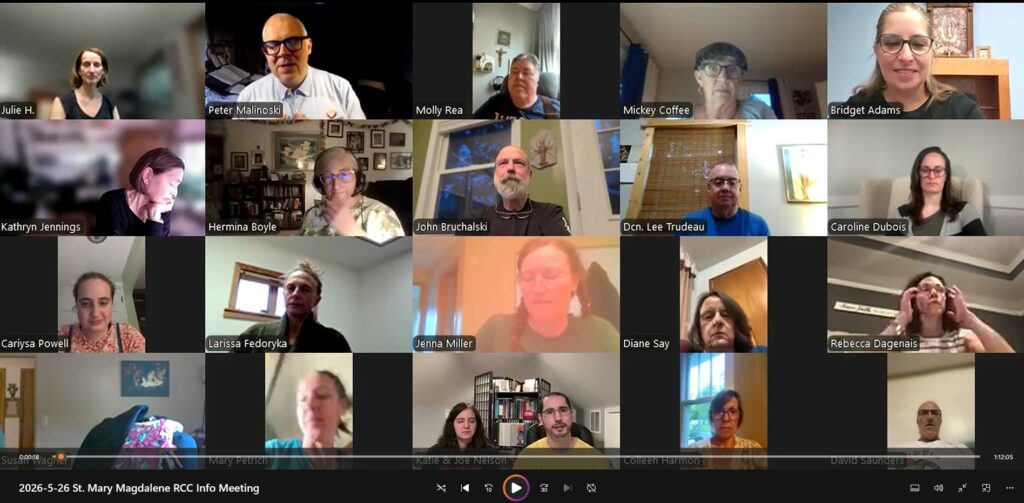
But amazing things happen when the 0.5% find each other in community join a serious pilgrimage to better human formation. Finds out so much more on our RCC landing page, and if the time seems right for you, you can apply here. Need-based scholarship applications are available. And check out our informational video below, or listen here.
Resources for Catholic formators
Check out the recordings for two free workshops:
- Catholic Parts Work in Human Formation video, audio, and transcript
- IFS Basics for Catholic Formatorsvideo, audio, and transcript.
Here are two more great resources for you: The first is a downloadable PDF of resource sheet for your own personal human formation. The second is a resource sheet for those you accompany in their personal formation, all IFS-informed, all grounded in a Catholic anthropology and metaphysics.
And don’t forget, we have an in-person retreat for you, from August 10-13, 2026 in Bloomington, IN titled Authentic Being and Authentic Relating. Check out all the details here.
Scripture for Your Inner Outcasts episodes
Dr. Gerry explains how the Lord listens to the groans of your most exiled parts in today’s episode of Scripture for Your Inner Outcasts. You can also check out yesterday’s episode from the 11th Sunday in Ordinary Time as Dr. Gerry and Dr. Peter discuss how God carries those young parts of us who are unwanted and unloved. Scripture for Your Inner Outcasts, to our knowledge, is the only podcast specifically for parts of us who are exiled and who feel alone, bringing light, love, and hope to our exiled parts. Check it out every day on our landing page or wherever you get your podcasts.