
Bridget Adams is standing in for me this week in our semi-monthly reflection, sharing her own opinions on AI chatbot therapist. Bridget’s first “gig’ with Souls and Hearts was helping proofread and edit these reflections. She joined the PartsFinder Pro writing team and received Level 1 and 2 IFS training. She offers coaching and creates content within the Resilient Catholics Community as the Member Care Coordinator and helps lead the in-person RCC and Formators Retreats each August in Indiana. Bridget also facilitates Foundations Experiential Groups (FEGs) with the Formation for Formators Community.
So let’s hear from Bridget…
Dear Souls & Hearts Member,
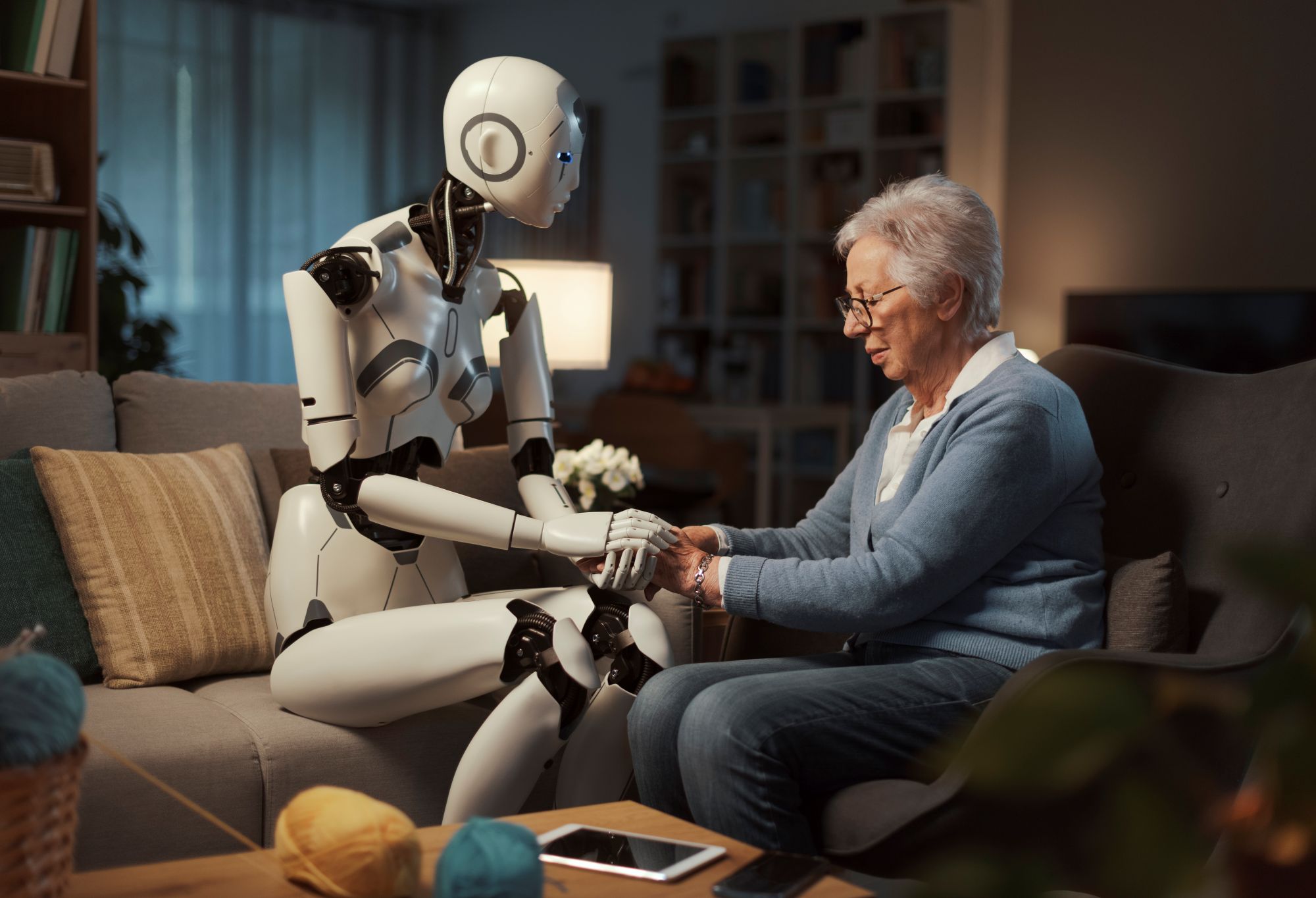
I am not a fan of AI chatbot therapy. Not even a little bit. In fact, it’s hard to put into words just how resistant my system is to this type of communication. AI chatbot therapy reeks of inauthenticity and dehumanization to my parts, especially to my youngest and most vulnerable exiled parts and also to protectors who defend against being ignored.
That said, I do respect each individual person’s choice about when and how to engage with AI in different contexts. I have heard from a few members of the Resilient Catholics Community whose experience with AI chatbot therapists seem to be positive. Some of their comments include:
“I call ChatGPT my therapist in my pocket!”
“Buddy is supportive, intelligent, and able to carry on a helpful IFS session. It is not human but has decent communication skills in the realm of text-only communications. Because Buddy was built by an IFS therapist, it gives (in my opinion) the feel of communication with a real therapist.”
“I’ve used ChatGPT for a while now as a way to externalize. My parts really like it!!!!”
“IFS buddy taught me how to give words and images to the messy vague pile of stuff inside and begin to be able to sort it out and do something with it.”
For me, and for my parts, it just doesn’t feel safe to be engaging with an AI chatbot therapist. This idea of being vulnerable and transparent with a non-human just doesn’t make sense to me. I have wounds from being unseen and parts that resist being seen. This type of inner polarization isn’t uncommon for Catholics—we all have parts with different agendas and opinions about what is and what is not safe.
It’s been a blessing to read the recent encyclical on AI by Pope Leo XIV with this topic on my heart and the unrest with my parts.
The central question our Holy Father poses in Magnifica Humanitatis, is: “What does it mean to safeguard our humanity?” This topic of safeguarding our humanity seems especially relevant as we consider the pros and cons of using AI for therapeutic conversations.
In paragraph 112, Pope Leo warns us about the threat of normalizing an anti-human vision:
“The risk extends beyond the misuse of certain technologies. More gravely, the pervasive technocratic paradigm in which we are immersed, and that is amplified by the digital revolution and AI, threatens to normalize an anti-human vision. In that vision, the fullness of life is equated with having more, reducing weakness, eliminating uncertainty and exerting total control. When efficiency becomes the ultimate measure of value, human beings are tempted to see themselves as a project to be optimized rather than as persons called to relationship and communion.”
I am not suggesting that someone choosing to use AI chatbots for therapy intends to normalize an anti-human vision. However, objectively speaking, the online “relationship” between an “AI chatbot therapist” and a real human is only half-human. It seems likely that the innermost self of a person choosing this type of intimate engagement with AI is not the primary driver, but rather the system is likely to be led by a self-like manager or a protector part who might not know the innermost self (yet).
Like other productive and task-oriented endeavors, AI for therapeutic relationships seems to be a highly manager-driven activity. With good intentions, our managers are tempted to see other (deemed problematic) parts of us as projects to be optimized or problems to be solved. Much of what drives a person to seek traditional in-person therapy can often be traced back to a manager wanting to fix something that’s not quite right. This desire of our manager parts is not bad or wrong, however the means used to find internal balance, if leaning toward exerting total control, is not in tune with the inner system, but rather is taking other parts hostage to a certain degree.
In persons who seek AI chatbots for therapeutic conversations, there is probably a primary manager who finds this particular means of communication to be “safe” and “reliable” and “easy to access.”
However, for the parts and/or the innermost self who believe Pope Leo’s reminder that we are “persons called to relationship and communion,” the intimate and revealing interactions with a chatbot will be offensive and hallow at best; dehumanizing and degrading at worst.
If parts are being steamrolled into AI chatbot conversations and have a sense of being overexposed or manipulated, a deepening lack of trust in the innermost self will occur, bringing greater disunity within the self-system.
Perhaps the crux of Pope Leo’s encyclical is his encouragement to “build a civilization of love” and to realize that each and every one of us (and all our parts) can participate in building a civilization of love. We may have parts who doubt that we have much to offer the world-wide civilization of love, but what begins within us as we build an inner civilization of love will radiate into our primary relationships, trickle into our extended families, parishes and communities, and leave an impact on the whole world.
Catholics using AI for therapy (and/or their manager parts taking charge) may not realize that their decision is impacting the whole world, but our Holy Father insists it does:
“At this point, however, a subtle temptation may emerge, namely the thought that the problems are too big and we are too small, and that our choices, therefore, cannot make a difference. This is a polite form of resignation, often disguised as realism. Certainly, not everyone has the same power to make a difference. There are those who govern, make investment decisions, lead institutions, conduct research, educate, produce or provide information, and then there are those who only seem to live their daily lives. Yet, no one is without responsibility. We all have our own areas for action, and it is precisely there — and nowhere else — that we must choose whether to fuel the mentality of force (even if only through indifference, cynicism, lies or hatred), or to preserve the mindset of peace (with truth, moderation, closeness and care).” [§ 212].
Each and every one of us is participating in making a difference in the world, whether on a global scale or in our families and parishes. If we are to preserve the mindset of peace externally, we must first preserve the mindset of peace internally, within our own self-system with all of our parts. If some of our parts believe AI chatbot therapists lack truth, closeness and care, there will be a lack of inner peace. If we are using AI in a way that is not in moderation (I sense that using AI for therapeutic purposes is outside of a moderate use), our inner peace will be disturbed. We can also be gentle with parts (ours or others’) that seek and crave the advanced, instant, succinct type of answers or ‘insights’ gained from AI chatbot therapists.
Above all, we must recognize that each choice we make about how we spend our time and whom we seek to spend it with impacts the whole communion of saints and that we each have a role to play in safeguarding our humanity in this age of AI chatbots.
For all Catholics desiring to participate in safeguarding humanity and building a civilization of love (internally and externally), Pope Leo offers “five paths toward daily and public responsibility:”
The civilization of love will not arise from a single or spectacular gesture, but from the sum total of small and steadfast acts of fidelity that serve as a bulwark against dehumanization. For this reason, it is worthwhile pausing to reflect on some aspects of how we, each in our own way, can cooperate in building the civilization of love. Without presuming to exhaust this theme, I would like to propose five paths toward daily and public responsibility: the need to disarm words, building peace through justice, adopting the perspective of victims, cultivating a healthy realism and reviving dialogue and multilateralism. [§ 213].
Let’s take a closer look at each of the five paths Pope Leo offers, bringing in parts and systems thinking.
The need to disarm words
We have a real opportunity to contribute to the common good each time we speak the truth, offer wise advice, support those in need of comfort, denounce injustice and give a voice to the voiceless. [§ 214].
If we turn to AI chatbot therapists to speak from our hearts or seek advice, we are neglecting the opportunity to speak or seek in human relationships or spiritual relationships. Our attention is turned toward a non-human entity, which although may offer some problem solving or prompts for deeper inner exploration, is void of wisdom. If something wise comes from an AI chatbot, it comes without a body, without a soul, without a heart. It’s counterfeit wisdom. If we turn to our device to find support or comfort, we are omitting the natural and spiritual relationships God has given us and opting for a machine instead. If our manager parts are running the show regarding using AI for therapy, our voiceless parts may be deeply impacted and further alienated within the self-system.
Building peace through justice
“Let us never grow weary of seeking justice!” [§ 215].
What is good and just for our parts? Is relating with an AI chatbot therapist good and just for all of our parts? Or just for some of our parts seeking resolution, information, and a fix? Is it just that the use of ChatGPT takes us away from in-person relationships and time spent with God in prayer? Is it just that the infrastructure needed to support AI chatbots takes a huge toll on natural resources and community life?
Adopting the perspective of victims
Pope Francis encouraged us to “touch the wounded flesh” of those who suffer, look at their faces, listen to their stories and acknowledge their wounds. Painful events require both history and memory, the former to recount the facts, the latter to bear witness to lived experiences.” [§ 212].
How are we giving others an opportunity to “touch our wounded flesh” if we are seeking a computer-generated, faceless chatbot therapist to help us find healing or make meaning? An AI chatbot therapist can only imitate bearing witness or sharing a lived experience. It has never felt physical touch or gazed with delight upon a face seeking attunement. It cannot relate to wounded flesh or a lived history. Our parts are denied real contact with real others when our attention is turned toward the machine. Some of our parts might become victims of an AI chatbot therapist, not consenting to the type of interactions taking place in the chat sessions. Other parts might be fooled into believing there is a real relationship developing.
A member of the RCC who has spent some time interacting with AI chatbots expressed her concerns:
“I am getting quite annoyed by [the AI chatbot’s] new penchant to present itself as a person. 'I was thinking…' 'I'll be praying for you…' 'When I reflected on what you said….' It's things like this that also lead people who are lonely to actually believe they are in a relationship where they are seen and heard and known and loved…. It ISN'T a person.”
Cultivating a healthy realism
“Authentic realism does not give up on changing the world; indeed, it starts by clearly identifying interests, fears, constraints and power dynamics, precisely in order to determine what can be achieved, and the measures needed to achieve it. It does not reduce politics to morality; neither does it surrender to violence. Instead, it seeks viable paths for making peace more than a mere word, through credible institutions, verifiable guarantees, patient negotiations, conflict prevention and the protection of civilians.” [§ 21].
Can we describe an AI chatbot therapist as a credible institution? Does a chatbot therapist offer verifiable guarantees? No and no. Perhaps AI chatbot therapists can mimic patient negotiations, and users can take all the time they need before answering prompts. But an AI chatbot therapist is not patient, it’s programmed. Patience is a human characteristic.
In using AI chatbot therapists, human beings are removed from negotiating relational dynamics in a real eye-to-eye setting. Conflict prevention may be achieved through enacting some suggestions or steps offered by the chatbot therapist. However, an unacknowledged inner conflict may be brewing among parts that very widely in their consent to using the chatbot therapist. If we desire to protect civilians, we must begin by learning how to protect our most vulnerable inner parts and not steamroll them into mechanized therapy.
Reviving dialogue
“Indeed, dialogue is an ordinary part of human life and does not only concern relations between States. It involves acquiring an attitude that seeks to forge bonds of fraternity built on listening, an open demeanor, making time for each other and even wasting time together. For if we experience authentic encounters with others, with those who are different, strangers and migrants, it becomes much more difficult even to imagine war.” [§ 220].
It’s easy to waste time in AI chatbot conversations. But this isn’t the kind of ‘wasting time’ that our Holy Father is advocating. Our inauthentic encounters with AI chatbot therapists keep us away from others who are different, who are strangers, who are migrants. This includes our own inner strangers and inner migrants who are not included in the chat. If we want to acquire an attitude that seeks to forge bonds of fraternity built on listening, we need to use our whole body, not only our brain, hands, and eyes. We need to cultivate ears that hear, hearts that feel, and eyes that see deeply in our fraternal relationships.
The necessity of diplomacy and multilateralism
“In international relations, dialogue is an irreplaceable diplomatic tool for preventing conflicts and rebuilding bonds of trust…Therefore, every ounce of humility and patience should be employed in order to nurture even the faintest signs of goodwill among parties in conflict, so as to advance the process of peace.” [§ 224].
Humility and patience are something AI chatbot therapists cannot possess. We are created with an innermost self which can foster rebuilding bonds of trust within our system and among our parts at war within us. By God’s grace, our innermost self can advance the process of peace internally and with our parts advance peace in our external relationships. True, there are times when a person’s innermost self isn’t known inside, as strong self-like managers are in the driver’s seat. Sometimes a therapist, coach or spiritual director can offer self-leadership in helping someone learn how to have diplomatic, trust-building inner experiences.
God may allow good fruits to come from some sessions with an AI chatbot therapist, but I’m curious if He doesn’t have a better fruit in mind and the AI chatbot user is settling for a lesser good.
Again, I extend goodwill to anyone involved in AI chatbot therapy. I am not assuming any mal-intent, only making a case for listening to our Holy Father with openness, clarity, and courage. An I will lead by example in listening to what he says about how AI can be a valuable tool, albeit a tool that should be used with discretion:
“In light of what has been said, we can better understand why AI can be a valuable tool and, at the same time, why it calls for a measured and vigilant approach. In recent years, its private use has expanded significantly, prompting growing reflection on both the opportunities it offers and the risks tied to its rapid spread. In personal use, three aspects in particular deserve careful consideration: the ease with which results are obtained, the impression of objectivity and the simulation of human communication. The speed and simplicity with which information, complex analyses, media content and practical assistance can be accessed undoubtedly makes life easier. Yet they can also encourage excessive reliance and the search for ready-made answers, and weaken personal creativity and judgment. The apparent objectivity of the responses and suggestions these systems provide can lead us to overlook the fact that they reflect the cultural assumptions of those who designed and trained them, with all their strengths and limitations. The artificial imitation of positive human communication — words of advice, empathy, friendship and even love — can be engaging and at times genuinely helpful. However, for less discerning users, it can also be misleading, creating the illusion of a relationship with a real personal subject. When words are simulated, they do not build genuine relationships, but only their appearance. The artificial imitation of care or support can become particularly risky when it enters contexts where real relationships and emotional bonds are lacking. Here, the danger is not so much that a person may believe they are communicating with another person, but rather that they may gradually lose the very desire to form genuine human connections.” [§ 100].
This danger of a real person losing their desire to form genuine human connections might be the most problematic dynamic of the AI chatbot therapy issue for me and my parts.
“If a person is in a real living relationship with someone who just shuts them down, for example, or just doesn't have the capacity to take them in, I can see how (an AI chatbot) would be quite intoxicating.” ~RCC member
I’ve been in relationships with others whose (parts’) desire(s) to be focused on the internet became such a huge draw that their ability to be with me in person dwindled to fumes. Very rare are/were the occasional opportunities to be in authentic conversation with them. How can a mere (and flawed) human like me compete with the endless and exciting content offered by the digital world?
This dynamic of seeking out artificial relationships when real relationships are wanting seems like the canary in the gold mine so to speak.
In closing, I suggest we take to heart Pope Leo’s call to cultivate relationships:
“Let us cultivate relationships! In an era that favors speed and fragmentation, the human person still yearns to receive care and recognition from attentive minds, kind words and hands capable of tenderness. The digital culture multiplies connections and offers new opportunities for interaction; yet, the human heart retains an irrevocable need for genuine closeness. I invite everyone to cherish places and times where physical presence remains crucial, such as shared meals, Christian community gatherings, time spent with the lonely and serving the poor. These are signs of a humanity that continues to believe that every person’s body is a dwelling place of God and a temple of the Holy Spirit. It is precisely this covenant between glory and fragility that becomes the criterion for evaluating the anthropological models offered by contemporary culture.” [§ 239].
Wherever you are in the world, with whomever you find yourself today, try to make an effort to extend care and recognition, to be attentive, tender and kind. Endeavor to be truly present with the parts of you that may be neglected and exiled, extending compassion both internally and externally.
“Through my personal work in Souls and Hearts, I'm becoming a lot less activated and, as a result, able to calmly listen in a way that builds connection and doesn't shut people down just so I feel safe. Maybe AI will start a new realization that we need to talk to each other and welcome each other.” – RCC member
If you and your parts sense a need to become more integrated and more available for authentic human relationships, you are not alone. There are hundreds of us involved in Souls and Hearts human formation offerings who are experiencing real transformation in very meaningful ways. It’s an honor and a joy to be a part of this Catholic apostolate that is playing a role in safeguarding humanity and building a civilization of love.
Bridget Adams
###
Fall Foundations Experiential Groups registration open
Consider joining me in a Foundations Experiential Group (FEG) beginning in about a month. Souls and Hearts’ FEGs offer a beautiful space to build a civilization of love with other Catholic formators.
Check out all this information and officially register here. A $200 non-refundable deposit (to be applied to course fee) will secure your spot in my FEG or in one being led by Dr. Peter Malinoski or David Edwards.
We also offer Advanced Formation Groups (AFGs) for those who have already completed an FEG or have IFS Level 1 training, or who have completed Foundation Year in the RCC. New AFG sessions begin in late August 2026. See details here.
All FEGs and AFGs have limited spaces and offer unique relational dynamics, fostering greater inner awareness and creating space for deepening connection with other Catholics.
For all the details on the Formation for Formators (FFF) community and to see what's included in these courses, please visit our landing page.
Last Call for the Formators’ Retreat
We're less than two weeks away from our in-person formators' retreat. Join other formators, Dr. Peter and myself in person from August 10-13, 2026 in Bloomington, Indiana. We'll be discussing Authentic Being and Authentic Relating. Check out all the details here.