
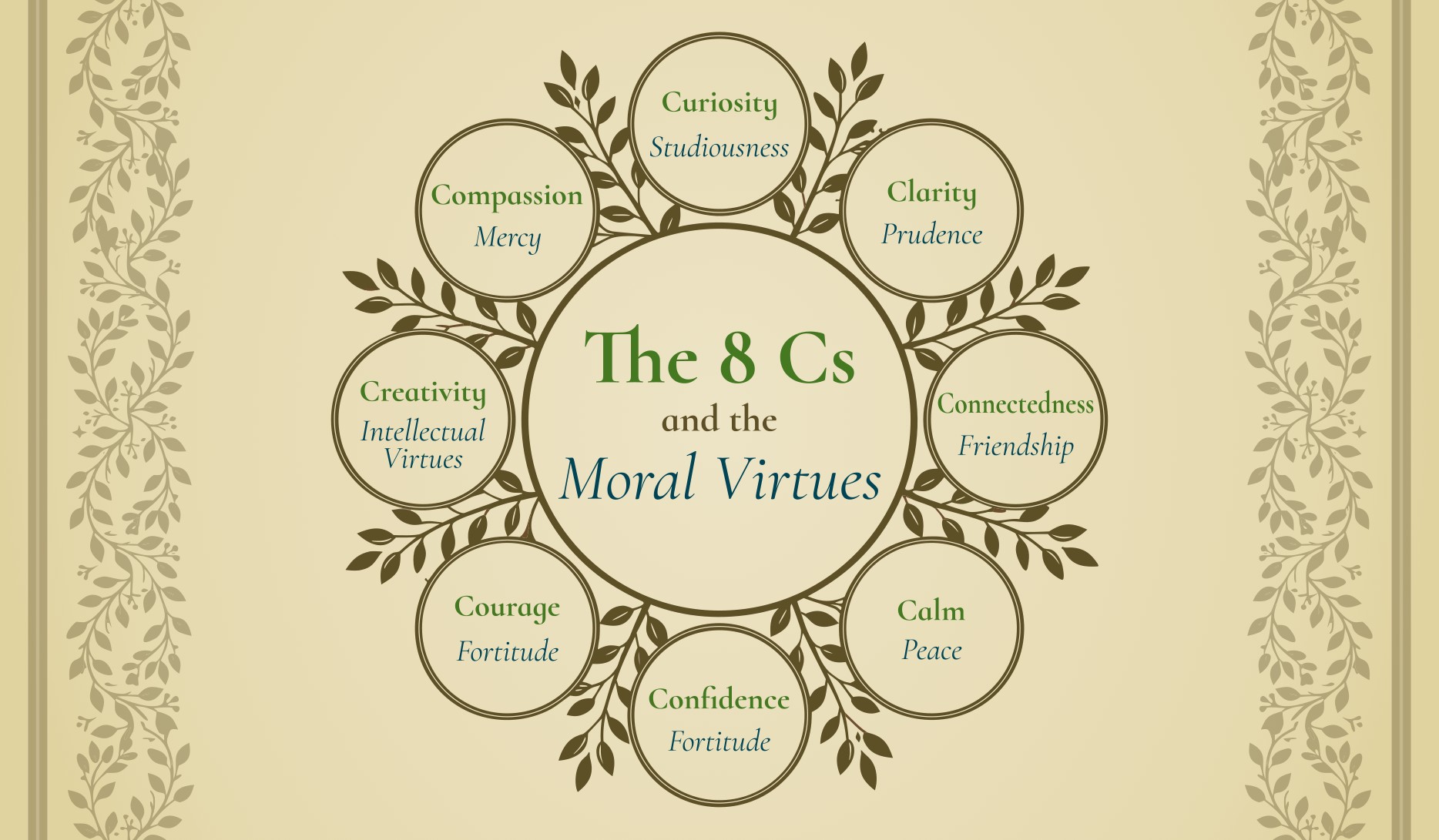
For the reflections in January, March, and April of 2026, I am so excited to have Monty De La Torre, Ph.D. join us. Dr. De La Torre is a Catholic philosopher who has done some of the most interesting theoretical and conceptual work on a metaphysical approach that incorporates Internal Family Systems concepts while remaining firmly grounded in a Catholic anthropology – you can find examples in his previous reflections for Souls and Hearts:
- On the Metaphysics of the Human Person from April 26, 2023
- On the Metaphysics of Human Formation from May 3, 2023
- The Metaphysics of the Human Act from August 23, 2023
- The Metaphysics of Voluntariness from August 30, 2023
And I’m excited to have a little sabbatical to focus on some visionary work for Souls and Hearts.
Today, Dr. De La Torre takes on a topic that is near and dear to many of our Souls and Hearts members: virtue. I am pleased to present you his reflection.
The 8C’s of IFS and Their Connection to the Virtues
By Monte De La Torre
In IFS, the Self is defined as,
“The innate presence in each of us that brings balance and harmony along with certain nonjudgmental, transformative qualities (curiosity, caring, creativity, courage, calmness, connectedness, clarity, compassion, presence, patience, persistence, perspective, playfulness) to our internal family. While parts can blend with (overwhelm and therefore obscure) the Self, the Self nevertheless continues to exist and is accessible as soon as parts separate (that is, unblend).” (Anderson, et al., 2023, pg. 5)
“…it [the innermost self] is the centerpiece of the IFS Model… The idea that at your essence you are pure joy and peace, and that from that place you are able to manifest clusters of wonderful leadership and healing qualities and sense a spiritual connectedness…” (Schwartz, 2023, pg. 21)
For a Catholic, these amazing qualities sound a lot like virtues. In this reflection, I want to explore these “nonjudgmental,” “transformative,” and “healing qualities” of the Self known in IFS as the 8 C’s: curiosity, calm, clarity, connectedness, confidence, courage, creativity, and compassion. Specifically, I want to define and distinguish these qualities by getting to the essence of each to identify which of the 8 C’s are actual virtues. We will see why this is important once we review the definition of virtue.
What Is A Virtue?
The definition of virtue by the Catechism of the Catholic Church (CCC) is worth quoting in its entirety:
“A virtue is an habitual and firm disposition to do the good. It allows the person not only to perform good acts, but to give the best of himself. The virtuous person tends toward the good with all his sensory and spiritual powers; he pursues the good and chooses it in concrete actions…
Human virtues are firm attitudes, stable dispositions, habitual perfections of intellect and will that govern our actions, order our passions, and guide our conduct according to reason and faith. They make possible ease, self-mastery, and joy in leading a morally good life. the virtuous man is he who freely practices the good.
The moral virtues are acquired by human effort. They are the fruit and seed of morally good acts; they dispose all the powers of the human being for communion with divine love.” (CCC, §§ 1803-1804)
A virtue is a kind of habit, that is, a kind of repetitive act that we do and that directs us toward what is truly good. Virtues help us to know the objective good and to choose it by guiding our intellect and will. For obvious reasons, the attainment of virtue is crucial for the attainment of happiness. Through virtue, we grow in love of self, God, and neighbor. From this perspective, we can understand interior integration, in part, as a continual pursuit and growth in virtue. From an IFS perspective, the more unburdened we become, the greater our capacity for virtue and “communion with divine love.”
Moral Virtues
The virtues are typically divided into two general kinds: moral and intellectual. For the sake of this reflection, I will be focusing on the moral virtues.
Four moral virtues have fundamental and overarching importance and are classified as cardinal virtues. The Church teaches that “Four virtues play a pivotal role and accordingly are called ‘cardinal’; all the others are grouped around them” (CCC, § 1805).
- “Prudence is the virtue that disposes practical reason to discern our true good in every circumstance and to choose the right means of achieving it” (CCC, § 1806).
- “Justice is the moral virtue that consists in the constant and firm will to give their due to God and neighbor” (CCC, § 1807).
- “Fortitude is the moral virtue that ensures firmness in difficulties and constancy in the pursuit of the good.” (CCC, § 1808).
- “Temperance is the moral virtue that moderates the attraction of pleasures and provides balance in the use of created goods” (CCC, § 1809)
The cardinal virtues do not exhaust the kinds of virtue that exist. There are a host of virtues that fall under the cardinal virtues. You might consider these as sub-virtues, for example: humility and magnanimity. Now, let us take a closer look at the 8Cs and their relationship to the moral virtues.
Curiosity
According to St. Thomas, curiosity is a vice against the virtue of temperance. In the negative sense, curiosity is an inordinate desire for knowledge either in quantity and/or kind. This is not the meaning of curiosity according to IFS. In IFS, curiosity seems to be more akin to the virtue of studiousness: a genuine, innocent, and ordinate desire for knowledge about something. In an IFS context, to be curious or studious about another is to desire knowledge about the inner workings of a person’s internal family. Richard Schwartz provides a beautiful description of this quality: “Like an inquisitive child, we are full of innocent interest in people and their reactions. If people are angry at us … we become curious about their anger… When we ask them about it, they will sense no fear or judgment in our question – just innocent interest” (Schwartz, 2023, p. 40). To be curious about someone, then, is to be a student of that person’s soul.
Calm
Calm is a kind of “inner equanimity” (Schwartz, 2023, p. 37). It is a kind of tranquility of mind and body. This quality seems to be most akin to peace. According to St. Thomas, peace is not a virtue but an activity that flows from the virtue of charity. Monsignor Paul J. Glenn provides a helpful paraphrase of St. Thomas on this specific effect of charity: “Peace is not merely quiet agreement among men. Peace means harmony and satisfaction in all the tendencies and desires of a man’s heart. Peace, therefore, is more than outer concord; it is inner repose in the attainment of all that can be desired” (Glenn, 1978, p. 206). Calm or peace in the therapist provides the stability necessary for effective therapy.
Clarity
Clarity is “…the ability to perceive situations without distortion from extreme beliefs and emotions – in other words, seeing through the eyes of the Self” (Schwartz, p. 38). To “perceive situations without distortion” sounds like the ability to see or discern the truth of things, i.e., to see things as they really are. This sounds most like the virtue of prudence or one of its parts, such as understanding or circumspection. As defined above, prudence enables us to know and align the correct means and ends. It would seem, then, that if we gain prudence, we will gain clarity.
Connectedness
According to Google’s use of the Oxford English Dictionary, connectedness is defined as “a feeling of belonging to or having affinity with a particular person or group.” In IFS, we experience connectedness when we experience an increased desire to love our parts and others. Simultaneously, there is an increased awareness or sensitivity to those who lack this quality. A desire to connect with another is a desire to love another through a kind of friendship or kinship. Thus, connectedness seems akin to a natural form of charity or something like friendship. As St. Thomas notes, there is a mutual affinity when experiencing the love of friendship. So, it seems, with the quality of connectedness.
Confidence
In IFS, confidence is the quality that allows our system to respond rather than react or be overly sensitive to perceived threats: “As people heal their vulnerable parts, their critics relax and their defenses drop. They feel Self-confident in the sense that their Self has healed those parts and has shown its ability to protect them or to comfort them if they are hurt again” (Schwartz, 2023, p. 43). Elsewhere, “Words like grounded and solid describe the effects of the Self’s confidence, and that confidence offers a platform of stability as we encounter challenges in the world” (Schwartz & Sweezy, 2020, p. 51). (Schwartz makes a fascinating connection between confidence and grace. See Schwartz, 2023, p.44). This quality resonates with the virtue of fortitude. According to St. Thomas, confidence allows us to venture after great things, which typically entails some element of danger or risk, and to hope in our ability to attain it, albeit with the help of God.
Courage
The quality of courage allows the Self to be “…forceful and protective… in the face of injustice…” (Schwartz & Sweezy 2020, p. 52). Basically, despite any pain that may arise in dealing with others or the “frightening places” of our psyches, courage keeps us firm in the pursuit of our good and the good of others (Schwartz 2023, p. 47). This quality, too, seems to fall under the virtue of fortitude.
Creativity
The quality of creativity is described as an ability to “…problem-solve with spontaneous, out-of-the-box thinking…” (Schwartz & Sweezey 2020, p. 52). Intellectual insight, intuition, guidance, understanding, wisdom, etc., are unleashed through the quality of creativity. As a result, “Solutions to long-standing problems emerge…” especially when it comes to creating “harmony in relationships” (Schwartz 2023, p. 48). Schwartz also describes this as a flow state: a state in which “… creative expression spontaneously flows out of them and they are immersed in the pleasure of the activity” (Schwartz 2023, p. 48). Creativity flows from the intellect. If we are being creative or in a flow state, then the intellect is unencumbered from doing what it does best, which is to pursue the truth of things. Some virtues apply to the intellect specifically and, by extension, allow for greater or less creativity. These are the intellectual virtues: wisdom, science, understanding, art, and prudence. So, the quality of creativity seems to be the result of intellectual virtue.
Compassion
Schwartz makes a distinction between pity, empathy, and compassion:
“With pity, you see someone suffering and you feel sorry for them, but at the same time a part of you is glad that person isn’t you…
When you feel empathy, you see a person suffering, and because you have a certain level of self-awareness, you know a part of you suffers in the same way, so you identify with the sufferer’s pain…
When you feel compassion, you see a person suffering, you feel empathy for them, and you know that they have a Self that, once released, can relieve their own misery…Compassion, then, leads to doing whatever possible to foster the release of the other’s Self rather than become the other’s healer. With compassion, you can be openheartedly present with sufferers without feeling the urge to change them or distance from them” (Schwartz 2023, p. 41-42).
Compassion is commonly associated with or synonymous with mercy. In either case, one recognizes the pain of another and seeks to alleviate the pain (the same would apply to pity and empathy). Compassion/mercy begins as a feeling or passion. When individual feelings begin to form habitual acts governed by reason (especially concerning justice), then it becomes the virtue of mercy. So, true compassion leads to the virtue of mercy.
Closing Thoughts
As you can see, the 8Cs have a close relationship with the virtues. It is important to note, as stated in the catechism, that all virtues are directed toward the good. Thus, one can make a distinction between an actual virtue and a counterfeit, for example, true mercy from false mercy (this comparison is analogous to the self-like parts within our system). Actual virtue disposes us toward “communion with divine love.” Our parts can either help in the pursuit of virtue or hinder it. This, I believe, is a crucial element of IFS therapy in a Catholic context. The process of befriending and unburdening parts is, among other things, a process that is meant to lead us toward the acquisition of virtue. To that end, our parts are either aiding or frustrating communion and intimacy with God.
References
Anderson, F. & Sweezy, M. & Schwartz, Richard. (2017). Internal Family Systems Skills Training Manual: Trauma-Informed Treatment for Anxiety, Depression, PTSD & Substance Abuse. PESI Publishing & Media.
Glenn, Paul J. (1978). A Tour of the Summa. Tan Books and Publishers.
Schwartz, Richard C. (2023). Introduction to Internal Family Systems: Second Edition. Sounds True.
Schwartz, Richard C. & Sweezy, Martha. (2020). Internal Family Systems Therapy: Second Edition. The Guilford Press.
###
IFS Basics for Catholic Formators: A free workshop tomorrow, Tuesday, January 13
The Formation for Formators Community of Souls and Hearts is offering and introductory workshop for Catholic therapists, coaches, spiritual directors, and others who accompany individuals in their personal formation.
Dr. Peter Malinoski, clinical psychologist and Level 3 IFS therapist, and Bridget Adams a personal coach with Level 2 IFS training will present:IFS Basics for Catholic Formators Zoom workshop on Tuesday, January 13, 2026 from 1:00 PM to 2:30 PM Eastern, walking through Internal Family Systems for Catholic formators. More info and registration is here, and a downloadable, shareable PDF flyer is here.
A free Zoom informational meeting on Saturday, January 31 for the RCC, which reopens for appications in 19 days.
Are you up for the challenge of joining the Resilient Catholics Community? Are you interested in learning more about the core of Souls and Hearts?
If so, join Dr. Peter, Bridget Adams, and David Saunders for a live, 90-minute Zoom meeting on Saturday, January 31, 2026 from 1:00 PM to 2:30 PM Eastern Time. We will present on the RCC, have a brief experiential exercise, and have an extended time for Q&A and discussion. Registration is free.
We will also put the recording of that meeting up on our RCC landing page, where you also can find other informational meetings, testimonials from RCC members, and so much more information, including this 19-minute experiential exercise to help you discern about applying to the RCC.
Still have questions about the RCC? Feel free to reach out to Dr. Peter at crisis@soulsandhearts.com or on his cell at 317.567.9594, especially during his conversation hours, which are every Tuesday and Thursday from 4:30 PM to 5:30 PM Eastern Time.
Dr. Gerry and Dr. Peter on Scripture for Your Inner Outcasts
Join Dr. Peter and Dr. Gerry as they bring the light of last Sunday’s Mass readings (the Feast of the Baptism of the Lord) to your exiles, who are called out of their darkness and isolation in this SFYIO episode.
Also, check out today’s episode, on the Mass readings for the first Monday in Ordinary time, by Bridget Adams, who directly addresses your exiled parts who feel constantly criticized and devalued by manager parts, drawing from the experience of Hannah the childless wife of Elkanah, who was relentless criticized by his other wife, Peninnah, in 1 Samuel 1.
If you haven’t already, find a time to listen daily; it’s only a few minutes long. Dr. Peter listens when he is shaving each morning.
Need help finding something on the Souls and Hearts website?
Check out our Souls and Hearts resource page, where we list so many of our resources, categorized alphabetically by topic. There’s also a very useful search bar for key terms.