
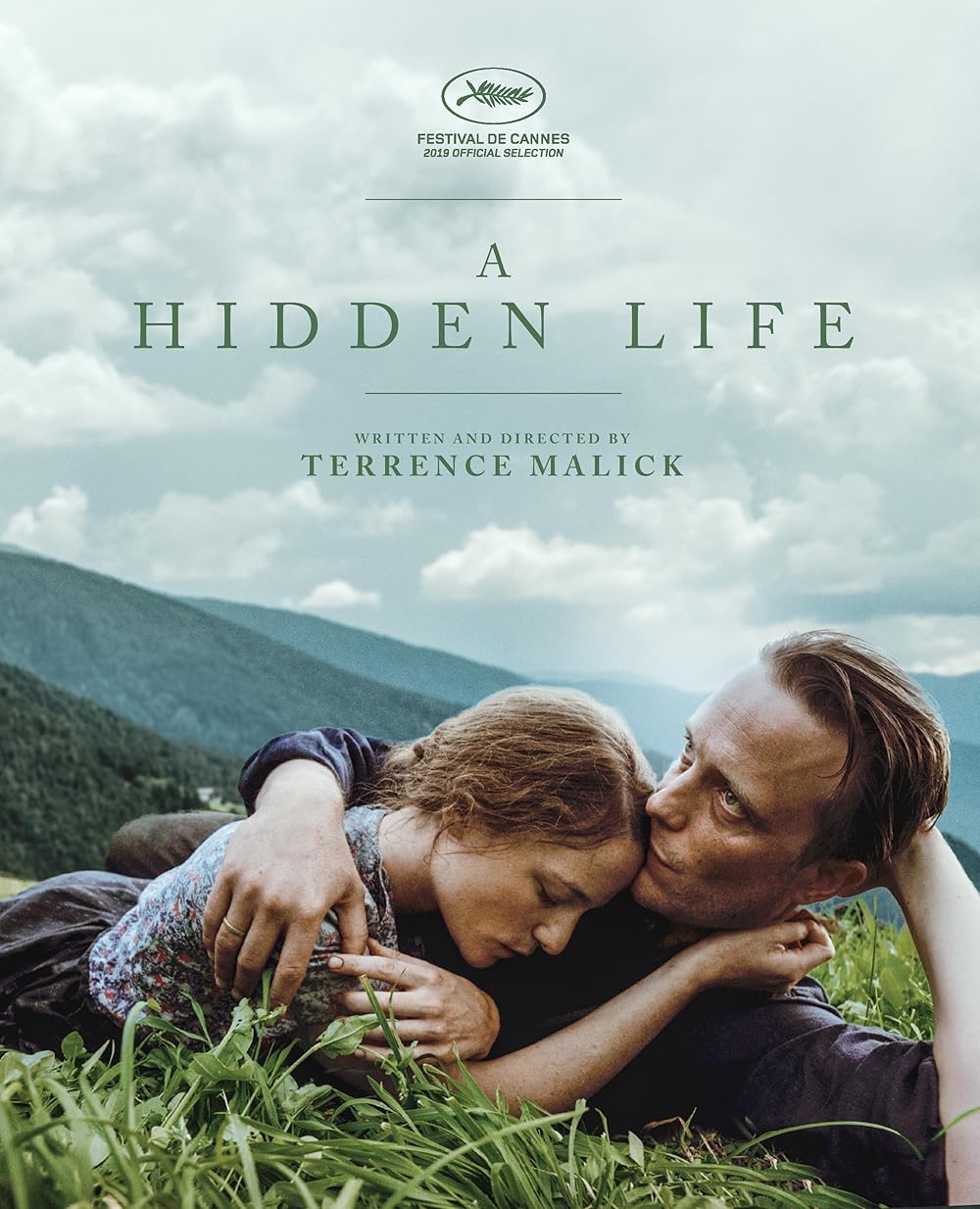
A Hidden Life (2019) is a Fox Searchlight and TSG Entertainment film written and directed by Terrence Malick who is well known for such films as Badlands, Days of Heaven, The Tree of Life, and The Thin Red Line. His films often touch on spiritual and philosophical topics related to transcendence and moral choices. The film stars August Diel as Franz Jägerstätter, and Velerie Pachner as his wife Franziska (Fani) Jägerstätter. Both actors put in stellar performances.
A Hidden Life is a spectacular and beautiful film based on the true story of Franz Jägerstätter, an Austrian farmer who refused to sign an oath of allegiance to Hitler during World War II.
The film’s many faces
On one hand, this is a film about conscience and moral choices. It is about taking a stand even when it produces profound hardship for your family and fatal consequences for yourself.
On the other hand, this film is a love story. It is about the intimate and enduring love between a husband and his wife. Beautiful and heartwarming moments are captured with very few words. The viewer is drawn into the tenderness and intimacy of everyday life and love.
Additionally, the film is also the love story between humanity and nature itself. The film explores moral truth and parallels it with the truth we find in nature and in authentically loving relationships. This, in my opinion, is a message that is not easy to communicate, even in words, but Malick captures it in breathtaking ways with his lavish cinematography of nature next to intimate dynamics between family members.
The film is based on the book Franz Jägerstätter: Letters and Writings from Prison which was edited by Erna Putz. It is remarkable that the voiceovers throughout the film are largely taken from the actual letters between Franz and his wife Fani while he was in prison.
Setting the stage
It is worth watching this film for the cinematography alone. The beauty of the landscape reflects the beauty in the marital and familial relationships. In this town, with its Edenic purity, the human spirit is one with nature. There are surprisingly few verbalizations – the story is told primarily by the scenery and the movements of the human players.
This paradise is interrupted by the appearance of the serpent, in the form of Nazis, who recruit for the war. We now see scenes of wartime destruction juxtaposed with the hardships of winter.
Franz doesn’t believe in what Germany is fighting for and is opposed to killing innocent people. He is a man of integrity and refuses to contribute to the wartime fund and therefore also refuses to accept the family allowance from the state. Franz ponders deep questions, “If God gives us free will, then we’re responsible for what we do, and what we fail to do.”
The diocesan church painter, an insightful prophet, at one point tells Franz, “I paint all this suffering, but I don’t suffer myself… I paint the comfortable Christ. How can I show what I haven’t lived? Someday I’ll paint the true Christ.”
The voices of parts
In choosing not to take the oath and join the war effort, Franz begins his Christ-like journey. The people in town turn against him and his family for opposing the war. Even his mother initially reacts poorly to Franz’s choice.
We see the river water flow harder and we hear voices, perhaps the voices of Franz’s parts:
You still belong to your people, your race, your blood, your village. They’ll hang you!
Your wife and children will have no one to support them.
You are worse than them [Allies] because they are enemies, you are a traitor.
Franz’s inner thoughts are troubled:
I hold to a memory of what I knew once.
I find no one to turn to.
Nothing enters my soul.
His wife Fani turns to God, and we hear the voice of her inmost self:
If we are faithful to Him. He’ll be faithful to us.
We have Him. That’s everything.
Then we hear the struggling of her parts:
You can’t change the world.
The world is stronger.
I need you.
Working towards integration
The filmmaker does an incredible job showing the external chaos through the natural world while the internal chaos rages inside. The priest, and the Church in general in this movie, tries to placate and smooth things over, “God wants peace and happiness, not to bring suffering on ourselves.” Franz’s response is courageous, “We have to stand up to evil.”
This movie is about recollection. It is about working through the internal conflicts within. We hear few words, and when we do, they are important and insightful. This film is essentially a slow-motion view of true recollection in the midst of temptation as the conscience must choose.
Franz hears all the negative voices of his parts:
It won’t make a difference.
God doesn’t want you to suffer.
You have a duty.
Think of your mother.
Think of your children.
You can’t change the world.
He simply listens and listens. Nature somehow moves with the turmoil in his heart as we see images of waterfalls and dark clouds.
Parts in prison
Once in prison, Franz and Fani continue corresponding with each other. Their words show tremendous sensitivity and intimacy. It is remarkable that the filmmaker used the actual letters between husband and wife for these scenes.
Like Jesus before Pilate, Franz has conversations with Nazis. “You think anyone will hear of your defiance? Nothing will come of it.” Franz replies with a question, “Does it make a difference if this war is just or unjust?” The Nazi responds, “How do you know what is good or bad? Do you know better than I? Did heaven tell you this? We all have blood on our hands.”
The voices of the enemy persists:
He who created this world, He created evil.
Conscience makes cowards of us all.
Take care my friend, the Antichrist is clever. He uses man’s virtues to mislead him.
A powerful thing happens to Franz in prison – he discovers that no one can take away his freedom because it is within. “When I give up the idea of surviving at any price, a new light flows in. I see my own weakness, I see the weakness of others, not judging.” The main imagery is now the prison and the German city. Franz is in a kind of hell, but he still refuses to sign the oath and be released. His lawyer says, “If you sign the papers, you will go free.” Franz replies, “I am free.”
The voices become his prayer as Franz’s parts align with his inmost self:
Darkness is not dark to you.
Bring us to your eternal light.
To You I cry. My rock, my fortress.
Give me strength to follow you.
Spirit. Lead me. Show me.
Under tremendous challenge, Franz maintains, “I have this feeling inside me that I can’t do what I believe is wrong.”
Joining inmost selves in marriage
It is his conscience, his inmost self that guides him and instructs his will. He is self-led throughout this film and especially in this ordeal. When Franz is sentenced to death, the priest, with good intentions, tries to convince him to recant, “God doesn’t care what you say, it’s only in your heart.” Franz, however, strives for integration. His heart is perfectly aligned with his will.
Fani understands her husband’s integrity. In one of the most heartwarming parts of the film he turns to her, “Do you understand?”
Her answer is powerful; it is the answer of one beloved to another: “I love you. Whatever you do, whatever comes, I am with you. Always. Do what is right.”
This tear-inducing scene is one heart connecting with another’s heart. It is the inmost self in mutual love with another’s inmost self.
A very Catholic movie
This is a profoundly Catholic movie. It is about the beauty of this created world, the beauty of relationships, and the power of love. It is about the human soul seeking God and answering the call of conscience. It is about suffering and loss. It is about sacrifice. It is about discovering the beauty of humanity and the triumph of love even in death.
What is the significance of the title of the film? It is taken from George Eliot’s poem Middlemarch. In it, Eliot extols the virtue of quiet, faithful, ordinary people who make the world better.
"For the growing good of the world is partly dependent on unhistoric acts; and that things are not so ill with you and me as they might have been, is half owing to the number who lived faithfully a hidden life, and rest in unvisited tombs."
It isn’t so much the great politicians and famous celebrities who make the world better, but the kindness and morality of unsung heroes.
Although an “ordinary” man, Franz was later venerated as a martyr. He was executed on August 9, 1943, which is one year to the day that Edith Stein (Saint Teresa Benedicta of the Cross) was also executed by the Nazis at Auschwitz. Her feast day is August 9. One of her many great works was The Hidden Life: Essays, Meditations, Spiritual Texts which was part of her collected works, specifically Volume 4 in the English translation, and written not long before she was taken to the concentration camp by the Nazis. Her book reflects on how divine grace works subtly within souls through a spiritual communion with God, resulting in an outward spiritual influence that is largely unseen by the world.
Franz Jägerstätter was beatified by the Catholic Church (in 2007 by Cardinal Jose Saraiva Martins on behalf of Pope Benedict XVI). His feast day is May 21. This film, in my opinion, powerfully honors him and his memory.
Blessed Franz Jägerstätter, pray for us!
Saint Teresa Benedicta of the Cross, pray for us!
Saint Maximillian Kolbe, pray for us!
Christ is born! Glorify Him.
Dr. Gerry Crete is the author of Litanies of the Heart: Relieving Post-traumatic Stress and Calming Anxiety Through Healing Our Parts which is published by Sophia Institute Press. He is the founder of Transfiguration Counseling and Coaching, Transfiguration Life, and co-founder of Souls and Hearts.
###
Dr. Gerry and Dr. Peter answer your questions on the IIC Podcast
You need to love yourself properly to love others in an ordered way. How can we understand St. Thomas Aquinas' insistence on us governing our passions from an IFS perspective in a way that loves our passionate parts? How can we be detached from worldly goods? Do saints get blended with their parts? Are there benefits to some kinds of blending with parts? How can we frame the Theology of the Body to resonate more with women's concerns? How can we consider both errors of commission vs. errors of omission in parts work? What about the importance of mercy, the centrality of love, the requirement of interior integration in for human formation through an Internal Family Systems lens, grounded in a Catholic understanding of the human person? Join Dr. Gerry Crete, Dr. Peter Martin, and Dr. Peter Malinoski take these questions and more in this episode with a live audience. Check it out here in video or audio.
Breaking news! Dr. Gerry and Dr. Peter together on the SFYIO podcast each Sunday
In 2026, the Scripture for Your Inner Outcasts podcast will feature Dr. Gerry and Dr. Peter sharing the Mass Readings from each Sunday with your exiled parts through an Internal Family System lens. Check this one out from yesterday: You Exiled Parts Have Much in Common With the Infant Jesus.
You can find the SFYIO podcast wherever you listen to podcast or at this RSS Feed: https://feeds.transistor.fm/scripture-for-your-inner-outcasts
In the Gospels, Jesus reaches out to the outcasts, the most marginalized and rejected members of His society. In this very brief podcast, we take His approach inside – to reach out to your inner outcasts, the parts of you who are walking in darkness and gloom. Listen in and invite the Good News in the daily Mass readings to shine on your inner lost sheep, your inner prodigals, your inner lepers, your lame, deaf, and blind parts, your inner tax collectors, and your inner prostitutes – all those parts of you deemed unworthy and unacceptable by your protector parts.
Why? So that you can integrate inside, heal, and grow to flourish in accepting being loved, loving yourself in an ordered way, and then being able to love God wholeheartedly, with all your parts, and your neighbor as yourself. All informed by Internal Family Systems and other parts work approaches, and all firmly grounded in a Catholic understanding of the human person. Join us in seeing Scripture through a new lens, coming alive for those parts of you that may have experienced spiritual neglect and need healing.
Dr. Gerry on The Catholic Coaching Podcast with Matt and Erin Ingold
Check out episode 277 titled When Therapy Language Becomes Harmful (And How to Use It Well). In this episode of The Catholic Coaching Podcast, Matt sits down with Catholic therapist Dr. Gerry Crete to talk about a growing challenge in today’s mental health conversations: the overuse and misunderstanding of psychological language. Words like trauma, narcissism, abuse, and mental health are being used more than ever—but are we always using them correctly? Together, they explore:
- When therapy language helps—and when it harms
- The difference between real trauma and ordinary human struggle
- Why labeling too quickly can actually block healing
- How to recognize when someone truly needs professional support
- The difference between coaching, therapy, and spiritual direction
- How compassion, discernment, and humility restore clarity
Drop by for a listen here or wherever you take in your podcasts.
The basics of IFS for Catholic formators in two free Zoom workshops
The Formation for Formators Community of Souls and Hearts is offering two introductory workshops for Catholic therapists, coaches, spiritual directors, and others who accompany individuals in their personal formation. Dr. Peter Malinoski, clinical psychologist and Level 3 IFS therapist, and Bridget Adams a personal coach with Level 2 IFS training will present:
- IFS Basics for Catholic Formators Zoom workshop on Tuesday, January 13, 2026 from 1:00 PM to 2:30 PM Eastern, walking through Internal Family Systems for Catholic formators. More info and registration is here, and a downloadable, shareable PDF flyer is here.
- Catholic Parts Work in Human Formation will be on the evening of June 10, 2026 at 8:00 PM to 9:30 PM Eastern with Bridget and Dr. Peter. More info and registration is here.
The Resilient Catholic Community reopens for new applications in February
In 27 days, the Resilient Catholics Community reopens all during the month of February. If you are a Catholic who sees how important structure is for your personal human formation, if you want to shore up your natural human formation foundation for your spiritual life, if you want to deeply learn your human formation arithmetic so you can do your spiritual algebra, and if you want to bring in this parts- and systems- thinking inside, consider the Resilient Catholics Community.
The RCC offers you a structured program in a community of likeminded Catholics, in relationship with other Catholics in small groups, flourishing and thriving as we journey together toward loving God wholeheartedly -- with all our parts -- and our neighbors as ourselves.
Considering doing our 19-minute experiential exercise to help you discern whether it’s a good idea to apply to the RCC.
If you apply, there still is a mutual discernment process that lasts some weeks and includes the PartsFinder Pro (the PFP), a set of 23 measures to help you come to understand 10-15 of your parts (managers, firefighters, and exiles) and how they relate to your innermost self and how your parts relate to each other.
You will get feedback on your PFP through a 6- to-7-page report (you can download a PDF for a sample fictional report for a man and a woman) and can discuss your findings in a 15-minute Zoom interview with a Souls and Hearts staff member – all of that is included in the $499 application fee (contact Pam at office@soulsandhearts.com if there is financial need for a scholarship).
Get on our interest list on the RCC landing page to stay abreast of all developments! If you have questions, feel free to reach out to Dr. Peter at crisis@soulsandhearts.com or on his cell at 317.567.9594.