

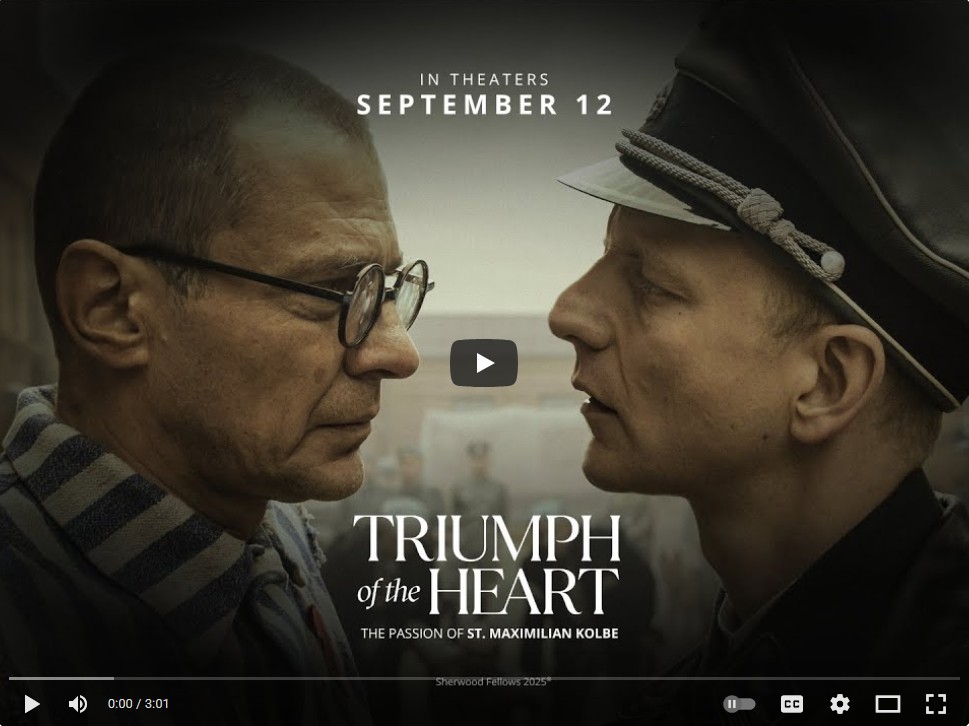
In my view, Triumph of the Heart written and directed by Anthony D’Ambrosio and produced by Sherwood Fellows and CineMammoth Productions, ranks among one of the most powerful faith films I have ever seen.
The production values and acting quality easily compete with anything Hollywood produces. It is not a movie for the faint of heart, but it is a movie that will inspire the deepest core of your innermost self. And you will need tissues…
The final days of St. Maximillian Kolbe
The movie recounts the last days of Saint Maximillian Kolbe, the Franciscan priest who was taken in 1941 to the Auschwitz death camp in German occupied Poland. When a prisoner escapes, the Nazi camp commander Karl Fritzsch has the guards select ten men to be starved to death (unless or until the escapee is found).
When Franciszek Gajowniczek, a Catholic family man, is chosen, Father Kolbe famously volunteers to go in his place. The film tells the story of these ten men, Kolbe included, who were imprisoned in an underground bunker without food or water, four of them surviving for 14 days.
Father Kolbe remains strong in his faith as he ministers to the various dying men. It is a story that reminds us of the dignity and worth of each human being in the face of the worst kind of human cruelty. It is a deeply Christian story that reveals the paradoxes of our faith: man can be the cruelest of creatures and yet has the greatest dignity and worth; hope can be found in the places of despair; light can penetrate the blackest darkness; love not only defeats but transcends every kind of suffering.
A window into the interior world
From a parts perspective, I couldn’t help but see the drama unfold like a window into the interior world of a suffering humanity. I saw the prison cell as the soul, and the Franciscan saint as the inmost self: the image of God who brings grace and love and humanity to the other men.
The imprisoned men represent every kind of man, every kind of part. There is an atheist cynic who resists and mocks God and religion. There is an aging Jewish teacher who cares for his dying student. Among the other men, there is a communist, an informer, a young innocent working class man who was once a choir boy, and so on – the faces of wartime Poland.
They each represent different parts of this system. Some fight with each other, but eventually they learn to rely on and love each other. Kolbe guides each one with patience and tender compassion.
Warning: spoilers ahead!
The faith messages never felt forced or heavy handed to me. Every actor brought depth and humanity to their parts making the story not only believable but often heart wrenching.
Kolbe played by Marcin Kwasny embodied a calm Christ-like presence without ever coming across with pious sentimentality. So much is revealed about each character not only through their backstories which are told in short flashbacks but just by the subtle human tragic beauty in their faces.
Albert played by Rowan Polonski is a poignant example of the journey of a man with hopes and dreams that are dashed when he chooses to join the Polish army against the Nazis and is captured. It is through his bonding with, not only Kolbe, but the other men, that he truly discovers himself and is able to share in a smuggled letter to Margaret, his lost love, that “somehow in this ugly end, I have triumphed.”
This film is also about choosing life even in the darkest most desperate places. At one point Kolbe states, “Love is the realest thing no one can take from us, even now.”
The prisoners are given a sharp rock that they could use to kill themselves. Kolbe dissuades them from taking this option and there’s a powerful moment where he prevents a fellow prisoner from using the rock, and he also helps another man who is in favor of letting the man kill himself, choose instead to save him.
This powerful pro-life message is sincere and believable, raw and heart-stopping – never pedantic or polemical. Saint Maximillian Kolbe emerges as a man whose faith is in his very bones – he has become another Christ, and he faces each suffering and broken human at his worst.
Perhaps one of the most moving scenes occurs when some of the men ask for Kolbe to hear their confessions. The truth and honesty of the human condition is revealed when he absolves these men of their sins, releasing the heavy burdens they were carrying.
Especially powerful is the man who confesses being an informant to the Nazis and that he was the one who informed on Kolbe (who according to the historical record hid Jews in his monastery). There’s a long pause as Kolbe absorbs this information.
The saint then chooses to then confess himself that he had been wrongly focused on ministering to his fellow Catholics, but that God had actually called him to be here in Auschwitz to be with them. He absolves this man of his sins and even the atheist cynic cannot help but be moved by the sincerity of his self-sacrificing faith.
Moving music
I was also moved by the use of music in this film. Initially at the prompting of Kolbe the prisoners sing the Polish anthem, and this causes the Nazi commander to respond with outrage. They continue to sing songs including Marian hymns.
Music represents their solidarity as well as the life of the human spirit and so, with Kolbe’s guidance, the prisoners are never truly broken. Music has the potential to connect us with each other, as well as with the depths of our soul – and ultimately with God Himself.
Toward the end they sing the now dead Jewish man’s song, “Hear O Israel. The Lord is our God.” At the very end we see Kolbe invited to the wedding feast he’d been longing for his whole life where there is music and dancing. The movie ends with a powerful eschatological moment where all the men are reunited in song and joy – a true triumph of the heart.
PS: Special thanks to Dr. Margaret Boudreaux, a Catholic pediatrician in north Atlanta, who arranged for this movie to be shown at my local theatre! We need to promote excellent Catholic films like this one!
Find out more about where you can view Triumph of the Heart here.
Dr. Gerry Crete is the author of Litanies of the Heart: Relieving Post-traumatic Stress and Calming Anxiety Through Healing Our Parts which is published by Sophia Institute Press. He is the founder of Transfiguration Counseling and Coaching, Transfiguration Life, and co-founder of Souls and Hearts.
St. Kateri cohort of the Resilient Catholics Community (RCC) is now open!
The 11th cohort of the RCC opened last week. Applications for the St. Kateri Tekakwitha cohort are now being accepted. The whole process begins with the PartsFinder Pro, an extensive set of questionnaires that help our staff hypothesize the parts of your interior system as well as how they might be interacting with one another.
The RCC is at the core of Souls and Hearts – where our RCC members do so much beautiful personal human formation work, leading to interior integration, transformation, and flourishing.
If you are interested in working with your own parts, bring them into greater harmony within you, under the leadership and guidance of your innermost self, journeying toward flourishing, consider joining us in the RCC.
Dr. Gerry and Matt Fradd on Pints with Aquinas, discussing “Therapy Culture”
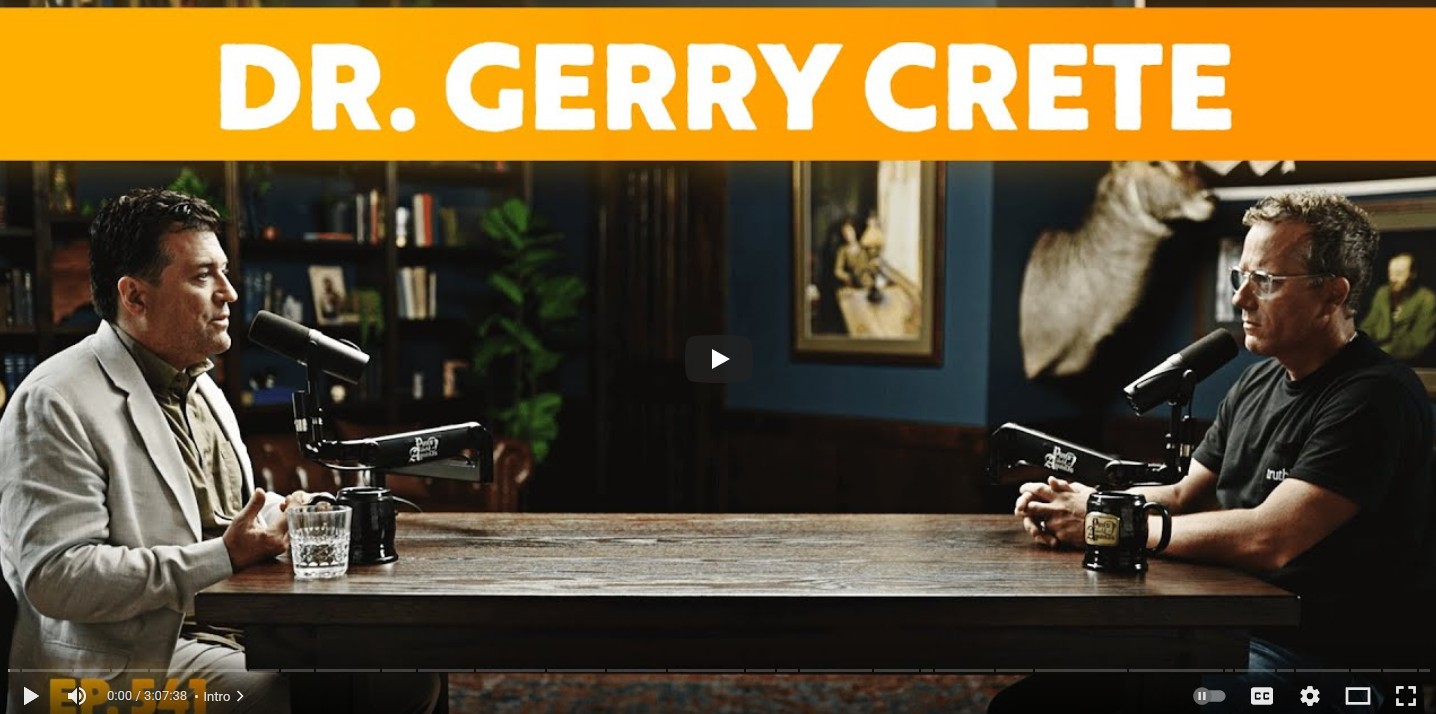
In this episode, Matt sits down with therapist Dr. Gerry Crete to unpack what therapy actually is, how it differs from spiritual direction, why so many people today are seeing therapists regularly, and if therapy is actually healthy or potentially toxic. (Audio only is here.)
Check out Christopher West doing his parts work with Dr. Greg Bottaro here (and praising Dr. Gerry’s book, Litanies of the Heart in the first few seconds of this video).
Dr. Gerry on the IIC podcast
Check out Dr. Gerry in episode 175, titled IFS, Parts Work, Vatican II, and Your Conscience (video audio).
“Man is divided within himself.” So says the Vatican II document Gaudium et Spes. Sins – original sin, the sins of others, and your own personal sins lead to your inner fragmentation and the obscuring of your conscience. What is your conscience? Where is your conscience within you? What does Vatican II say about IFS concepts? How did St. Maximilian Kolbe live sacrificial love in Auschwitz with interior integration, inner unity? And what does Vatican II say about psychology and the social sciences? Dr. Gerry Crete joins Dr. Peter Malinoski for a wide-ranging discussion of these questions and so much more.